Showing posts with label khan academy. Show all posts

Khan Academy is Our Ally, Lets Work Together

This article is crossposted and in reference to The Time Has Come to Stop Playing Defense and Change Education but is in reference to many posts and tweets over the last few months.


I want to call our attention to a worrisome trend emerging in the online Education world. Our disagreements are leading toward division and preventing us from making effective change. Revolutions are doomed to fail when fear and strongly worded language is used to incite and stir up the masses. 

We do not need to burn someone else at the stake in order to have reform. Nor do we need an enemy. If you dislike that teaching has a bad rap or that students have poor learning opportunities you simply need to share what you do and let it stand on its own. What I am hearing is a lot of anger and frustration, and rather than tweeting and creating inflammatory posts that divide we should find our common ground and work together towards our common mission.

Frankly while I respect all sides on this discussion (and would consider many of you friends and colleagues) I feel like there is a lot of undue ire toward the Khan Academy. In my opinion, this will get us nowhere. From everything I have seen Sal is equally committed to helping change education for the better. If you disagree with it then like he said on HA post your own stuff. To be honest, I have exhaustively read and researched all of the interested parties posts about modeling and instruction as well as the books and resources out there (about 6 months of intensive research) and I agree with them, but they are what most great teachers would agree with anyways. Modeling is not this OMG pedagogy, it is taught in many University science education programs. However even the instructors of modeling pedagogy still suggest worksheets with questions that if they came from anyone else would be considered pseudocontext. If we are willing to promote that program even though it is still in need of refinement and growth then we should do the same for Khan Academy while it is in its early development stages. There is still much work to do and we can do more if we do it together.

We do have our problems. We have a huge population and the “teachers who care and are qualified” to “students” ratio is rather dismaying. There is an exponentially increasing amount of information and we agree there is not enough time to go through it all with students (far less so if you are trying to do any kind of deep and meaningful learning). The idea that we cannot use video technology to support learning flies in the face of everything we have learned about YouTube. Millions go on every day to learn something new and while it may not be deep learning, it was not intended to.
If we wanted Khan Academy to cover every viewpoint or concept, our world's surface would be covered by servers maintaining all of the data. The hope is that teachers will use these videos for students to support or review what is in the classroom and students will use it to take control of their learning. Of course there are those teachers who are going to use it as the primary teaching tool but that is not the fault of the Khan Academy any more than it is Facebook's fault that students get distracted. Tools can be inappropriately used but that does not mean they should be discredited. Some complain that his videos are the same as a lecture and do not change. This is no different than textbooks but textbooks are an incredible reference for students as they are working to understand just not as their primary learning tool. By that standard almost everything on the Internet is static and unfit for reference and instruction but we all know how silly that is. There is no technology that will or should ever replace student - student and student - master interaction.

There is hope, support, vision, and funding behind the Khan Academy, something that education reformers greatly covet. We can find ways to work with their very open development team: from the lead programmer Ben to Sal himself, to create a resource we can all be proud of. Having series of posts and webinars dedicated to tearing down Khan Academy will only lead to a pile of rubble and no progress. The number of us online and actively thinking about our pedagogy is sadly a small percentage of the teaching population, if we cannot support each other as allies then our mission is doomed. If you are going to propose something else, post concrete and specific things to support teachers. My philosophy is to give teachers something to think about but also something they can use tomorrow. Please try do the same and let me know how we can help because you are not alone to do all of the work. 
Having high minded ideals is one thing but when the students come in the next day, what are we going to do that meets the goals of our collective pedagogy while still (as long as we have to) meeting the State/Federal requirements that keep us employed. Khan Academy is not controlled by government organization so in fact they could be one of our best hopes for learning opportunities outside the classroom and for those who do not have access to the great resources that we all enjoy.

Subscribe to BrokenAirplane for all of the relevant technology and education news/information.

Math As Jazz - Applying and Using it as a Tool

For me there is no better friend than one you can have great discussions with. I swear this was being written before Allison (of Infinigons) and I talked today, but having the discussion with her about it really allowed me to understand my own position better. Nonetheless, this was one of my more difficult posts to write because there are so many sides to it.

When I think of some of my favorite math bloggers/writers I can sense their frustration with how math is currently taught. Some refer to the "dumbing down of the curriculum", others say that rote memorization and skills are emphasized over understanding. In the incredible Lockhart's Lament, the loss of rhetoric, proof, and play with mathematics in schools is mourned for.

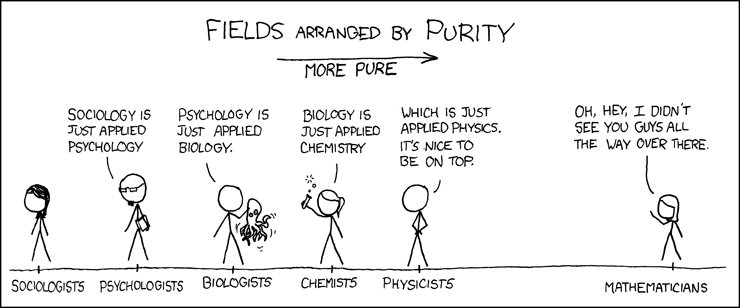
Image courtesy of XKCD.com (to read it is to love it)

Helping students discover fundamental concepts in math is a wonderful experience for all involved, yet as Lockhart himself admits, this can take a long time. Sometimes I cannot wait, I have things I want the student to use the math and the understanding can come afterwards. You see for me, math is both a beautiful thing but also a tool to be used. One can use an Arduino to create amazing things without understanding all of the design, science, and math behind it (in fact that was a part of its design), one can participate in the building of an FRC robot while learning along the way (it was similarly designed this way).

In the same way, the Pythagorean theorem can be tremendously valuable long before its understanding of how or why. While some would rail against this use before understanding, I find that it encourages motivation, play, and also progress. Often Math/Science teachers tell me that they never have the time to get to programming math because they are so busy trying to have them understand it before they can apply it. In my mind you will never get there in the unfortunately short amount of time we have students each day/year.

In my opinion, to try and teach understanding before application will often time go over student's heads and not stick in their minds in the long term. I would love to see what classrooms could accomplish if they were to start using math right away to build, create, derive, etc. Understanding would come but it would come from the student's aha moments and play. 

A car mechanic learns by playing and experimentation because often the manuals and experience fail to explain a problem, but a mechanic who has no basic understanding of the car, is just tinkering in their garage and is likely to break something. More so in the medical field where it would be grossly unethical to operate without understanding. On the job training is in my opinion the best there is but it is worthless if there is no foundation of skills.

Project based learning requires that we dive in and learn as we go but we must also have a skill set to build upon. At the beginning of the year, I am limited by what projects I can do with students because of their limited math, technology, and critical thinking skills. But as these grow throughout the year, I find them more and more able to do and create. By throwing them into the deep end and saying figure this out, they gain a mastery more quickly than a stepwise process would.

The pure math/applied math debate rages on even within the upper echelons of the math community as does the one over the superiority of theoretical and experimental science. What has been proven time and time again is that some gravitate towards a side but the community is stronger because of both. I can't imagine a class where my students constructed everything from first principles and derived and discovered all math/physics as that would seem to me to be too slow a pace and not my style of learning. Yet, a year spent only applying equations mindlessly would similarly leave the students at a disadvantage.

I don't struggle with the balance, I seek quality. As Allison mentioned in her post, I get frustrated by those who rabble rouse and say that teachers are doing it all wrong but don't provide any steps to improve. If your class is so amazing then share in detail. Don't just post on your blog, "My students are engaged and discuss math like Euler and Gauss reincarnate." Post the lesson, the dialog, a video, something! I know we cannot replicate another's teaching exactly because that depends on the context, relationship, style, etc. But, at least give us something to work with and inspire instead of just tearing others down.

I agree more than anyone else, that things need to change for the better. What I am unwilling to do is cut down the efforts of hard working passionate people (like the Khan academy) because their work is in its infancy or is being misused. I am also similarly frustrated with those who call for reform but provide no resources or ideas. If a teacher is online and reading blogs, that is a good thing and they should come away equipped and supported not guilt ridden. If there is something that needs correcting or calling out, then by all means do it, but it should always be coupled with resources or ideas on how they can improve.

Finally, lets all remember what has been said about opinions. No matter who you are or how popular your  blog, always remember that there is more than one way to teach "right". If your background is in pure math, then teach that with passion and your students will love it; if it is in the application of it (e.g. engineering) then likewise do that. Students love passion and while we should seek balance, if you are bored or confused, your students will be likewise. But let's please stop name calling and using superlatives. If someone's math or teaching looks weird and different to yours, learn from them but stop saying it "isn't math" or that they are "destroying critical thinking" at least unless you are willing to provide evidence or support to other teachers to help them see your side.

Subscribe to BrokenAirplane and keep up with all of the latest education and technology resources!

Lets All Share Our Awesome Math

So as I said in a previous post, Spring Break is my chance to take a moment to reflect and see what I can do better. Thanks to all of you sending me articles and my network of resources, I have had no shortage!

One theme that mysteriously keeps coming to my attention is the lack of richness in our curriculum. In one of BrokenAirplane's earliest posts, I encouraged all of us to aim for the highest level of application as the end result of our student's learning. Now in the last couple of weeks, I am seeing great posts from thoughtful writers about how shallow our textbooks and assignments are.

In this one, Frank speaks about how the Khan Academy is actually reinforcing our shallow model of education. I agree with his point if teachers are allowing these "tools" to be the complete math curriculum. It would be like going to a cooking class and spending weeks learning about the mixer, the oven, baking soda, etc. and never actually making a cake.

While on the other hand, I teach at a school which does not track and I have 9th grade students who are ready for Trigonometry and others who never understood Elementary Math. Using ALEKS and Khan Academy occasionally (<20% of class) has dramatically improved their confidence in their skills and participation in class discussions.

Another source of this mathematical meme came from Republic of Math and describes the difference between contrived and real problems. Contrived problems are a poor attempt to compel the student to care when the only purpose of the word problem was to wrap a story around a calculation problem. Kirby Urner has said before that we need to tell better and bigger stories and we will find that math is a part of that bigger story without having to make some contrived reason up, and just a couple of days ago, Dan Meyer spoke about the need for strong narrative to drive critical thinking.

The other part that keeps rattling off in my mind comes from my "Is Calculating Math?" post about Conrad Wolfram's exhortation that we stop the trend of 80% class time teaching/learning to calculate. I agree 100% and yet I am now finding myself overwhelmed. I am asking you out there for help at getting better at mathematical modeling. If you haven't watched the TED Talk, check it out here.


According to the Mathematics for Teaching Blog, mathematical modeling breaks down into 4 categories:

Empirical modeling involves examining data related to the problem with a view of formulating or constructing a mathematical relationship between the variables in the problem using the available data.
Simulation modeling involve the use of a computer program or some technological tool to generate a scenario based on a set of rules. These rules arise from an interpretation of how a certain process is supposed to evolve or progress.
Deterministic modeling in general involve the use of equation or set of equations to model or predict the outcome of an event or the value of a quantity.
Stochastic modeling takes deterministic modeling one further step. In stochastic models, randomness and probabilities of events happening are taken into account when the equations are formulated. The reason behind this is the fact that events take place with some probability rather than with certainty. This kind of modeling is very popular in business and marketing.
All of these are applications of mathematical knowledge and I want my students to do it more than they are. The Internet is based upon the idea of sharing and not reinventing the wheel so if you have had success in your classroom with Challenge Problems, projects, or any other application of these ideas that you think would be suitable for 9th grade math students I would greatly appreciate it.
I am aware of the great resources out there from Dan Meyer, Ben Rimes, ASU's modeling instruction and the like. As I said, I am not so much concerned about the pedagogy as the questions. At my school we have teams of humanities/math teachers and I yearn for my students to talk about math class the way they do after leaving my partner's class. Sure they talk about the cool thing they just did with Arduino or Python but I want to help them see the bigger picture and allow puzzles and math to be a source of fun and thought for them not just frustration.

I am tired of looking through textbooks and sifting through websites hoping for great math. There is nothing I like more than walking around and having a great idea for a project or problem come to me, but I would love more. Basically, I am asking for your "Awesome Awesomeness" as one of my colleague put it. Please share it in the comments or tweet it using the hashtag #AwesomeMath.

Subscribe to BrokenAirplane and keep up with all of the latest education and technology resources!

Khan Academy New Features - Learn More than Ever Before

Everyday makes me wish more and more that I had been a student in today's world to have access to the amount of technology and resources students have that are free. A while ago, I was told I was autodidactic. This was said with the implication that I could learn anything and they were unable to. It is amazing how labels put us into boxes.

For those who think that learning on your own is impossible I teach you how to learn anything and give you resources for online learning. To think of what I was able to learn with the library and Web 1.0 and realizing the exponentially greater resources of today makes me hopeful that classrooms will shift from teaching skills to facilitating exploration and creative thinking.

Salman Khan has become a household name in recent months, and well deserved of that recognition. He created hundreds of high quality education tutorials of his own volition and shared them with the world for free at KhanAcademy.org. The tutorials cover a wide variety of topics in Science and Math and even a few on finance and history. Bill Gates gave him a huge amount of praise recently, saying how often his children and he watch the videos.

If you have been to the site before, you will want to check it out again because financial and technical support has rallied to Khan side to further improve the site. Go to KhanAcademy.org and browse through the tutorials. What you will notice is that these videos are intended to teach discrete skills. This is useful because many videos breeze through too many topics quickly before one can get the hang of it.

The second thing you will notice which is much appreciated is the built in ability to download the videos. Many schools restrict access to YouTube and while I had previously recommended Browser Extensions and sites like KeepVid, having an easy way to download a video is priceless. Note: the video will download as an FLV file which takes up little memory and can be viewed for free with the VLC Player (aka "the cone").

The most intriguing new feature are the exercises. Students of all ages can click on the Do Exercises button and conveniently login with their Facebook or Google Account.


You will see a game like interface with levels of mathematical knowledge ranging from addition to calculus. Students can travel through the exercises via multiple routes of their choosing and receive energy points for completing the objectives. Hints are offered if requested but bonus points are awarded if completed on their own.

Teachers can be added as a "coach" and see the progress and data on their students. Just click on the buttons at the bottom of any screen a student has logged into.


The videos have been wildly successful, with data showing dramatic gains in student performance. I appreciate the fun and interactive interface but I hope teachers do not rely to heavily on the extrinsic motivators to have students want to learn math.

What this could provide classrooms is freedom from skill building lessons and now being able to spend more time on activities and projects that apply and deepen learning. Thank goodness for the altruism of people like Salman Khan who choose to keep this free in order to help as many as possible.

If you would like to support the Khan Academy, they state that their primary need is to get the word out. Share this with all of the math/science teachers, IT Managers, Administrators, family members, and struggling students you know. If you have knowledge of a second language, they would appreciate your help in translating the videos. But, of course if you have the means to financially support the endeavor they would appreciate it. Information can be found here.

Let's make sure people and programs like this are supported and used as much as possible. It is a great time to be in education. This is the type of programs I was hoping for and encouraging in the Hub Proposal. Never before has quality education been available to all and I am excited to share these resources with you.

Update: Since this post was written, a developer has created an iPhone, Android, iPad app that allows you to easily watch the Khan Academy videos from the phone.

Subscribe to BrokenAirplane!

Collaborative Learning Strategies in the Digital Age

Every teacher at some point will arrange the classroom into groups either for a specific project, ease of walking around, or perhaps because they believe they will help each other. A few days later many of these classrooms will revert to a more individualized seating chart. Why? It could be noise of students talking to each other, copying each other's work, or not getting any work done at all.

There has never been a better time for you to move their desks back together. You might need to make a couple more adjustments to your classroom though to make it truly effective.

Let's state the obvious, students want to sit next to each other. Stated even more generally, humans are social creatures. We as educators love to meet in the lounge or department meetings and catch up and talk even if it isn't always about education. I believe that if the students already have motivation and energy to do something we should not fight it but harness it.

When students are sitting next to each other they are going to talk, the question is what will they talk about? Well if your assignment is compelling and worthy of their time then they will talk about that. Maybe not the entire time but we ask our students to work for 8-10 hours straight. This flies in the face of all wisdom about productivity. Those of us who are great at getting things done know that it can't be all work and no play.

You might say, well some topics are boring and simply must be learned and there is no way to make it otherwise. I say you are not being creative enough. Can the topic be placed into a social context like a game or involve peer review? Yesterday my students played the game battleship on graph paper to review/learn coordinate graphing, and I heard so many of the coveted "Ohhh now I get it" and there wasn't a student not playing/learning (and no I do not teach a magical class of students who love any and all things math).

So if you have a compelling assignment and are willing to accept that they will not be 100% efficient (no one truly is), then lets consider the benefits of putting them in a collaborative setup:

Peer Feedback and Instruction: If you have instituted a culture of collaboration and team success, then your students will look at each others work and give them ideas on how to refine their work. Most useful is when they start to help each other to understand their work. Students can speak to each other and explain things much more efficiently and effectively than those outside their circle can. If you constantly are encouraging your students to help each other to understand (and not cheat them by giving them the answer) then you will quite simply be blown away by how much students will want to help each other.

This also allows you to help more people because when you have explained something to someone else, you can ask them to help the other person with the same question. Every educator knows that teaching a concept to someone else helps them understand the concept even more. Give that gift to your students as well. As they struggle to coherently explain it to someone else they create deeper understanding. I tell both students that if either of them still have questions they can come back and ask me. You will find overtime that even those who are not typically well versed in math will eventually come around and become better at asking for help and giving help at what they do understand.

Initially students can be reticent to ask or give help to each other. This is due to years of training the students to be solely reliant upon the teacher. When I have given instructions to the students, placed them on my website for later reference, and/or placed them on the whiteboard. I ask the students for 2-3 questions as a class(and then wait until they ask them, sometimes they need some time to think about it). Then we begin group work.

When the students want to ask me questions, I will redirect them to students. "Have you asked everyone around you?" If they answer yes, then I have 3 or 4 students to work with, otherwise I move onto another student and only answer the questions that the students can't answer. This can be painful for students and teachers to do initially but it pays off greatly and will allow you to spend more time with struggling students or with those who need an additional challenge.

Social Innovation: When you are in the presence of thoughtful colleagues great ideas emerge. When students are working on projects or assignments and are in a creative mindset, it is an exciting environment to be in. This culture that is so willing to explore and try new things can take your curriculum to new heights. This is especially useful when my students are programming in Python. Some great side collaboration projects in the class and outside have emerged out of this.

21st Century Skills: Report after report from business leaders says that the two skills they wish their incoming employees had were the ability to think creatively (outside-the-box) and collaborate well with others. Collaboration  is also listed as one of the 7 survival skills in Tony Wagner's The Global Achievement Gap.  Please do not deny your students the opportunity to grow in this critical area. Using effective social skills to communicate ideas and learn is just as important if not more than any one thing you will teach them.


Digital Natives: A term coined by Marc Prensky, it describes those who have grown up in a world with YouTube, Google, Smartphones, and everything else that provides instant information. Just as teachers in the past needed to adapt their teaching style to incorporate other innovations (e.g. television, radio, chalkboards, books) we would do well to observe their natural learning state and utilize the power inherent in it.

Students from this generation and those of us who have migrated to this type of thinking, use the vast information of the Internet to learn skills and understand. What brought about "Web 2.0" was the increase in video content but also the ability to share information with others. Where the Internet used to be a digital repository, it has now become a living breathing community, truly a World Wide Web.

My students are often sharing ideas on others blogs and finding people from all over the world to collaborate with. Through free communication tools, they have found experts willing to work with them and bounce ideas back and forth. This was simply not a feasible option for them a few years ago. Bring in an author, expert, community member through video conference for free and see how it will change all that you do. Make sure that you have coaching sessions about how to professionally meet and speak with others as this tends to be a skill that students need improvement.

If you can find and encourage opportunities for your students to use this to learn traditional content (e.g. Personal Learning Networks - PLNs, Instructables, YouTube Tutorials, Khan Academy) your students might be more willing to "buy-in".


My experimenting with Social Learning began a couple of years ago when I asked students to work together on an SAT Math study packet. After they finished, I asked them to honestly share. Their responses included that they felt like they had understood it better than when they had heard it in a lecture (and their scores reflected this), they also admitted that the chances of them "cheating" and simply getting the answer was likely.

When we discussed this, I explained to them that the goal of these group activities is not simply to get the "A" but to learn and understand. I remind them that while they might have good short term results, "no one cheats their way through medical school". A statement that may not be true, but it drives home the point that at some point they will be asked to demonstrate their knowledge on their own and it is in their best interests to not take the shortcut.

I am not saying that students should only learn via the Internet or games, these are just some ideas for encouraging social exchange of information, and yes I do assess individually via tests, so while individual learning is the goal, you will find that the learning occurs will just as much and creates an environment electric with discovery and ideas.

If you need further convincing of how powerfully this can transform your classroom, I suggest you watch this TED Talk. Sugata Mitra is showing the world the power of each of your students. Below that is the Dean of Pixar Univerity (yes that Pixar) about the need for students and adults to collaborate.


Learning Online - Become an Expert in Anything for Free

A couple of years ago, I was working on the creation of an online/hybrid High School. Here are a few of the resources that we found. I will update this post as more emerge.

Make your own games

Create your own online classroom
Moodle - One of the easiest and versatile ways to create an online classroom.
Project Foundry - Create Student guided, educator directed Project Based Learning
Teach Mate - Find someone to learn or teach. 

Lectures/Classes
Khan Academy - Quality tutorials created by Salman Khan on a variety of topics. Popular with teachers all over the world!
TED Talks - Hear inspirational and informative talks from people around the world on a variety of fascinating topics.