Showing posts with label technology. Show all posts

Getting rid of old "new" pedagogy

Did you know that our way of schooling is only a 100 - 1000 years old? That may seem like a lot but it is less than 1% of human history. We transmitted culture and knowledge for thousands of years before the first school opened its doors. What do you think about that? Should we be nostalgic and go back to the "old ways"? Impossible, none of us were there to see it and too many generations have passed for us to even know what that would look like.

But, if our pedagogy cannot keep up with technology then we miss out on enormous opportunities for learning. Not because technology drives pedagogy but because technology provides new ways of accessing learning. We have experienced rapid growth and change in our society. In evolutionary terms this signals the beginning of change. However, the transition should not be mistaken for the new form it is just temporary. All of our debates and frustration with how tools are or are not being used is just that, a shifting era in the way in which we learn.

Although one could not predict what the change will be into, it is possible to see what pressures are driving this change. Examining this will help us pool our resources and focus our energies on what could be lasting.

Curriculum - The Common Core Standards in the US are slowly being adopted by states as the framework for what students should learn. Much like a cell phone purchased in January, it is obsolete by February. Not to specifically target the CCS but knowledge is growing so rapidly in depth and breadth, our strength will be in the diversity of our experts not the uniformity of our mastery.

Assessment - Of course one should know how to do what they are expected to be doing, and it should be possible to provide assurance that they are qualified to do so. But what are we doing to ensure they are capable of working with others? I'm not saying play nice and communicate effectively, but if a doctor and an engineer are capable of collaborating, something great will come from that. We need to move away from a liberal education which is a mile wide and an inch deep into a highly interdisciplinary one where divisions of knowledge become blurred.

We also need to move away from the idea that I am the master and I will always be the master. It should be implied in your studying with me that you will learn what I have to teach but discover and innovate beyond what I understood. If the student never exceeds the master then we have a negative feedback loop and innovation is stiffled. At the same time, one should not consider themselves an educator if their learning stopped when they left the University with a piece of paper in their hand.

The New Economy  - Up until recently, the bulk of our workforce was skill based. If you knew how to do something then you were paid to do it and you could do that skill for the rest of your life. Technology made it possible for industries to change or become obsolete. Suddenly an entire generation was unable to do the thing their family had done for generations and simultaneously industries popped up that had never existed before.

Knowledge became the new currency and people went back to school to be retrained, students were told an education was critical and the more you had the better. It was about what you knew and how much of it. But with everyone entering the universities, there was no hope of employment for everyone. The bar was raised to make an undergraduate degree the new standard and now more and more employers are pushing towards a graduate degree as the new cutoff. Sometimes employers are not even looking for someone with a degree in a particular field. It doesn't matter, in our system, the more knowledge you have the better worker you must be.

Whether this is a result of the transition mentioned above or the emergence of the new form, we are seeing the synthesis of knowledge and skill. It is not enough to know anymore you must be able to do. If you have your ear to the ground you will see lots of new institutions of learning. Some of them are online and some of them are grassroots organic but people are flocking to them to apply their knowledge and learn useful skills.


Now we must continue to learn out of necessity if we wish to stay relevant. There are more and more online learning resources for us to continue our education for little or no cost. Yet this is not enough, it will be those who apply their knowledge who create the next big thing or find new ways to live. If we are not showing our students how to create and exclaiming when they do create, "How did you do that?!?" then we are not going beyond the pedagogy we inherited.

Update: Found Sal making these points in video form (uploaded on my birthday)!

Convergence is everywhere.


Sage Removes Barriers for Technology in Math Classrooms

If you are not yet using programming with your math and science students, you might have a couple of excuses why.

1) I don't have the time to learn (give me 30 minutes)
2) My school won't let me install the software.

Technology in schools is difficult especially if you are working with older hardware or infrastructure. Many schools will only install new software at the beginning of the year, but if you are going to start programming you'll want to get started now.

Sage makes programming more convenient than ever while adding in some powerful math packages. You might see your graphing calculator's packaging saying it can carry you through college, Sage will take you from elementary math to your PhD and beyond. Created by William Stein with the intention of being a powerful free and open source alternative to technology like Mathematica.

You might wonder how Sage changes anything. Well Sage contains multiple programming languages so you are not constrained to one, but more importantly the Sage Notebook provides the ability to program in the cloud. While there are other options out there, Sage makes it really easy and puts it all together in a dead simple interface.


Let's explore the Sage Notebook (the cloud based version).

There are so many options for logging in, you can create a Sage Notebook account, use your Google/Yahoo/OpenID credentials or you can browse the worksheets without logging in.

Much like Geogebra, you can browse the public worksheets of other people in the community of users.


Click New Worksheet. Once in the worksheet, you can click on the drop down menu that says Sage and see how many options you have for languages. This covers the many programming languages one would need. If you are just starting out, you may want to use Sage, Python, or R (statistics).

If you read this blog, you know I love Python for its simple syntax and ease of use. With Sage you don't have to give that up, the syntax is essentially the same.

To see what really makes Sage a great fit for math try entering a fraction and hitting Shift+Enter. In Sage, fractions are treated like an actual object. You can multiply it, add two fractions, and all of the other manipulations you would do on paper.


A feature very popular in Wolfram|Alpha is the equation solver. Try this out in Sage:


It couldn't be easier to graph:


Once you have a worksheet you can share it with people so they can interact with it or publish it for viewing. In fact most of the examples in this post can be seen here. Just click on the buttons in the upper right of the workbook.
This is just meant to whet your appetite, there are so many different ways this can be used, especially when you consider all of the different functionality and the ability to work online and save/share your work. The documentation is very helpful and there are numerous tutorials created by the community to help you learn. Take a look at Sage's tour for more examples of what is possible.

You will not be disappointed as this is no toy but a powerful full mathematical suite. Student will love this for the same reason they love Geogebra. It takes abstract concepts and manipulation of symbols, variables, and functions and treats them like objects in a game. Now you can play with the math as opposed just focusing on calculating.

Being able to quickly see the effects of an equation or its graph means students can draw conclusions faster rather than being unnecessarily distracted by the arithmetic or plotting of points.  I hope you will take me up on this invitation to use this free tool. The hard work that the Sage community has put into making this available to all should not be in vain.

If you are already using Sage (and I know many of you are) be sure to share in the comments or on Google+ how you are using it.

Stay connected and check out the other tutorials on BrokenAirplane by following the links on the top and the most popular posts on the sidebar.

Technology is Not Magic

Perhaps you read the story this week from the New York times about how technology in the classroom is not showing an improvement in test scores. It may surprise you (unless you know me) to find that I could have wrote that article years ago. Except I would have called it, "New Technology + Old Ways of Educating Lead to Lower Test Scores and Empty District Budgets."

Every day I hear about a new panacea for all that is wrong with education. Often this magic comes from a piece of software, website, or hardware. To hear the marketing departments of these companies talk, you would think you just put ________ into your classroom and everything will right itself.

If this were an infomercial we would all laugh at the hyperbole, but unfortunately thousands of districts flock to these vendors and fork over money like a gambler spending his family's food money. Early in my career, I was given a pink slip in order to shore up budgets. In that same year, millions of dollars were spent on adding interactive whiteboards, clickers, microphones, cameras, etc. I have seen or heard this too many times to feel like my situation was an anomaly.

These technologies are incredibly cool and powerful so why are we not seeing a bump in scores? My first reason that I will only mention briefly as I have spoken on it in the past is the growing disconnect between test scores and learning. There are so many issues and errors with the "system" used to assess learning that I would question every statement that begins or ends with "test scores show" or "led to an increase/decrease in test scores".

The oft cited Tony Wagner refers to the skills needed to close the global achievement gap (video).  If you don't have the time to read them, I can quickly summarize them by saying that they are not skills that can be tested by today's assessments.

Technology can be used for good and evil, it can give us superpowers or add convenience. This is one of the reasons why the Flintstones/Jetsons cartoons are so funny. In the Flintstons you see Fred in his foot pedaled car when he could far more easily walk or run. In the Jetsons, modern society remains exactly the same as it is but with technology (e.g. George walking the dog on a treadmill because for some reason they live in the sky). This is what we have done with technology, spent all of our money on shiny toys only to do things the exact same way as we did before.

Here are a few conversations I have had or overheard over the years:
  • Why should students learn to program, they already have calculators?
    • Problem solving/creative thinking
  • If you give students access to the Internet, all they will do is copy-and-paste.
    • Perhaps your assignment could be updated to require thought.
  • We have to block all social networking and chat on the school networks or students will spend all of their time talking to each other.
    •  Do teachers spend all of their time working alone without collaboration (oh wait, sadly many do).
  • You (Phil) can do all of these cool things you do because you had XYZ technology or laptops.
    • Hahahahahahahahahahhahaha. Have you ever tried to do a boring assignment on a laptop? The lesson is still boring.
  • We can't have cell phones in school. (Never really heard the justification)
    • My dream is to have school in an open field or apprenticing at a lab/workshop. Cell phones could make that possible and they cost far less than the tech we are filling our rooms with.
Here are the marketing companies: Look we took all of your old lessons and assignments and made them flashy and gave the students buttons to push. 

Here is my challenge to our community: Help the students do things that were never possible before.

If your test scores are not going up, don't look to adding some new piece of entertainment, give the students a challenge to create, apply, engineer. If that involves technology, great! If it doesn't then that is probably better.


Subscribe and Connect to BrokenAirplane and stay up to date with the best resources for your classroom.

Blender 3D Modeling Resources for Education

Subscribe to BrokenAirplane!

When I show Blender to educators, they immediately say show me how you do that so I can use that in my classroom!

When they see Blender's interface for the first time they want to run away. It is overwhelming but once you spend an afternoon with it you discover that it isn't confusing, its powerful and packed with features.


For those of you who have never heard of or used Blender, it is 3D rendering software allowing you to create models for video games, CAD printing, and now a movie! It was the technology behind the OVRP Virtual Bike and did I mention it is Free and Open Source?

I agree it has a learning curve but for many, this is an opportunity to learn a software that is highly applicable to their future career without costing them the thousands for a proprietary software like Maya.

Blender is the perfect software to prove what Patrick and I say about learning technology because you as the teacher have little if any experience with it.

We cannot wait until we are masters or pros to use a technology with the students. There are too many and it would take too long. You should not let that stop you from using it. Show it to your students and they will learn more than you ever thought possible. While the following are not all of the resources out there, these are the ones my students and I have used with success. That is the great thing about the Blender community, there are so many choices out there.

Video Tutorials:
HamsterHill - These are the tutorials that my students started using to learn Blender and they are great, his accent occasionally trips you up but they are easy to follow nonetheless.
IraKrakow -  For more advanced topics these were very helpful.
BlenderUnderground - Very well made and high quality. If you are looking to become a master of Blender, these would be a great first step towards professional level knowledge.
Tutorials for Blender 3D - If you are creating a video game or movie with Blender, these tutorials are for you. logic blocks, textures, and the Blender Game Engine are all covered well in here.
Blender Cookie - Excellent suggestion from Black Stormy covering a wide variety of concepts from start to finish as well as those concepts beyond modeling (particles/physics/lighting/etc)

Text Based Tutorials:
Blender 3D: Noob to Pro - An incredibly well done community generated wiki that will take you through all of the essentials. Patrick and I were at a conference together and spent much of our time working through the exercises in this book. It prepared us to make the Virtual Bike tour and Patrick's class' 3D movies. Go step by step or reference it (and yes I know it's spelled n00b, I'm just copying the website).

Keyboard Shortcuts - This is ESSENTIAL! There are so many commands and features possible and you will waste a lot of time trying to find them in the menus. After using Blender for a while you will remember them as well as the other Windows/Mac keyboard shortcuts you should be using.

I'll continue to add to this list as I come across them as I do with my Android, Free Software, Humanities, Math Science, Geogebra, and Programming Resources lists.

Subscribe to BrokenAirplane!

Off to Google and What You Can Do This Summer

Subscribe to BrokenAirplane!

It is official, I am going to work for Google! The position was brought to my attention by Dan Meyer and after a wonderful interview process at the Googleplex, I am going to be the new Curriculum Fellow.

While many would think this would be a no-brainer, I wrestled with this decision for many days. While the job and the workplace is a dream come true, I love my job and my robotics team and it pained me to think of leaving. I have made the most of the situation by committing myself to be their virtual mentor for the foreseeable future. While we do need someone physically there, I am too intertwined to the process to even think of how I would be able to remove myself (nor do I want to). So that is how I have made my peace with that.

I am so happy that I get every teacher's wish, more time. I have been working for years piece by piece to create a computationally enriched science and math curriculum but between robotics and the daily classes, it has moved at a snails pace. Since that is what I was hired to do by Google, I cannot wait to provide the challenge more focus. No longer do I have to work on the car while it's running so to speak.

My other goal is to bring "the new cool" and amazing experiences that comes from a 21st century STEM program. I hope to be able to support more schools and especially more students have great learning opportunities and adventures.

This post coincides with the beginning of summer for me and like many other bloggers am going to take some time off. Especially with my move to the Mountain View area, ISTE starting this Sunday, and my Graduate Studies, I need to change my posting frequency at least in the short term. I will still post if something important or awesome comes up but at least for a month or so I am going to post less frequently.

I am always around either by Twitter, Facebook or Email just click one of the pictures on the upper right of the blog. (Not the ones here, as it is just a picture). I highly suggest you subscribe to the RSS feed so you will not miss anything. I send my coworkers a digest of what I share with you and many of them keep an archive of them, their request as I was leaving was to somehow keep the emails coming, but you can do this by subscribing via email or rss.

Do not fear, now with summer you may find yourself finally able to try some new things out. Here are a couple of recommendations:

Subscribe to BrokenAirplane for all of the relevant technology and education news/information.

Cyberpatriot Student Competition Teaches IT Skills

Subscribe to BrokenAirplane!

Learning occurs when there is motivation and resources, we prove this every time we get on YouTube. Students have so much competing for their cognitive surplus that many educators drive themselves nuts trying to compete with highly interactive video games, tv, or social networking. This is where the head fake comes in. While not coined by him, Randy Pausch brought this term into the education world when he referred to ALICE as a way for students to make stories and videos while learning Java Programming. While Robotics provides an excellent challenge for builders, programmers, etc, it is not frequent enough throughout the year so I sought out another way my students could get valuable computing skills.

Luckily, the Air Force Association brought it to my attention that they host a competition called CyberPatriot to encourage students to learn about IT, Networking, and Programming skills. This program began a couple of years ago when it was identified that our global community needs users who are aware of how to properly defend their computers and networks against cyber attacks such as viruses, phishing, and identity theft. Furthermore, there is a need for trained professionals to defend our larger infrastructure against cyberwarfare.

CyberPatriot involves groups of 5 or so students defending their computers against simulated attacks. These attacks occur within a virtual machine so they are harmless to the actual computer but students must defend themselves nonetheless and earn points for their team based upon how quickly and capably they do so. Check out the following promotional video for more info:


The registration cost is $350, but assuming you own a computer, that is all that you need to start a team and compete. All of the training resources and software is free and can be found at http://www.highschoolcdc.com/. While programming and engineering are too often neglected in our schools, IT, networking, and hacking have it all the more difficult. Students who learn these valuable skills are far too often labeled as criminals or thwarted by their schools IT department. But, this would be the perfect program to ask your school's IT manager to be a mentor. They would be given the recognition for all of the hard work they deserve, have eager students willing to learn, and be able to perhaps provide resources or practice scenarios. 

Mentors are hard to find for this program and the books explaining it clearly are even more scarce, which is why we need programs like this to flourish. When FIRST Robotics began 25 years ago, it struggled to gain a foothold in schools and gain the interest of companies. Cyberpatriot is just getting started and your students can be in it from the beginning. This is another opportunity for your students to have fun and learn skills that are highly applicable to the real world and translate into a career, please consider starting a Cyberpatriot team!

Subscribe to BrokenAirplane for all of the relevant technology and education news/information.

Creating Video Tutorials for Your Classroom Version 2.0

Subscribe to BrokenAirplane!

Video tutorials are a tool with the power to do a lot of good for learning. I have believed this for quite sometime in fact it was one of the first posts on BrokenAirplane. There are three main obstacles to overcome in this area and they are: Access to technology and videos, pedagogy and usage of video tutorials in your classroom, and high quality creation of video tutorials.

The first one is quickly diminishing as smartphones become more and more ubiquitous, many more students around the world have a phone rather than a computer. The issue of pedagogy is arising as an issue as some schools are adopting video tutorials or technology based lessons as a replacement for the teacher. Others feel that the video tutorial is not effective at delivering content.

I believe that video tutorials have a time and a place. In Patrick and my experience, they are most effective when they are used for a specific skill or concept as opposed to curriculum. This keeps the video focused and allows students to focus on a concept. When it is something "fuzzy" like Inertia or Gravity (as proven by the Veritasium videos/research) it is difficult to convey it through a video, there are better ways of ensuring that these concepts are understood and that they stick. Video tutorials best work in situations where it is a new skill and has multiple steps.

It is my belief that we are stronger when we work together as a global community of learners and educators. Each of us must have at least one amazing thing that is worth sharing with the world and video tutorials allow us to share all of those wonderful talents with each other and our students. So Patrick and I have worked much this year to refine our instructions on how to make video tutorials. In that time we have discovered some really cool things both technologically and pedagogically and we wanted to share them with you. I hope you will share this around your school, share with us what you are doing with the technology, and provide any feedback to ensure that this is helpful to as many people as possible.

Here is a link to the original PDF for the Video Tutorials.

Subscribe to BrokenAirplane for all of the relevant technology and education news/information. 

Khan Academy is Our Ally, Lets Work Together

This article is crossposted and in reference to The Time Has Come to Stop Playing Defense and Change Education but is in reference to many posts and tweets over the last few months.


I want to call our attention to a worrisome trend emerging in the online Education world. Our disagreements are leading toward division and preventing us from making effective change. Revolutions are doomed to fail when fear and strongly worded language is used to incite and stir up the masses. 

We do not need to burn someone else at the stake in order to have reform. Nor do we need an enemy. If you dislike that teaching has a bad rap or that students have poor learning opportunities you simply need to share what you do and let it stand on its own. What I am hearing is a lot of anger and frustration, and rather than tweeting and creating inflammatory posts that divide we should find our common ground and work together towards our common mission.

Frankly while I respect all sides on this discussion (and would consider many of you friends and colleagues) I feel like there is a lot of undue ire toward the Khan Academy. In my opinion, this will get us nowhere. From everything I have seen Sal is equally committed to helping change education for the better. If you disagree with it then like he said on HA post your own stuff. To be honest, I have exhaustively read and researched all of the interested parties posts about modeling and instruction as well as the books and resources out there (about 6 months of intensive research) and I agree with them, but they are what most great teachers would agree with anyways. Modeling is not this OMG pedagogy, it is taught in many University science education programs. However even the instructors of modeling pedagogy still suggest worksheets with questions that if they came from anyone else would be considered pseudocontext. If we are willing to promote that program even though it is still in need of refinement and growth then we should do the same for Khan Academy while it is in its early development stages. There is still much work to do and we can do more if we do it together.

We do have our problems. We have a huge population and the “teachers who care and are qualified” to “students” ratio is rather dismaying. There is an exponentially increasing amount of information and we agree there is not enough time to go through it all with students (far less so if you are trying to do any kind of deep and meaningful learning). The idea that we cannot use video technology to support learning flies in the face of everything we have learned about YouTube. Millions go on every day to learn something new and while it may not be deep learning, it was not intended to.
If we wanted Khan Academy to cover every viewpoint or concept, our world's surface would be covered by servers maintaining all of the data. The hope is that teachers will use these videos for students to support or review what is in the classroom and students will use it to take control of their learning. Of course there are those teachers who are going to use it as the primary teaching tool but that is not the fault of the Khan Academy any more than it is Facebook's fault that students get distracted. Tools can be inappropriately used but that does not mean they should be discredited. Some complain that his videos are the same as a lecture and do not change. This is no different than textbooks but textbooks are an incredible reference for students as they are working to understand just not as their primary learning tool. By that standard almost everything on the Internet is static and unfit for reference and instruction but we all know how silly that is. There is no technology that will or should ever replace student - student and student - master interaction.

There is hope, support, vision, and funding behind the Khan Academy, something that education reformers greatly covet. We can find ways to work with their very open development team: from the lead programmer Ben to Sal himself, to create a resource we can all be proud of. Having series of posts and webinars dedicated to tearing down Khan Academy will only lead to a pile of rubble and no progress. The number of us online and actively thinking about our pedagogy is sadly a small percentage of the teaching population, if we cannot support each other as allies then our mission is doomed. If you are going to propose something else, post concrete and specific things to support teachers. My philosophy is to give teachers something to think about but also something they can use tomorrow. Please try do the same and let me know how we can help because you are not alone to do all of the work. 
Having high minded ideals is one thing but when the students come in the next day, what are we going to do that meets the goals of our collective pedagogy while still (as long as we have to) meeting the State/Federal requirements that keep us employed. Khan Academy is not controlled by government organization so in fact they could be one of our best hopes for learning opportunities outside the classroom and for those who do not have access to the great resources that we all enjoy.

Subscribe to BrokenAirplane for all of the relevant technology and education news/information.

The Computer History Museum and Website Remind Us How We Got Here

Subscribe to BrokenAirplane!

Everyone reading this likely remembers a time without the enormous amount of technology present in our lives. Perhaps some remember a time where there were no personal devices like cell phones and others only remember the massive departure from MySpace to Facebook. An incredible shift has happened in our world and we don't really address it. In fact in the classroom we seem to avoid the topic. Our students who have never known a world without YouTube, ubiquitous cell phones, and Wikipedia are likely to never know what it was like and what was gained or lost with the addition of technology to every part of our lives.

There are few places in the world that have been a part of this shift more so than the Santa Clara Valley, also known as Silicon Valley. The list of companies that started there or moved there encompasses every aspect of the technology revolution. So it is fitting that the Computer History Museum should be there as well.

When I toured this, it was awe inspiring and informative all at once. To see original technology for me was similar to seeing the Mona Lisa at the Louvre. What I found most interesting was how intricate older technology was before small ICs (example: Apollo Guidance Computer) and how large it had to be to accommodate it. Much of these room sized computers and technology could fit inside your pocket in their current forms.

Now, considering many of my readers are not in California, you might consider this interesting but not particularly helpful. However, the museum's website is filled with even more information than the museum itself. The Exhibits page about topics like semiconductors, Pong, ENIAC, Google, Homebrew Computer club, and more brings up a wealth of resources and the timeline page is full of history and innovations woven into our technological story.

As technology becomes more and more a part of our lives, it integrates itself into our science and math, but also our history and humanity. This website and museum are a great way to begin to share that legacy with your students and perhaps come to accept it as a part of our student's education.

Subscribe to BrokenAirplane for all of the relevant technology and education news/information.

What Does Our Music Say About Us? Python Music Experiment Part 2

Subscribe to BrokenAirplane!

Perhaps you tried my class' experiment with their favorite music, finding out the frequency of a word and seeing if there was any significance in the repetition of that word. We did a another experiment where we analyzed the Billboard Top 100 for 2000-2009.

The words that came up most frequently (with a couple of random outliers) were:
Me
My
Got
We
I’m
Love
Your
Mine
With
Baby
I
You
Like
Do you see a connection? They did. Especially as they are reading Romeo and Juliet in their Humanities class. Love and possessions is what the students felt was being repeated over and over. While the profitability in increasing desire and hype over possessions is obvious, I posed to them, "Why might a lyricist or company hype up songs about love?" One student's response, "Because when you are in love you will do anything for them or buy them anything."

I then posed to them the challenge of writing a song (a good song!) that does not use any of these words. It was like lyrical Taboo. It would be interesting to see what our culture would be like if we didn't use these songs in all of our most played songs.

Subscribe to BrokenAirplane and keep up with all of the latest education and technology resources!

Google Lit Trips Lets Students Experience Their Books

Subscribe to BrokenAirplane!

This was a tip from a colleague and I am glad I remembered it as I was caught up in some recent traveling. Humanities Teachers at my school have the job of teaching both Literature/Writing and History/Geography. Within the context of a story, one can often bring the history and geography into it and provide a richer experience.

With Google Lit Trips, much of the work has been done for you. Simply look at the top of the page for the level of reader (K-5, 6-8. High School, and Higher Ed) and scroll to find the book you are reading. Then download the file to Google Earth and play the tour for your students. The content has been created by teachers just like yourself and can include a landmarks tour and Sketchup Models of ancient or fictional buildings. You will also find great resources like reader guides and links to interesting websites about the book.

If you have a passion for a particular book, why not add it to the website and share it with the world!

If you have not used Google Earth or Sketchup before, you will be amazed at how easy and fun it is for learning. There are many great tutorials on how to use both: Google Earth Tutorials (Historical Imagery), Getting Started with Sketchup are some examples.

Be sure to check out the BrokenAirplane Humanities Resources page for other resources for English, Social Sciences, Geography, Music, Foreign Language and more!


By the way, this project was created by Jerome Burg, a Google Certified Teacher. If you are interested in becoming one, the deadline for this year's Teacher Academy is June 16th so click the link and apply!

ALEKS Math Qualitative and Quantitative End of Year Follow Up

Subscribe to BrokenAirplane!

I stand behind the technology I recommend. Anything I recommend must:
  • Support and Encourage Learning - No technology for technology's sake. Nor it can it simply be a flashy electronic version of older technology (e.g. smart boards instead of overhead projectors). If it does not help or make life easier then it isn't going to be on my list.
  • Affordable to as many as possible - There might be wonderful technology out there but if it can only be used by 1% of schools, I will hesitate to post about it. I know there are grants and resources available to purchase these things but there are often much better ways to spend that money.
That is how software makes it onto my list for classroom technology or if necessary a longer post. I wish to follow up with a previous post I made about ALEKS, software which differentiates and helps support the learning of math skills.

I want to reiterate, that ALEKS is not intended to replace math teachers and in fact will make them all the more necessary. It allows you to have one-on-one time with your students and help them each out where they need it. It has allowed me to teach the way I always wanted to. ALEKS teaches math "skills" and not necessarily the broader definition of math that many believe is necessary to create a love and/or appreciation for it. However, as you will see, this program has made it possible to accomplish my goals as a math teacher this year.

First some data:
Pre-Assessment: ALEKS' CA Algebra 1 class has 257 "Objectives" based upon the 25 or so California State Standards. It gives an initial assessment at the beginning of the year. My class average at the beginning of the year was 29% mastery of the objectives.

To give a more accurate description of my class, I teach a untracked class referred to as Math 1. This means we learn Algebra, Geometry, Statistics, and Number Theory in increasing complexity each year. Which means that some students enter my class having already studied Algebra. However, all of my students take the Algebra 1 State Standardized Test (CST/STAR).

The breakdown of my students initial scores were as follows:
21% of students - 0-10% of objectives
24% of students - 11-20% of objectives
31% of students - 30-40% of objectives
2% of students -  60-70% of objectives

I should also mention that this data is only for the students taking Algebra in ALEKS, so the students I have taking Geometry are not included as they would skew the data. I wanted to show as clearly as possible what has happened as a direct result of ALEKS.

After using ALEKS in my class for 20% of our total time and maintaining an at home requirement for the entire year, the class average is 61%. This would be higher but I would switch the student into Geometry once they showed they had all of the major objectives and those necessary to do well in Algebra and Geometry.

The largest individual gain by a student still in Algebra was 55% with the smallest being 9%. If you knew the specific students with 9% gains and their struggles and math history you would celebrate it as a triumph as well. I wish ALEKS allowed one to track a student from one class to another so I could share with you the gains by my 9th graders studying Geometry in ALEKS. I can share with you that one of my students in the Geometry class has essentially taught herself 80% of the Geometry curriculum. Think of the possibilities of what people can do with resources and motivation.

With a year of ALEKS for one student costing about the same as a family of four going out to eat, this is a great deal. I think it would be wonderful if parents could support their schools and purchase this for their students or at least help. While Public school is free, it is certainly easier to justify one family spending this for their own student than to have the school spend thousands when that money could be used elsewhere. The schools that could use this most need support from their communities.

My other point, is if skills could be learned primarily at home or for 20% of the class time think of what this would allow teachers to do with their time! I know it has made an incredible impact on my class both in esteem, readiness, and ability. Flipping my classroom has freed us up to do great projects and activities which could not be done in a standard classroom time frame.

Finally, I wanted to share what my students are saying now, because at the end of the day, that is what matters. Last semester, there were students who enjoyed it and were able to learn from it, but many still were frustrated at the new learning situation. I learned from discussions and feedback with the students that it was taking them time to get used to having freedom and choice in their learning and the opportunity to learn at a pace that was right for them. Many of them had never spoke up in a math class and asking questions was anathema to them.

Overwhelmingly they said in a recent survey that they feel more confident asking for help and support. Two-thirds of them said they felt confident about taking Geometry next year, and the a little more than that said they would definitely use ALEKS again. What more can you ask for? A great example of technology support learning in a way that could not be accomplished otherwise.

Has ALEKS worked for you? Have you found something else that worked equally well if not better? Let us know in the comments.

Subscribe to BrokenAirplane for all of the relevant technology and education news/information!

BitCoin: Dangerous or The Next Logical Evolution for Society?

Subscribe to BrokenAirplane


While reading Slashdot a couple of days ago, I came across an article describing BitCoin and referring to it as "The Most Dangerous Open Source Project Ever". Of course being subversive by nature, I had to read more and I realized that this could be very useful for classrooms to discuss finances, government policy, logarithms, Capitalism, and the list could go on for the whole semester. Here is an overview video courtesy of WeUseCoins.


Additionally, this takes very confusing topics (Banking/Global Monetary Policy and Logarithms) and places it in terms that every teenager knows well. Peer to Peer (P2P) is the same process by which many download music, movies, software, etc. So the implications of BitCoins being untraceable and unable to shut down are already understood.

I imagine a math or humanities class could have a long term project regarding the effects this program could have on society, while discussing the pros and cons of such a currency, and having a tangible discussion about the reasoning behind a logarithmic non-inflationary growth curve. While the number of companies and organizations that take BitCoins is relatively few, there is enough to make it a discussion worth having. Not to mention the fact that students can enter the BitCoin market and sell their cognitive surplus and apply their skills right away.

More info about BitCoins can be found here:
BitCoin.org
BitCoin Wiki
Organizations that Currently Accept BitCoin
WeUseCoins - Overview

If nothing else it makes for excellent discussion. I hope you and your students do some great things with this information and if you do use it, please share how it went in the comments!


Subscribe to BrokenAirplane and keep up with all of the latest education and technology resources!

Start Programming with Your Math and Science Class Today

If you are a long time reader of this blog, then you have seen the many ideas, thoughts, and examples of how I use and encourage the use of programming to learn math and science. I realized that I have not ever created a clear introduction to getting started with using Python in your class.

I hope that this tutorial helps you get started and have some great ideas. The more of us who are using and creating awesome math the more it helps everyone else. So please enjoy, ask questions, try something, and share with us what you did and how it went. It is exciting to think of all of the cool learning, questions, and skills that your students will gain from this experience.

Enjoy, and if you have any feedback or discover errors let me know. Here is a link to the PDF as well.

Subscribe to BrokenAirplane and keep up with all of the latest education and technology resources!

Math As Jazz - Applying and Using it as a Tool

For me there is no better friend than one you can have great discussions with. I swear this was being written before Allison (of Infinigons) and I talked today, but having the discussion with her about it really allowed me to understand my own position better. Nonetheless, this was one of my more difficult posts to write because there are so many sides to it.

When I think of some of my favorite math bloggers/writers I can sense their frustration with how math is currently taught. Some refer to the "dumbing down of the curriculum", others say that rote memorization and skills are emphasized over understanding. In the incredible Lockhart's Lament, the loss of rhetoric, proof, and play with mathematics in schools is mourned for.

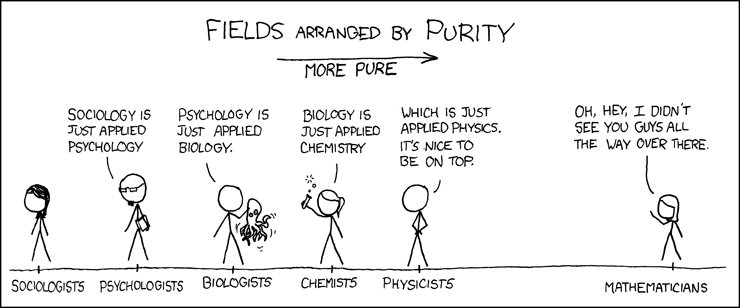
Image courtesy of XKCD.com (to read it is to love it)

Helping students discover fundamental concepts in math is a wonderful experience for all involved, yet as Lockhart himself admits, this can take a long time. Sometimes I cannot wait, I have things I want the student to use the math and the understanding can come afterwards. You see for me, math is both a beautiful thing but also a tool to be used. One can use an Arduino to create amazing things without understanding all of the design, science, and math behind it (in fact that was a part of its design), one can participate in the building of an FRC robot while learning along the way (it was similarly designed this way).

In the same way, the Pythagorean theorem can be tremendously valuable long before its understanding of how or why. While some would rail against this use before understanding, I find that it encourages motivation, play, and also progress. Often Math/Science teachers tell me that they never have the time to get to programming math because they are so busy trying to have them understand it before they can apply it. In my mind you will never get there in the unfortunately short amount of time we have students each day/year.

In my opinion, to try and teach understanding before application will often time go over student's heads and not stick in their minds in the long term. I would love to see what classrooms could accomplish if they were to start using math right away to build, create, derive, etc. Understanding would come but it would come from the student's aha moments and play. 

A car mechanic learns by playing and experimentation because often the manuals and experience fail to explain a problem, but a mechanic who has no basic understanding of the car, is just tinkering in their garage and is likely to break something. More so in the medical field where it would be grossly unethical to operate without understanding. On the job training is in my opinion the best there is but it is worthless if there is no foundation of skills.

Project based learning requires that we dive in and learn as we go but we must also have a skill set to build upon. At the beginning of the year, I am limited by what projects I can do with students because of their limited math, technology, and critical thinking skills. But as these grow throughout the year, I find them more and more able to do and create. By throwing them into the deep end and saying figure this out, they gain a mastery more quickly than a stepwise process would.

The pure math/applied math debate rages on even within the upper echelons of the math community as does the one over the superiority of theoretical and experimental science. What has been proven time and time again is that some gravitate towards a side but the community is stronger because of both. I can't imagine a class where my students constructed everything from first principles and derived and discovered all math/physics as that would seem to me to be too slow a pace and not my style of learning. Yet, a year spent only applying equations mindlessly would similarly leave the students at a disadvantage.

I don't struggle with the balance, I seek quality. As Allison mentioned in her post, I get frustrated by those who rabble rouse and say that teachers are doing it all wrong but don't provide any steps to improve. If your class is so amazing then share in detail. Don't just post on your blog, "My students are engaged and discuss math like Euler and Gauss reincarnate." Post the lesson, the dialog, a video, something! I know we cannot replicate another's teaching exactly because that depends on the context, relationship, style, etc. But, at least give us something to work with and inspire instead of just tearing others down.

I agree more than anyone else, that things need to change for the better. What I am unwilling to do is cut down the efforts of hard working passionate people (like the Khan academy) because their work is in its infancy or is being misused. I am also similarly frustrated with those who call for reform but provide no resources or ideas. If a teacher is online and reading blogs, that is a good thing and they should come away equipped and supported not guilt ridden. If there is something that needs correcting or calling out, then by all means do it, but it should always be coupled with resources or ideas on how they can improve.

Finally, lets all remember what has been said about opinions. No matter who you are or how popular your  blog, always remember that there is more than one way to teach "right". If your background is in pure math, then teach that with passion and your students will love it; if it is in the application of it (e.g. engineering) then likewise do that. Students love passion and while we should seek balance, if you are bored or confused, your students will be likewise. But let's please stop name calling and using superlatives. If someone's math or teaching looks weird and different to yours, learn from them but stop saying it "isn't math" or that they are "destroying critical thinking" at least unless you are willing to provide evidence or support to other teachers to help them see your side.

Subscribe to BrokenAirplane and keep up with all of the latest education and technology resources!

New Frontiers of Learning and Old Ways of Thinking

When I was in college, I asked if I could take a class online because my wife was a flight attendant at the time and I only saw her once or twice a week. They placed me in the online learning class and it was the silliest thing I had ever experienced. Basically, we watched (or were supposed to) a video of the lecture and then answer some multiple choice questions afterwards. I soon found out that the questions after the video were extremely simple and could be found from a quick reading of the textbook which for me at least was better than sitting through a 90 minute video.

Contrast this with my experience as an Electrician in the US Navy's Nuclear Power program. After taking classes for a year or so, we are transfered to the "Prototype", a permanently moored (docked) submarine where we can learn and apply our knowledge before going out to the fleet. This involved spending about one-third of your time reading the T-manuals aka textbooks, one-third in the boat finding the equipment and learning on it, and one third in front of a computer being assessed on your knowledge. Meanwhile you also met with a mentor who would actually sign you off on your knowledge and test you as he/she felt necessary.

Blended learning, hybrid learning, or whatever else people are calling it, claim that organizing learning in this matter will change education. Here are some questions that one should ask when designing this type of environment:

1) Are you trying to teach the old stuff in a new way? This could work but it requires student motivation or it will have the same problems that you encountered when you did it the old way. Some tech advocates (salesmen), have been saying for the last 30 years that if you add a computer, students will do better. This is blatantly stated in some of their pitches but it is wrong. Boring is still boring. Technology has never been nor will it be the magic bullet or panacea for education's problems.

The Nuclear Navy has not updated their curriculum much in decades, but because we were all hand picked for our program and wanted to be there, we didn't care how old the boat or the textbooks were. This would apply to any program, think of your classrooms and how every time there are those few students who you wish you could clone. This is usually the difference between a college gen-ed class where everyone needs to be there and an upper division degree specific course.

2) If you are going to make your class online or at least assess it online, are your assessment questions able to be found by reading the book or Googling the answer? Are you ok with that possibility? I have the impression that my professor in college wanted me to watch the video, but if that was the case then they should have made the questions require more thought than just fill in the blank or put something into the lecture that was worth my time.

Many of you may have encountered annoyances with online learning. Yet, this is no more an indictment of online learning than sitting through a bad lecture is of direct instruction. This is not a technology problem as our Navy technology was outdated and the graphics looked about 20 years old, this is a pedagogy problem. If your class would be boring and ineffective in person, it will be even more so online because the human engagement is lost.

3) How can I best use the technology I have to enhance learning? I always say, that learning should be able to happen in a field in the woods or on a mountain. Technology is not needed to make learning occur. What technology is best at doing is automating or offloading repetitive or annoying tasks and facilitate fast retrieval or information or communication.

In my Navy Prototype Training, computers and books were our primary sources of learning. There were no lectures but we would form discussions with other students and train ourselves using good old whiteboards. When we had a question, instructors were there to clarify or deepen our understanding but we always had to come with a question. They were too busy for us to come up and say, "what are you going to teach us today". In the boat, we could learn via hands on one-on-one demonstration/application.

When we felt ready to be assessed, the computer would check for our basic level of understanding and then we could go to our advisor. They would have some more questions that could not be found directly in the book but had to demonstrate our understanding (e.g. what happens when this valve is open and you try and speed up the pumps?) The conversations were always frustrating because they would enjoy trying to stump us but we loved it nonetheless because it was a game.

4) Why do we need to know this? I know the arguments for a Liberal Arts education and yet I feel like our learning is so broad that students graduate with no mastery of anything. What job could a student get out of high school, or as Quinn puts it, "What survival value does high school have?" You might say, "Well that is why they need to go to college" but with the amount of learning available online, I bet we could do a lot more efficient job of learning with mentors helping clarify and support online learning.


There is no replacement for human interaction/discussion when learning, it's how we culturally evolved. The question is what role will humans play in learning with all of this information readily available for free? This is not a new question it is a rediscovery of old ways of thinking. Ancient peoples did not have school houses with lectures and curriculum, learning happened through exploration. Far from thinking that as a quaint or savage mode of learning, I think it is the key to unlocking our human potential for creating and innovating.

This does not replace teachers, it just changes our job description.

Subscribe to BrokenAirplane and keep up with all of the latest education and technology resources!

Lets All Share Our Awesome Math

So as I said in a previous post, Spring Break is my chance to take a moment to reflect and see what I can do better. Thanks to all of you sending me articles and my network of resources, I have had no shortage!

One theme that mysteriously keeps coming to my attention is the lack of richness in our curriculum. In one of BrokenAirplane's earliest posts, I encouraged all of us to aim for the highest level of application as the end result of our student's learning. Now in the last couple of weeks, I am seeing great posts from thoughtful writers about how shallow our textbooks and assignments are.

In this one, Frank speaks about how the Khan Academy is actually reinforcing our shallow model of education. I agree with his point if teachers are allowing these "tools" to be the complete math curriculum. It would be like going to a cooking class and spending weeks learning about the mixer, the oven, baking soda, etc. and never actually making a cake.

While on the other hand, I teach at a school which does not track and I have 9th grade students who are ready for Trigonometry and others who never understood Elementary Math. Using ALEKS and Khan Academy occasionally (<20% of class) has dramatically improved their confidence in their skills and participation in class discussions.

Another source of this mathematical meme came from Republic of Math and describes the difference between contrived and real problems. Contrived problems are a poor attempt to compel the student to care when the only purpose of the word problem was to wrap a story around a calculation problem. Kirby Urner has said before that we need to tell better and bigger stories and we will find that math is a part of that bigger story without having to make some contrived reason up, and just a couple of days ago, Dan Meyer spoke about the need for strong narrative to drive critical thinking.

The other part that keeps rattling off in my mind comes from my "Is Calculating Math?" post about Conrad Wolfram's exhortation that we stop the trend of 80% class time teaching/learning to calculate. I agree 100% and yet I am now finding myself overwhelmed. I am asking you out there for help at getting better at mathematical modeling. If you haven't watched the TED Talk, check it out here.


According to the Mathematics for Teaching Blog, mathematical modeling breaks down into 4 categories:

Empirical modeling involves examining data related to the problem with a view of formulating or constructing a mathematical relationship between the variables in the problem using the available data.
Simulation modeling involve the use of a computer program or some technological tool to generate a scenario based on a set of rules. These rules arise from an interpretation of how a certain process is supposed to evolve or progress.
Deterministic modeling in general involve the use of equation or set of equations to model or predict the outcome of an event or the value of a quantity.
Stochastic modeling takes deterministic modeling one further step. In stochastic models, randomness and probabilities of events happening are taken into account when the equations are formulated. The reason behind this is the fact that events take place with some probability rather than with certainty. This kind of modeling is very popular in business and marketing.
All of these are applications of mathematical knowledge and I want my students to do it more than they are. The Internet is based upon the idea of sharing and not reinventing the wheel so if you have had success in your classroom with Challenge Problems, projects, or any other application of these ideas that you think would be suitable for 9th grade math students I would greatly appreciate it.
I am aware of the great resources out there from Dan Meyer, Ben Rimes, ASU's modeling instruction and the like. As I said, I am not so much concerned about the pedagogy as the questions. At my school we have teams of humanities/math teachers and I yearn for my students to talk about math class the way they do after leaving my partner's class. Sure they talk about the cool thing they just did with Arduino or Python but I want to help them see the bigger picture and allow puzzles and math to be a source of fun and thought for them not just frustration.

I am tired of looking through textbooks and sifting through websites hoping for great math. There is nothing I like more than walking around and having a great idea for a project or problem come to me, but I would love more. Basically, I am asking for your "Awesome Awesomeness" as one of my colleague put it. Please share it in the comments or tweet it using the hashtag #AwesomeMath.

Subscribe to BrokenAirplane and keep up with all of the latest education and technology resources!