As I was reading an article critical of MOOCs and online learning (there seem to be no shortage as everyone likes a good straw man), I was annoyed by a certain statement made about halfway into the article.
"Every age has its autodidacts, gifted people able to teach themselves with only their books. Woe unto us if we require all citizens to manifest that ability."
Learning is our natural state of being. We can't help but learn new things. I don't want citizens to manifest the ability to "teach themselves" I want them to rediscover that with resources and support, one can learn anything.
If you are letting someone else set the curriculum and pace for your learning you will inevitably be disappointed. I have enjoyed my formal schooling thus far and have benefited from great educators but I considered them a supplement to my learning not the other way around. I've have always kept a stack of books at my desk since I learned to read. When the Internet emerged, I found both resources and community that addressed my questions that books and the classroom could not answer.
When I was a child, if I wanted to learn about a topic there were two options: learn about it in school, or buy the book. Now I have books, school, videos, forums/conferences, web pages, virtual simulations, online classes, and more. Almost all of these can be found via the Internet from a computer that fits in my pocket.
In this new world, enriched with technology, Educators are not obsolete, they are more useful than ever before. We no longer need to be disseminators of information, and this should be welcome news. For how could we ever hope to keep up with the rapid increase in information. We must be mentors, and as my colleague +James Sanders puts it, curators of quality resources. The author seems to agree with this when she says that education at it's core is, "one mind engaging with another, in real time: listening, understanding, correcting, modeling, suggesting, prodding, denying, affirming, and critiquing thoughts and their expression."
There has never been a better time to learn. Resources and communities are plentiful. Never stop learning.

The views expressed here do not necessarily represent those of my employer.
Showing posts with label education. Show all posts
Showing posts with label education. Show all posts

#CompThinkChat on Twitter - Join the discussion
Computational Thinking is showing up in discussions and talks everywhere I look. The Next Generation Science Standards reference them and the skills are implied in the Common Core.
A few days ago, I saw this tweet from @Kevin_Krenz:

and knew that this would be a perfect way to bring the community together to discuss and share experiences with Computational Thinking. Kevin put this planning document together and #CompThinkChat was born.
The first chat is Wednesday Aug 8th at 7pm CST (5pm PST/8pm EST) and continuing every other week. This may not be the best time for everyone who wants to be involved so add your suggested times to the planning doc and let's see what works out in the long run.
If this is your first Twitter chat, here's the steps to get started:

and knew that this would be a perfect way to bring the community together to discuss and share experiences with Computational Thinking. Kevin put this planning document together and #CompThinkChat was born.
The first chat is Wednesday Aug 8th at 7pm CST (5pm PST/8pm EST) and continuing every other week. This may not be the best time for everyone who wants to be involved so add your suggested times to the planning doc and let's see what works out in the long run.
If this is your first Twitter chat, here's the steps to get started:
- Sign up for Twitter.
- Sign in during the scheduled chat time.
- If you are using the Twitter homepage search for #CompThinkChat in the upper right corner. This filters out all tweets except those relevant to the chat.
- Chat! Share your thoughts, questions, link, etc. Note: Make sure you add #CompThinkChat to your Tweets so everyone else can see them.
There are many ways to access Twitter, especially on your mobile device. I personally use Silver Bird for Chrome and Seesmic on Android but do a search and try a few out to see what works best for you.
If you miss out on a chat, they will be archived in the Exploring Computational Thinking General Forum.
Here's the document of Computational Thinking Resources I share in my presentations about Computational Thinking. All are invited to join the chat whether you have been using Computational Thinking since Papert, Wing, or if this is the first time you have heard about it. It'll be exciting to hear the community's thoughts on the implications and possibilities and I hope you will join us!
Here's the document of Computational Thinking Resources I share in my presentations about Computational Thinking. All are invited to join the chat whether you have been using Computational Thinking since Papert, Wing, or if this is the first time you have heard about it. It'll be exciting to hear the community's thoughts on the implications and possibilities and I hope you will join us!
Getting rid of old "new" pedagogy
Did you know that our way of schooling is only a 100 - 1000 years old? That may seem like a lot but it is less than 1% of human history. We transmitted culture and knowledge for thousands of years before the first school opened its doors. What do you think about that? Should we be nostalgic and go back to the "old ways"? Impossible, none of us were there to see it and too many generations have passed for us to even know what that would look like.
But, if our pedagogy cannot keep up with technology then we miss out on enormous opportunities for learning. Not because technology drives pedagogy but because technology provides new ways of accessing learning. We have experienced rapid growth and change in our society. In evolutionary terms this signals the beginning of change. However, the transition should not be mistaken for the new form it is just temporary. All of our debates and frustration with how tools are or are not being used is just that, a shifting era in the way in which we learn.
Although one could not predict what the change will be into, it is possible to see what pressures are driving this change. Examining this will help us pool our resources and focus our energies on what could be lasting.
Curriculum - The Common Core Standards in the US are slowly being adopted by states as the framework for what students should learn. Much like a cell phone purchased in January, it is obsolete by February. Not to specifically target the CCS but knowledge is growing so rapidly in depth and breadth, our strength will be in the diversity of our experts not the uniformity of our mastery.
Assessment - Of course one should know how to do what they are expected to be doing, and it should be possible to provide assurance that they are qualified to do so. But what are we doing to ensure they are capable of working with others? I'm not saying play nice and communicate effectively, but if a doctor and an engineer are capable of collaborating, something great will come from that. We need to move away from a liberal education which is a mile wide and an inch deep into a highly interdisciplinary one where divisions of knowledge become blurred.
We also need to move away from the idea that I am the master and I will always be the master. It should be implied in your studying with me that you will learn what I have to teach but discover and innovate beyond what I understood. If the student never exceeds the master then we have a negative feedback loop and innovation is stiffled. At the same time, one should not consider themselves an educator if their learning stopped when they left the University with a piece of paper in their hand.
The New Economy - Up until recently, the bulk of our workforce was skill based. If you knew how to do something then you were paid to do it and you could do that skill for the rest of your life. Technology made it possible for industries to change or become obsolete. Suddenly an entire generation was unable to do the thing their family had done for generations and simultaneously industries popped up that had never existed before.
Knowledge became the new currency and people went back to school to be retrained, students were told an education was critical and the more you had the better. It was about what you knew and how much of it. But with everyone entering the universities, there was no hope of employment for everyone. The bar was raised to make an undergraduate degree the new standard and now more and more employers are pushing towards a graduate degree as the new cutoff. Sometimes employers are not even looking for someone with a degree in a particular field. It doesn't matter, in our system, the more knowledge you have the better worker you must be.
Whether this is a result of the transition mentioned above or the emergence of the new form, we are seeing the synthesis of knowledge and skill. It is not enough to know anymore you must be able to do. If you have your ear to the ground you will see lots of new institutions of learning. Some of them are online and some of them are grassroots organic but people are flocking to them to apply their knowledge and learn useful skills.
Now we must continue to learn out of necessity if we wish to stay relevant. There are more and more online learning resources for us to continue our education for little or no cost. Yet this is not enough, it will be those who apply their knowledge who create the next big thing or find new ways to live. If we are not showing our students how to create and exclaiming when they do create, "How did you do that?!?" then we are not going beyond the pedagogy we inherited.
Update: Found Sal making these points in video form (uploaded on my birthday)!
Convergence is everywhere.
But, if our pedagogy cannot keep up with technology then we miss out on enormous opportunities for learning. Not because technology drives pedagogy but because technology provides new ways of accessing learning. We have experienced rapid growth and change in our society. In evolutionary terms this signals the beginning of change. However, the transition should not be mistaken for the new form it is just temporary. All of our debates and frustration with how tools are or are not being used is just that, a shifting era in the way in which we learn.
Although one could not predict what the change will be into, it is possible to see what pressures are driving this change. Examining this will help us pool our resources and focus our energies on what could be lasting.
Curriculum - The Common Core Standards in the US are slowly being adopted by states as the framework for what students should learn. Much like a cell phone purchased in January, it is obsolete by February. Not to specifically target the CCS but knowledge is growing so rapidly in depth and breadth, our strength will be in the diversity of our experts not the uniformity of our mastery.
Assessment - Of course one should know how to do what they are expected to be doing, and it should be possible to provide assurance that they are qualified to do so. But what are we doing to ensure they are capable of working with others? I'm not saying play nice and communicate effectively, but if a doctor and an engineer are capable of collaborating, something great will come from that. We need to move away from a liberal education which is a mile wide and an inch deep into a highly interdisciplinary one where divisions of knowledge become blurred.
We also need to move away from the idea that I am the master and I will always be the master. It should be implied in your studying with me that you will learn what I have to teach but discover and innovate beyond what I understood. If the student never exceeds the master then we have a negative feedback loop and innovation is stiffled. At the same time, one should not consider themselves an educator if their learning stopped when they left the University with a piece of paper in their hand.
The New Economy - Up until recently, the bulk of our workforce was skill based. If you knew how to do something then you were paid to do it and you could do that skill for the rest of your life. Technology made it possible for industries to change or become obsolete. Suddenly an entire generation was unable to do the thing their family had done for generations and simultaneously industries popped up that had never existed before.
Knowledge became the new currency and people went back to school to be retrained, students were told an education was critical and the more you had the better. It was about what you knew and how much of it. But with everyone entering the universities, there was no hope of employment for everyone. The bar was raised to make an undergraduate degree the new standard and now more and more employers are pushing towards a graduate degree as the new cutoff. Sometimes employers are not even looking for someone with a degree in a particular field. It doesn't matter, in our system, the more knowledge you have the better worker you must be.
Whether this is a result of the transition mentioned above or the emergence of the new form, we are seeing the synthesis of knowledge and skill. It is not enough to know anymore you must be able to do. If you have your ear to the ground you will see lots of new institutions of learning. Some of them are online and some of them are grassroots organic but people are flocking to them to apply their knowledge and learn useful skills.
Now we must continue to learn out of necessity if we wish to stay relevant. There are more and more online learning resources for us to continue our education for little or no cost. Yet this is not enough, it will be those who apply their knowledge who create the next big thing or find new ways to live. If we are not showing our students how to create and exclaiming when they do create, "How did you do that?!?" then we are not going beyond the pedagogy we inherited.
Update: Found Sal making these points in video form (uploaded on my birthday)!
Convergence is everywhere.
YouTube for Schools Opens Resources Up to the Classroom
You're sitting at home, planning a lesson when suddenly you come across the most incredible video to supplement what you are trying to convey. Unfortunately, YouTube is blocked in your school and this is not option. I have encountered this situation numerous times or when I am in the classroom working with students and a question comes up that would be perfectly illustrated with a video.
It's a shame that so much great content is blocked. The justification makes sense, students might get distracted and some of the content online might be inappropriate. Thankfully YouTube has developed a way that we can have the best of both worlds. With YouTube for Schools, it is now possible for schools to unblock and access the large amount of content on YouTubeEdu safely as potentially offensive related videos and comments are disabled.
I am so honored to have worked with the YouTube team on this project. I knew it would make a huge difference in student's opportunities to learn from all of the excellent quality out there.
One great feature of YouTube for Schools are the hundreds of teacher curated videos aleady aligned with the Common Core Standards for English Language Arts and Mathematics. For Science the National Science Education Standards were used and for History/Social Studies the videos were aligned to the California State Standards. Now you can easily find videos to supplement whatever you are working on.
With all of the great content available on YouTube, you would think all of the best videos have already been uploaded right? Think again. Every one of you has a great video, lesson, experiment, project, story to share and now you can.
Here is my favorite part: schools can add their own videos to their personal unblocked playlists. If you would like to suggest your own playlist to add to YouTube for Schools, submit it to YouTube.com/Teachers where you can see all the playlists without a login.
With this new tool to support student learning, some examples of how you could use videos in the classroom are:
1) Show a visual representation of a concept after a lesson.
2) Record an important lecture or activity so students can review it later (especially if they were absent).
3) Create a video for when you are absent to help the students and substitute know what to do.
4) Flip your classroom.
The last one, is really exciting. Upload a video and ask students to watch it at home. Then when they come to class, your time is free to go deeper into the subject, do an experiment or project, and all of the other things you wished you could do if you had more time.
Don't stop there, use the tools on the web to support your students and have them support each other.

 However you do it, now students have a way to give specific feedback at their leisure (not constrained to class schedule or intimidated by peer pressure). You can refine the video if it was confusing to a lot of students and explain it better the next day in class. This kind of feedback might be difficult to obtain in class but now you have a way to assess student's learning and understanding as often as you would like.
YouTube for Schools opens your classroom up to the resources of the world. Teachers are empowered to supplement their lessons as well as share the amazing things they do with everyone.
Original Link from YouTube Blog - Opening Up a World of Educational Content with YouTube for Schools.
Subscribe to the BrokenAirplane blog to keep up to date with all things awesome in education!
It's a shame that so much great content is blocked. The justification makes sense, students might get distracted and some of the content online might be inappropriate. Thankfully YouTube has developed a way that we can have the best of both worlds. With YouTube for Schools, it is now possible for schools to unblock and access the large amount of content on YouTubeEdu safely as potentially offensive related videos and comments are disabled.
I am so honored to have worked with the YouTube team on this project. I knew it would make a huge difference in student's opportunities to learn from all of the excellent quality out there.
One great feature of YouTube for Schools are the hundreds of teacher curated videos aleady aligned with the Common Core Standards for English Language Arts and Mathematics. For Science the National Science Education Standards were used and for History/Social Studies the videos were aligned to the California State Standards. Now you can easily find videos to supplement whatever you are working on.
With all of the great content available on YouTube, you would think all of the best videos have already been uploaded right? Think again. Every one of you has a great video, lesson, experiment, project, story to share and now you can.
Here is my favorite part: schools can add their own videos to their personal unblocked playlists. If you would like to suggest your own playlist to add to YouTube for Schools, submit it to YouTube.com/Teachers where you can see all the playlists without a login.
With this new tool to support student learning, some examples of how you could use videos in the classroom are:
1) Show a visual representation of a concept after a lesson.
2) Record an important lecture or activity so students can review it later (especially if they were absent).
3) Create a video for when you are absent to help the students and substitute know what to do.
4) Flip your classroom.
The last one, is really exciting. Upload a video and ask students to watch it at home. Then when they come to class, your time is free to go deeper into the subject, do an experiment or project, and all of the other things you wished you could do if you had more time.
Don't stop there, use the tools on the web to support your students and have them support each other.
- With Google+ Hangouts, your students could form a study group and watch the video together to discuss.
- Have students add comments to a Google Spreadsheet that can be reviewed the next day (example), its really easy to make a column filled with times.
- Type 0:00:00 into Cell A2 and 0:00:01 in Cell A3 (or 0:00:05 to skip by 5 seconds, etc).
- Highlight both cells then grab-and-drag the blue box in the corner.

- Use Google Moderator to take questions just like the president.
- Another option is to use a Google Form and collect data that way.

YouTube for Schools opens your classroom up to the resources of the world. Teachers are empowered to supplement their lessons as well as share the amazing things they do with everyone.
Original Link from YouTube Blog - Opening Up a World of Educational Content with YouTube for Schools.
Subscribe to the BrokenAirplane blog to keep up to date with all things awesome in education!
Dangerous Things You Should Let Your Kids Do
I can not believe that I have never written about the Dangerous Things You Should Let Your Kids Do. You may or may not have heard of Gever Tulley so I have included his TED talk at the bottom of this post.
Our world has become too safe. In our effort to keep our children alive, we have let fear get the best of us and took all of the fun out of childhood. Our anti-bacterial everything are growing super strains of infection, the playgrounds are timid and yawn-inspring, and our Chemistry sets no longer ship with radioactive material (ok maybe that is a good thing). Don't even get me started on the supposed learning toys with one button and no challenge.
I heard about Tulley and his Tinkering School a few years ago at Maker Faire and swore that when my kids were old enough we would do this stuff. I didn't want my children to feel like they lacked the basic skills to create or if needed, survive. Plus, I have said numerous times that my most formative experiences have been learning side-by-side with my parents or under a mentor.
So a week ago, my two year old son could not stop talking about how much he loves my keyless entry badge for work. From what I can tell, he enjoys pulling the badge and watching it snap back on the reel, looking at the picture of his Dad, and saying the word Google with the same playfulness that must have inspired Mr. Kasner.
 I have always joked (it wasn't a joke) with my wife that when he was old enough, I would teach him soldering, programming, welding, etc. Well, now was as good a time as any. After a quick trip to Radio Shack we were ready to go. Now a two year old's attention is a funny thing, sometimes he wanted to help too much, and other times he wanted to go play with his toys and take a nap. Nonetheless, when I handed him his badge his eyes lit up with more intensity than the LED we put in it.
This was not the joy of a new toy, this was the joy that comes from being a part of the creation of something cool. My disclaimer is this is not my best work, but I hope that each year he and I can get progressively more challenging with these projects to the point where he is teaching me. With the cost of parts so low and the abundant learning resources I can't even predict what will happen over the next 10 years. Oh and don't think my soon to be born daughter is exempt, making is a family affair!
Before you say anything, don't worry I am not pushing for my children to be anything in particular, but our education system makes us masters of nothing and I want to make sure my children are equipped to follow any path they choose.
Watch the video below, and then please, please, please let your kids do something dangerous!
Subscribe and Connect to BrokenAirplane and stay up to date with the best resources in education.
Our world has become too safe. In our effort to keep our children alive, we have let fear get the best of us and took all of the fun out of childhood. Our anti-bacterial everything are growing super strains of infection, the playgrounds are timid and yawn-inspring, and our Chemistry sets no longer ship with radioactive material (ok maybe that is a good thing). Don't even get me started on the supposed learning toys with one button and no challenge.
I heard about Tulley and his Tinkering School a few years ago at Maker Faire and swore that when my kids were old enough we would do this stuff. I didn't want my children to feel like they lacked the basic skills to create or if needed, survive. Plus, I have said numerous times that my most formative experiences have been learning side-by-side with my parents or under a mentor.
So a week ago, my two year old son could not stop talking about how much he loves my keyless entry badge for work. From what I can tell, he enjoys pulling the badge and watching it snap back on the reel, looking at the picture of his Dad, and saying the word Google with the same playfulness that must have inspired Mr. Kasner.
 I have always joked (it wasn't a joke) with my wife that when he was old enough, I would teach him soldering, programming, welding, etc. Well, now was as good a time as any. After a quick trip to Radio Shack we were ready to go. Now a two year old's attention is a funny thing, sometimes he wanted to help too much, and other times he wanted to go play with his toys and take a nap. Nonetheless, when I handed him his badge his eyes lit up with more intensity than the LED we put in it.
This was not the joy of a new toy, this was the joy that comes from being a part of the creation of something cool. My disclaimer is this is not my best work, but I hope that each year he and I can get progressively more challenging with these projects to the point where he is teaching me. With the cost of parts so low and the abundant learning resources I can't even predict what will happen over the next 10 years. Oh and don't think my soon to be born daughter is exempt, making is a family affair!
Before you say anything, don't worry I am not pushing for my children to be anything in particular, but our education system makes us masters of nothing and I want to make sure my children are equipped to follow any path they choose.
Watch the video below, and then please, please, please let your kids do something dangerous!
Subscribe and Connect to BrokenAirplane and stay up to date with the best resources in education.
Technology is Not Magic
Perhaps you read the story this week from the New York times about how technology in the classroom is not showing an improvement in test scores. It may surprise you (unless you know me) to find that I could have wrote that article years ago. Except I would have called it, "New Technology + Old Ways of Educating Lead to Lower Test Scores and Empty District Budgets."
Every day I hear about a new panacea for all that is wrong with education. Often this magic comes from a piece of software, website, or hardware. To hear the marketing departments of these companies talk, you would think you just put ________ into your classroom and everything will right itself.
If this were an infomercial we would all laugh at the hyperbole, but unfortunately thousands of districts flock to these vendors and fork over money like a gambler spending his family's food money. Early in my career, I was given a pink slip in order to shore up budgets. In that same year, millions of dollars were spent on adding interactive whiteboards, clickers, microphones, cameras, etc. I have seen or heard this too many times to feel like my situation was an anomaly.
These technologies are incredibly cool and powerful so why are we not seeing a bump in scores? My first reason that I will only mention briefly as I have spoken on it in the past is the growing disconnect between test scores and learning. There are so many issues and errors with the "system" used to assess learning that I would question every statement that begins or ends with "test scores show" or "led to an increase/decrease in test scores".
The oft cited Tony Wagner refers to the skills needed to close the global achievement gap (video). If you don't have the time to read them, I can quickly summarize them by saying that they are not skills that can be tested by today's assessments.
Technology can be used for good and evil, it can give us superpowers or add convenience. This is one of the reasons why the Flintstones/Jetsons cartoons are so funny. In the Flintstons you see Fred in his foot pedaled car when he could far more easily walk or run. In the Jetsons, modern society remains exactly the same as it is but with technology (e.g. George walking the dog on a treadmill because for some reason they live in the sky). This is what we have done with technology, spent all of our money on shiny toys only to do things the exact same way as we did before.
Here are a few conversations I have had or overheard over the years:
Every day I hear about a new panacea for all that is wrong with education. Often this magic comes from a piece of software, website, or hardware. To hear the marketing departments of these companies talk, you would think you just put ________ into your classroom and everything will right itself.
If this were an infomercial we would all laugh at the hyperbole, but unfortunately thousands of districts flock to these vendors and fork over money like a gambler spending his family's food money. Early in my career, I was given a pink slip in order to shore up budgets. In that same year, millions of dollars were spent on adding interactive whiteboards, clickers, microphones, cameras, etc. I have seen or heard this too many times to feel like my situation was an anomaly.
These technologies are incredibly cool and powerful so why are we not seeing a bump in scores? My first reason that I will only mention briefly as I have spoken on it in the past is the growing disconnect between test scores and learning. There are so many issues and errors with the "system" used to assess learning that I would question every statement that begins or ends with "test scores show" or "led to an increase/decrease in test scores".
The oft cited Tony Wagner refers to the skills needed to close the global achievement gap (video). If you don't have the time to read them, I can quickly summarize them by saying that they are not skills that can be tested by today's assessments.
Technology can be used for good and evil, it can give us superpowers or add convenience. This is one of the reasons why the Flintstones/Jetsons cartoons are so funny. In the Flintstons you see Fred in his foot pedaled car when he could far more easily walk or run. In the Jetsons, modern society remains exactly the same as it is but with technology (e.g. George walking the dog on a treadmill because for some reason they live in the sky). This is what we have done with technology, spent all of our money on shiny toys only to do things the exact same way as we did before.
Here are a few conversations I have had or overheard over the years:
- Why should students learn to program, they already have calculators?
- Problem solving/creative thinking
- If you give students access to the Internet, all they will do is copy-and-paste.
- Perhaps your assignment could be updated to require thought.
- We have to block all social networking and chat on the school networks or students will spend all of their time talking to each other.
- Do teachers spend all of their time working alone without collaboration (oh wait, sadly many do).
- You (Phil) can do all of these cool things you do because you had XYZ technology or laptops.
- Hahahahahahahahahahhahaha. Have you ever tried to do a boring assignment on a laptop? The lesson is still boring.
- We can't have cell phones in school. (Never really heard the justification)
- My dream is to have school in an open field or apprenticing at a lab/workshop. Cell phones could make that possible and they cost far less than the tech we are filling our rooms with.
Here are the marketing companies: Look we took all of your old lessons and assignments and made them flashy and gave the students buttons to push.
Here is my challenge to our community: Help the students do things that were never possible before.
If your test scores are not going up, don't look to adding some new piece of entertainment, give the students a challenge to create, apply, engineer. If that involves technology, great! If it doesn't then that is probably better.
Subscribe and Connect to BrokenAirplane and stay up to date with the best resources for your classroom.
Subscribe and Connect to BrokenAirplane and stay up to date with the best resources for your classroom.
The Four Pillars of Math Education
I have had the pleasure of finding excellent books and articles this summer, it seems like change is in the air. If you want to know whether I am really enjoying reading something, look and see if I have a piece of paper out (or my phone), writing down all my thoughts. My wife tells me to read something to take my mind off things every once in a while, but if it isn't thought provoking then what's the point?
I believe I came across this article first in an EDU-SIG Python mailing but I cannot find the original post. This group participates in discussions regarding education and computing (specifically with the Python Programming Language). It is an excellent convergence of brilliant minds and I highly recommend it anyone with an interest in the subject.
The article is titled The Four Pillars Upon Which The Failure of Math Education Rests and in it Matt Brenner writes with the same passion and conviction as the writer of Lockhart's Lament (original article is a free PDF) so famously wrote. While there is no difference in the passion nor the topic of discussion, Four Pillars involves not didactic rhetoric but data and research. The article is longer, but it provides concrete steps math educators (and other content subjects as well) can take to make effective change in the classroom and is well worth the time.
If I may spoil the surprise a little bit to review the article, he shows an avalanche of data to support the claim that high stakes standardized testing based education (as it currently exists) is not working (no surprise to anyone reading this blog I'm sure). The claims of growth and success within districts or states are found to be the result of playing with the data or setting goals so low that it would be impossible not to meet them.
Additionally, we have feedback loops that makes it difficult to create reform. One example cited is the ever increasing size of the textbooks in order to be perceived as the best resource for schools. This results in a curriculum that becomes less and less based in understanding but in "skimming" information and "covering" facts. This arms race cannot cease as no textbook publisher seems interested in reducing the content to cover more in depth as it would potentially be perceived as less/lower quality.
In another cycle we must break out of, we are now in a society where the technology of our lives is far different than the ones our parents did. The ways and amount we can learn is staggering but we still teach and act as if the technological breakthroughs never happened. While we could continue to think that as long as we do it as well as our teachers did for us, things will carry on as they have. However, our society is different in many ways and calls for new learning in method and matter.
The article/book continues to point out the flaws in our educational system, but points more specifically to the flaws in math education. But far from a doom and gloom prophet, he provides excellent suggestions for what can be done tomorrow. Yes, while there are big picture issues to overcome there are still things we can do in our classrooms to break from the pedagogy of the past.
If Lockhart's Lament stirred you but left you wanting more, check out The Four Pillars.
I believe I came across this article first in an EDU-SIG Python mailing but I cannot find the original post. This group participates in discussions regarding education and computing (specifically with the Python Programming Language). It is an excellent convergence of brilliant minds and I highly recommend it anyone with an interest in the subject.
The article is titled The Four Pillars Upon Which The Failure of Math Education Rests and in it Matt Brenner writes with the same passion and conviction as the writer of Lockhart's Lament (original article is a free PDF) so famously wrote. While there is no difference in the passion nor the topic of discussion, Four Pillars involves not didactic rhetoric but data and research. The article is longer, but it provides concrete steps math educators (and other content subjects as well) can take to make effective change in the classroom and is well worth the time.
If I may spoil the surprise a little bit to review the article, he shows an avalanche of data to support the claim that high stakes standardized testing based education (as it currently exists) is not working (no surprise to anyone reading this blog I'm sure). The claims of growth and success within districts or states are found to be the result of playing with the data or setting goals so low that it would be impossible not to meet them.
Additionally, we have feedback loops that makes it difficult to create reform. One example cited is the ever increasing size of the textbooks in order to be perceived as the best resource for schools. This results in a curriculum that becomes less and less based in understanding but in "skimming" information and "covering" facts. This arms race cannot cease as no textbook publisher seems interested in reducing the content to cover more in depth as it would potentially be perceived as less/lower quality.
In another cycle we must break out of, we are now in a society where the technology of our lives is far different than the ones our parents did. The ways and amount we can learn is staggering but we still teach and act as if the technological breakthroughs never happened. While we could continue to think that as long as we do it as well as our teachers did for us, things will carry on as they have. However, our society is different in many ways and calls for new learning in method and matter.
The article/book continues to point out the flaws in our educational system, but points more specifically to the flaws in math education. But far from a doom and gloom prophet, he provides excellent suggestions for what can be done tomorrow. Yes, while there are big picture issues to overcome there are still things we can do in our classrooms to break from the pedagogy of the past.
If Lockhart's Lament stirred you but left you wanting more, check out The Four Pillars.
The Watchman's Rattle: Thinking Our Way Out of Extinction
"You consider yourselves inventive don't you? Well, be inventive."
 For those of you who don't recognize those words, they come from the Gorilla Ishmael from Daniel Quinn's book of the same name. Described as an "alien anthropologist" by some for his unique perspective, Quinn reveals through Ishmael to us the flaws in our thinking and why it is our story not our actions that are sending us towards inevitable collapse. Our cultural memes dictate everything we do, even the rebellious reforms we try to implement are still operating in opposition to the laws of nature.
Ishmael caused a critical shift in my thinking almost a decade ago and my highest recommendation to anyone would be to read it and share it with someone else. It is easy enough that it could be read by a 5th grader and with less than 200 pages it could easily fit into your summer reading plans.
The quote at the beginning of this post is Ishmael's response to the main character's realization of our predicament. I won't spoil for you the paradigm shift that one gets as a result of reading Ishmael but it is important to realize that our society does not lead a sustainable existence. Not exactly news to anyone but what makes Ishmael truly valuable is the insight as to why we continue to do live an unsustainable existence.
Many readers of Ishmael are left with the question, well what should we do now? In fact, an entire section of the website devoted to Ishmael revolves around that question (don't click expecting an easy answer). About 15 years later, research and insight allowed Rebecca Costa to provide her perspective in her book The Watchman's Rattle: Thinking Our Way Out of Extinction.
 Although I read a lot of books, my favorites are those that inspire new ideas for me. As I was reading this on the way to the ISTE Conference in Philadelphia, I easily filled 2 pages worth of thoughts, ideas, innovations inspired by this book. If for no other reason, check this book out because it makes you think.
The author draws from her research the realization that one of the causes of societal collapse is when we hit our cognitive threshold. When a society's problems become so complex that they cannot be solved by left brain/right brain thinking then we inevitably will fall prey to some cause like the Romans and the Mayans before us and be unable to think our way out of it.
Evolution, is too slow to provide us the biological gains to solve these problems, but we already have a mechanism built in that could be the key to our survival. Through numerous examples and with the latest in neuroscientific discoveries, the case is laid out for "insight" as a way to solve complex problems. While insight has always been a spontaneous non-repeatable occurrence, it has led to dramatic scientific and societal paradigm shifts as a result. Now scientists are discovering the factors that increase the likelihood of insight which could be used as a basis for innovation out of our current situation and into one more sustainable.
As Ishmael lays out in his book, our culture is the primary cause of our problems and not some failing of human nature or lack of technological innovation. Rebecca Costa shares the five supermemes which prevent us from reaching our goals. Memes are a cultural idea that is transmitted from person to person and generation to generation. The supermemes are those which are everywhere and are most destructive.
The problem is, when you describe a supermeme to someone their response is, "well that's the only way it could be or has been". We encounter this quite often with education as those who would remember a time before our industrialized classroom emerged are no longer with us and so we believe this is always the way it has been.
According to Quinn and Costa, the only way to overcome these cultural memes that are detrimental to our society is to ensure our beliefs are rooted in fact and logic as opposed to destructive memes. Once a critical mass of people understand why we are doing things the way we are, it is possible to abandon it and start again. This is demonstrated in science (documented by Thomas Kuhn) as well as in our history that a small growing group of people can cause a shift in our societal thinking.
So while I know what I need to do, it is also critical that more of you read these two books and become inspired yourself to, "Save the World" as Ishmael called it. I can think of no better time than now.
Ishmael by Daniel Quinn
The Watchman's Rattle by Rebecca Costa
Subscribe to BrokenAirplane!
 For those of you who don't recognize those words, they come from the Gorilla Ishmael from Daniel Quinn's book of the same name. Described as an "alien anthropologist" by some for his unique perspective, Quinn reveals through Ishmael to us the flaws in our thinking and why it is our story not our actions that are sending us towards inevitable collapse. Our cultural memes dictate everything we do, even the rebellious reforms we try to implement are still operating in opposition to the laws of nature.
Ishmael caused a critical shift in my thinking almost a decade ago and my highest recommendation to anyone would be to read it and share it with someone else. It is easy enough that it could be read by a 5th grader and with less than 200 pages it could easily fit into your summer reading plans.
The quote at the beginning of this post is Ishmael's response to the main character's realization of our predicament. I won't spoil for you the paradigm shift that one gets as a result of reading Ishmael but it is important to realize that our society does not lead a sustainable existence. Not exactly news to anyone but what makes Ishmael truly valuable is the insight as to why we continue to do live an unsustainable existence.
Many readers of Ishmael are left with the question, well what should we do now? In fact, an entire section of the website devoted to Ishmael revolves around that question (don't click expecting an easy answer). About 15 years later, research and insight allowed Rebecca Costa to provide her perspective in her book The Watchman's Rattle: Thinking Our Way Out of Extinction.
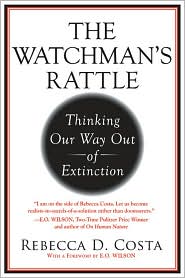 Although I read a lot of books, my favorites are those that inspire new ideas for me. As I was reading this on the way to the ISTE Conference in Philadelphia, I easily filled 2 pages worth of thoughts, ideas, innovations inspired by this book. If for no other reason, check this book out because it makes you think.
The author draws from her research the realization that one of the causes of societal collapse is when we hit our cognitive threshold. When a society's problems become so complex that they cannot be solved by left brain/right brain thinking then we inevitably will fall prey to some cause like the Romans and the Mayans before us and be unable to think our way out of it.
Evolution, is too slow to provide us the biological gains to solve these problems, but we already have a mechanism built in that could be the key to our survival. Through numerous examples and with the latest in neuroscientific discoveries, the case is laid out for "insight" as a way to solve complex problems. While insight has always been a spontaneous non-repeatable occurrence, it has led to dramatic scientific and societal paradigm shifts as a result. Now scientists are discovering the factors that increase the likelihood of insight which could be used as a basis for innovation out of our current situation and into one more sustainable.
As Ishmael lays out in his book, our culture is the primary cause of our problems and not some failing of human nature or lack of technological innovation. Rebecca Costa shares the five supermemes which prevent us from reaching our goals. Memes are a cultural idea that is transmitted from person to person and generation to generation. The supermemes are those which are everywhere and are most destructive.
The problem is, when you describe a supermeme to someone their response is, "well that's the only way it could be or has been". We encounter this quite often with education as those who would remember a time before our industrialized classroom emerged are no longer with us and so we believe this is always the way it has been.
According to Quinn and Costa, the only way to overcome these cultural memes that are detrimental to our society is to ensure our beliefs are rooted in fact and logic as opposed to destructive memes. Once a critical mass of people understand why we are doing things the way we are, it is possible to abandon it and start again. This is demonstrated in science (documented by Thomas Kuhn) as well as in our history that a small growing group of people can cause a shift in our societal thinking.
So while I know what I need to do, it is also critical that more of you read these two books and become inspired yourself to, "Save the World" as Ishmael called it. I can think of no better time than now.
Ishmael by Daniel Quinn
The Watchman's Rattle by Rebecca Costa
Subscribe to BrokenAirplane!
What Words Do You Live By?
There is nothing like a good quote. Sometimes it is attributed to the wrong person but it can stir one up none the less. For thousands of years of oral and written tradition, they were our sound bytes. They could spark revolution and awaken one to their life's purpose. Everyone has a pedagogy and educational philosophy even if they don't know it and many times it can be boiled down to something they heard or that someone said to them.
So I am asking, what quotes do you live by? In the classroom, in your life? What drives you everyday?
Mine are (in no particular order):
So I am asking, what quotes do you live by? In the classroom, in your life? What drives you everyday?
Mine are (in no particular order):
- Don't ask what the world needs. Ask what makes you come alive, and go do it. Because what the world needs is people who have come alive. (Howard Thurman)
- It is unworthy of excellent men to lose hours like slaves in the labour of calculation which could safely be relegated to anyone else if machines were used. (Gottfried Leibniz)
- It's not that I'm so smart, it's just that I stay with problems longer. (Albert Einstein)
- No matter what you do, be the best you possibly can at it. (My Great-Grandpa)
- Be on time, do a good job, look presentable, and respect others. (An Admiral I met in the Navy)
- Smile, breathe and go slowly. (Thich Nhat Hanh)
Subscribe to BrokenAirplane and keep up with all of the latest education and technology resources!
California Standards Test - How Your Students Can Learn and Enjoy Taking It
In California our big standardized test is approaching. In a project based learning school there is always a bit of apprehension because we know that we have taught for depth and not breadth. This means that students are over prepared for some topics and less prepared for others.
While we provide them with the usual advice of getting a good night's rest and have a simple breakfast available in the morning, we also emphasize the importance of using their critical thinking skills.
 I have always looked at tests as a game or puzzle which explains why I was often not stressed about it. I love trying to figure out a problem and I won't lie, I have rederived some equations but I also found a deeper understanding of a concept as I was trying to figure it out. While others are trying to recall facts and equations, I lean upon my understanding of the world to help me answer questions. If that sounds esoteric or inefficient, remember that I live and look at problems as puzzles. I would rather turn the tests into another opportunity for thinking and discovery for my students than into something they have to do and will not enjoy.
Help your students to think critically about a question as opposed to trying to remember the information. In the "real world" there is no analogous situation, people do their work and are free to look up information as needed or if it is truly important they remember it from using it so often. Looking at the test as a game can turn a painful experience into a exhausting but fun game. There are no shortage of people decrying the need for better testing, but while we wait for that we can help our students see this as a challenge to enjoy. I am not defending the test or saying we should have more but hoping to make the best of a situation.
Long after they have forgotten the content of your class they will be using the critical thinking skills they develop. My 2 cents, take them for what they are worth to you.
Subscribe to BrokenAirplane and keep up with all of the latest education and technology resources!
Subscribe to BrokenAirplane and keep up with all of the latest education and technology resources!
Math As Jazz - Applying and Using it as a Tool
For me there is no better friend than one you can have great discussions with. I swear this was being written before Allison (of Infinigons) and I talked today, but having the discussion with her about it really allowed me to understand my own position better. Nonetheless, this was one of my more difficult posts to write because there are so many sides to it.

A car mechanic learns by playing and experimentation because often the manuals and experience fail to explain a problem, but a mechanic who has no basic understanding of the car, is just tinkering in their garage and is likely to break something. More so in the medical field where it would be grossly unethical to operate without understanding. On the job training is in my opinion the best there is but it is worthless if there is no foundation of skills.
When I think of some of my favorite math bloggers/writers I can sense their frustration with how math is currently taught. Some refer to the "dumbing down of the curriculum", others say that rote memorization and skills are emphasized over understanding. In the incredible Lockhart's Lament, the loss of rhetoric, proof, and play with mathematics in schools is mourned for.
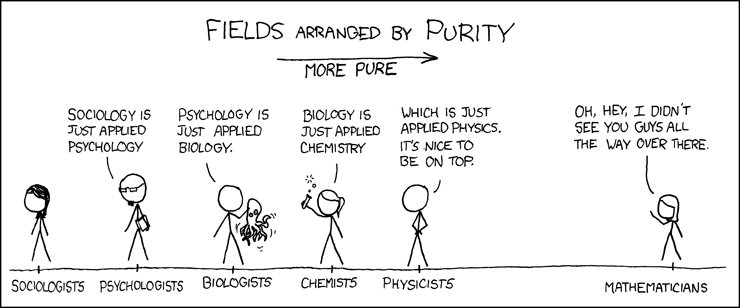
Image courtesy of XKCD.com (to read it is to love it)
Helping students discover fundamental concepts in math is a wonderful experience for all involved, yet as Lockhart himself admits, this can take a long time. Sometimes I cannot wait, I have things I want the student to use the math and the understanding can come afterwards. You see for me, math is both a beautiful thing but also a tool to be used. One can use an Arduino to create amazing things without understanding all of the design, science, and math behind it (in fact that was a part of its design), one can participate in the building of an FRC robot while learning along the way (it was similarly designed this way).
In the same way, the Pythagorean theorem can be tremendously valuable long before its understanding of how or why. While some would rail against this use before understanding, I find that it encourages motivation, play, and also progress. Often Math/Science teachers tell me that they never have the time to get to programming math because they are so busy trying to have them understand it before they can apply it. In my mind you will never get there in the unfortunately short amount of time we have students each day/year.
In my opinion, to try and teach understanding before application will often time go over student's heads and not stick in their minds in the long term. I would love to see what classrooms could accomplish if they were to start using math right away to build, create, derive, etc. Understanding would come but it would come from the student's aha moments and play.
In the same way, the Pythagorean theorem can be tremendously valuable long before its understanding of how or why. While some would rail against this use before understanding, I find that it encourages motivation, play, and also progress. Often Math/Science teachers tell me that they never have the time to get to programming math because they are so busy trying to have them understand it before they can apply it. In my mind you will never get there in the unfortunately short amount of time we have students each day/year.
In my opinion, to try and teach understanding before application will often time go over student's heads and not stick in their minds in the long term. I would love to see what classrooms could accomplish if they were to start using math right away to build, create, derive, etc. Understanding would come but it would come from the student's aha moments and play.
A car mechanic learns by playing and experimentation because often the manuals and experience fail to explain a problem, but a mechanic who has no basic understanding of the car, is just tinkering in their garage and is likely to break something. More so in the medical field where it would be grossly unethical to operate without understanding. On the job training is in my opinion the best there is but it is worthless if there is no foundation of skills.
Project based learning requires that we dive in and learn as we go but we must also have a skill set to build upon. At the beginning of the year, I am limited by what projects I can do with students because of their limited math, technology, and critical thinking skills. But as these grow throughout the year, I find them more and more able to do and create. By throwing them into the deep end and saying figure this out, they gain a mastery more quickly than a stepwise process would.
The pure math/applied math debate rages on even within the upper echelons of the math community as does the one over the superiority of theoretical and experimental science. What has been proven time and time again is that some gravitate towards a side but the community is stronger because of both. I can't imagine a class where my students constructed everything from first principles and derived and discovered all math/physics as that would seem to me to be too slow a pace and not my style of learning. Yet, a year spent only applying equations mindlessly would similarly leave the students at a disadvantage.
I don't struggle with the balance, I seek quality. As Allison mentioned in her post, I get frustrated by those who rabble rouse and say that teachers are doing it all wrong but don't provide any steps to improve. If your class is so amazing then share in detail. Don't just post on your blog, "My students are engaged and discuss math like Euler and Gauss reincarnate." Post the lesson, the dialog, a video, something! I know we cannot replicate another's teaching exactly because that depends on the context, relationship, style, etc. But, at least give us something to work with and inspire instead of just tearing others down.
I agree more than anyone else, that things need to change for the better. What I am unwilling to do is cut down the efforts of hard working passionate people (like the Khan academy) because their work is in its infancy or is being misused. I am also similarly frustrated with those who call for reform but provide no resources or ideas. If a teacher is online and reading blogs, that is a good thing and they should come away equipped and supported not guilt ridden. If there is something that needs correcting or calling out, then by all means do it, but it should always be coupled with resources or ideas on how they can improve.
Finally, lets all remember what has been said about opinions. No matter who you are or how popular your blog, always remember that there is more than one way to teach "right". If your background is in pure math, then teach that with passion and your students will love it; if it is in the application of it (e.g. engineering) then likewise do that. Students love passion and while we should seek balance, if you are bored or confused, your students will be likewise. But let's please stop name calling and using superlatives. If someone's math or teaching looks weird and different to yours, learn from them but stop saying it "isn't math" or that they are "destroying critical thinking" at least unless you are willing to provide evidence or support to other teachers to help them see your side.
Subscribe to BrokenAirplane and keep up with all of the latest education and technology resources!
The pure math/applied math debate rages on even within the upper echelons of the math community as does the one over the superiority of theoretical and experimental science. What has been proven time and time again is that some gravitate towards a side but the community is stronger because of both. I can't imagine a class where my students constructed everything from first principles and derived and discovered all math/physics as that would seem to me to be too slow a pace and not my style of learning. Yet, a year spent only applying equations mindlessly would similarly leave the students at a disadvantage.
I don't struggle with the balance, I seek quality. As Allison mentioned in her post, I get frustrated by those who rabble rouse and say that teachers are doing it all wrong but don't provide any steps to improve. If your class is so amazing then share in detail. Don't just post on your blog, "My students are engaged and discuss math like Euler and Gauss reincarnate." Post the lesson, the dialog, a video, something! I know we cannot replicate another's teaching exactly because that depends on the context, relationship, style, etc. But, at least give us something to work with and inspire instead of just tearing others down.
I agree more than anyone else, that things need to change for the better. What I am unwilling to do is cut down the efforts of hard working passionate people (like the Khan academy) because their work is in its infancy or is being misused. I am also similarly frustrated with those who call for reform but provide no resources or ideas. If a teacher is online and reading blogs, that is a good thing and they should come away equipped and supported not guilt ridden. If there is something that needs correcting or calling out, then by all means do it, but it should always be coupled with resources or ideas on how they can improve.
Finally, lets all remember what has been said about opinions. No matter who you are or how popular your blog, always remember that there is more than one way to teach "right". If your background is in pure math, then teach that with passion and your students will love it; if it is in the application of it (e.g. engineering) then likewise do that. Students love passion and while we should seek balance, if you are bored or confused, your students will be likewise. But let's please stop name calling and using superlatives. If someone's math or teaching looks weird and different to yours, learn from them but stop saying it "isn't math" or that they are "destroying critical thinking" at least unless you are willing to provide evidence or support to other teachers to help them see your side.
Subscribe to BrokenAirplane and keep up with all of the latest education and technology resources!
New Frontiers of Learning and Old Ways of Thinking
When I was in college, I asked if I could take a class online because my wife was a flight attendant at the time and I only saw her once or twice a week. They placed me in the online learning class and it was the silliest thing I had ever experienced. Basically, we watched (or were supposed to) a video of the lecture and then answer some multiple choice questions afterwards. I soon found out that the questions after the video were extremely simple and could be found from a quick reading of the textbook which for me at least was better than sitting through a 90 minute video.
 Contrast this with my experience as an Electrician in the US Navy's Nuclear Power program. After taking classes for a year or so, we are transfered to the "Prototype", a permanently moored (docked) submarine where we can learn and apply our knowledge before going out to the fleet. This involved spending about one-third of your time reading the T-manuals aka textbooks, one-third in the boat finding the equipment and learning on it, and one third in front of a computer being assessed on your knowledge. Meanwhile you also met with a mentor who would actually sign you off on your knowledge and test you as he/she felt necessary.
Blended learning, hybrid learning, or whatever else people are calling it, claim that organizing learning in this matter will change education. Here are some questions that one should ask when designing this type of environment:
1) Are you trying to teach the old stuff in a new way? This could work but it requires student motivation or it will have the same problems that you encountered when you did it the old way. Some tech advocates (salesmen), have been saying for the last 30 years that if you add a computer, students will do better. This is blatantly stated in some of their pitches but it is wrong. Boring is still boring. Technology has never been nor will it be the magic bullet or panacea for education's problems.
The Nuclear Navy has not updated their curriculum much in decades, but because we were all hand picked for our program and wanted to be there, we didn't care how old the boat or the textbooks were. This would apply to any program, think of your classrooms and how every time there are those few students who you wish you could clone. This is usually the difference between a college gen-ed class where everyone needs to be there and an upper division degree specific course.
2) If you are going to make your class online or at least assess it online, are your assessment questions able to be found by reading the book or Googling the answer? Are you ok with that possibility? I have the impression that my professor in college wanted me to watch the video, but if that was the case then they should have made the questions require more thought than just fill in the blank or put something into the lecture that was worth my time.
Many of you may have encountered annoyances with online learning. Yet, this is no more an indictment of online learning than sitting through a bad lecture is of direct instruction. This is not a technology problem as our Navy technology was outdated and the graphics looked about 20 years old, this is a pedagogy problem. If your class would be boring and ineffective in person, it will be even more so online because the human engagement is lost.
3) How can I best use the technology I have to enhance learning? I always say, that learning should be able to happen in a field in the woods or on a mountain. Technology is not needed to make learning occur. What technology is best at doing is automating or offloading repetitive or annoying tasks and facilitate fast retrieval or information or communication.
In my Navy Prototype Training, computers and books were our primary sources of learning. There were no lectures but we would form discussions with other students and train ourselves using good old whiteboards. When we had a question, instructors were there to clarify or deepen our understanding but we always had to come with a question. They were too busy for us to come up and say, "what are you going to teach us today". In the boat, we could learn via hands on one-on-one demonstration/application.
When we felt ready to be assessed, the computer would check for our basic level of understanding and then we could go to our advisor. They would have some more questions that could not be found directly in the book but had to demonstrate our understanding (e.g. what happens when this valve is open and you try and speed up the pumps?) The conversations were always frustrating because they would enjoy trying to stump us but we loved it nonetheless because it was a game.
4) Why do we need to know this? I know the arguments for a Liberal Arts education and yet I feel like our learning is so broad that students graduate with no mastery of anything. What job could a student get out of high school, or as Quinn puts it, "What survival value does high school have?" You might say, "Well that is why they need to go to college" but with the amount of learning available online, I bet we could do a lot more efficient job of learning with mentors helping clarify and support online learning.
There is no replacement for human interaction/discussion when learning, it's how we culturally evolved. The question is what role will humans play in learning with all of this information readily available for free? This is not a new question it is a rediscovery of old ways of thinking. Ancient peoples did not have school houses with lectures and curriculum, learning happened through exploration. Far from thinking that as a quaint or savage mode of learning, I think it is the key to unlocking our human potential for creating and innovating.
This does not replace teachers, it just changes our job description.
Subscribe to BrokenAirplane and keep up with all of the latest education and technology resources!
 Contrast this with my experience as an Electrician in the US Navy's Nuclear Power program. After taking classes for a year or so, we are transfered to the "Prototype", a permanently moored (docked) submarine where we can learn and apply our knowledge before going out to the fleet. This involved spending about one-third of your time reading the T-manuals aka textbooks, one-third in the boat finding the equipment and learning on it, and one third in front of a computer being assessed on your knowledge. Meanwhile you also met with a mentor who would actually sign you off on your knowledge and test you as he/she felt necessary.
Blended learning, hybrid learning, or whatever else people are calling it, claim that organizing learning in this matter will change education. Here are some questions that one should ask when designing this type of environment:
1) Are you trying to teach the old stuff in a new way? This could work but it requires student motivation or it will have the same problems that you encountered when you did it the old way. Some tech advocates (salesmen), have been saying for the last 30 years that if you add a computer, students will do better. This is blatantly stated in some of their pitches but it is wrong. Boring is still boring. Technology has never been nor will it be the magic bullet or panacea for education's problems.
The Nuclear Navy has not updated their curriculum much in decades, but because we were all hand picked for our program and wanted to be there, we didn't care how old the boat or the textbooks were. This would apply to any program, think of your classrooms and how every time there are those few students who you wish you could clone. This is usually the difference between a college gen-ed class where everyone needs to be there and an upper division degree specific course.
2) If you are going to make your class online or at least assess it online, are your assessment questions able to be found by reading the book or Googling the answer? Are you ok with that possibility? I have the impression that my professor in college wanted me to watch the video, but if that was the case then they should have made the questions require more thought than just fill in the blank or put something into the lecture that was worth my time.
Many of you may have encountered annoyances with online learning. Yet, this is no more an indictment of online learning than sitting through a bad lecture is of direct instruction. This is not a technology problem as our Navy technology was outdated and the graphics looked about 20 years old, this is a pedagogy problem. If your class would be boring and ineffective in person, it will be even more so online because the human engagement is lost.
3) How can I best use the technology I have to enhance learning? I always say, that learning should be able to happen in a field in the woods or on a mountain. Technology is not needed to make learning occur. What technology is best at doing is automating or offloading repetitive or annoying tasks and facilitate fast retrieval or information or communication.
In my Navy Prototype Training, computers and books were our primary sources of learning. There were no lectures but we would form discussions with other students and train ourselves using good old whiteboards. When we had a question, instructors were there to clarify or deepen our understanding but we always had to come with a question. They were too busy for us to come up and say, "what are you going to teach us today". In the boat, we could learn via hands on one-on-one demonstration/application.
When we felt ready to be assessed, the computer would check for our basic level of understanding and then we could go to our advisor. They would have some more questions that could not be found directly in the book but had to demonstrate our understanding (e.g. what happens when this valve is open and you try and speed up the pumps?) The conversations were always frustrating because they would enjoy trying to stump us but we loved it nonetheless because it was a game.
4) Why do we need to know this? I know the arguments for a Liberal Arts education and yet I feel like our learning is so broad that students graduate with no mastery of anything. What job could a student get out of high school, or as Quinn puts it, "What survival value does high school have?" You might say, "Well that is why they need to go to college" but with the amount of learning available online, I bet we could do a lot more efficient job of learning with mentors helping clarify and support online learning.
There is no replacement for human interaction/discussion when learning, it's how we culturally evolved. The question is what role will humans play in learning with all of this information readily available for free? This is not a new question it is a rediscovery of old ways of thinking. Ancient peoples did not have school houses with lectures and curriculum, learning happened through exploration. Far from thinking that as a quaint or savage mode of learning, I think it is the key to unlocking our human potential for creating and innovating.
This does not replace teachers, it just changes our job description.
Subscribe to BrokenAirplane and keep up with all of the latest education and technology resources!
Educational ARPA, Innovation from Within
A couple of weeks ago I saw an article about Obama's desire to create an ARPA for Education. For those of you not familiar with what an ARPA is, it stands for Advanced Research Projects Agency. This refers to a way of organizing research and directing funds towards certain projects. We have all benefited from ARPA projects, for example, a few Defense ARPA projects led to the Internet (ARPANET) and GPS to name a few.
ARPAs have a philosophy and structure that has made it highly successful and make it a perfect structure to help recreate education for the 21st century. Spurred on by this hope, I contacted the Department of Education about participating as a member of the ARPA-ED Network. There is some preliminary research and data collecting going on right now but awaits funding for FY2012. As this could take a while, I want to share my responses to some of the initial research questions. Feel free to leave your comments below.
This has required that I make the shift from being the one in charge of disseminating knowledge. There are books, videos, resources that have already explained this well and I am wasting my students time to lecture on one single topic when they could learn multiple topics in the same amount of time. I am more than happy to shift roles as it has allowed me to work one-on-one with my students and get to know them and their strengths in math. This would have been extremely difficult if not impossible in a traditional math class.
Another technology that I and my colleagues have found useful is the use of teacher created video tutorials. Sometimes the resources out there are not relevant or high enough quality to what you are trying to teach. Through the use of free software like Camstudio and ingenuity, we have created video tutorials on art, computer software, programming, robotics, math, physics, and more. These videos allow us to create the lesson once and then share it with students to watch at home or in class while we can help others work on projects that apply and deepen their understanding without having to waste time repeating ourselves.
The most important factor in implementing technology is using it to accomplish what was not possible before instead of doing the same thing in an new way. It is silly to think of using a cell phone while standing right next to the person and it is similarly non-sequitur to use the amazing software/hardware at our disposal to teach the same way we did for the last hundred years. My colleague and my classrooms look very different from other classrooms, technology is used to allow students to learn at their own pace and teachers assist them one-on-one to achieve full differentiation. Students are guided by their passions and use their skills the achieve personal and common goals.
If more real world justification is needed, consider that professionals (e.g. doctors, engineers, architects, mathematicians) are not expected to remember everything or even to know everything. As Seymour Papert said, “Those who succeed in their field, will not be those who know everything, but know where to find everything.” Think of what could happen if as Conrad Wolfram suggested, we spend our time applying and creating instead of just learning how to calculate. If we shift our efforts towards application and mastery instead of memorization and recal, we can powerfully shift how our students time is used and what they are able to do.
What are undiscovered networks where innovation in learning is occuring?
Whether it is programming, welding, sewing, painting, robotics, or anything else, makers will find no shortage of resources, videos, instructions, and more keep everyone learning all of the time. This is seen most vividly at the yearly events Maker Faire and pwn2own. Communities like these participate in what are called infinite games where “everyone wins” by helping each other and it never ends.
These communities are driven by a strong view on the openness of information. Usually what is created has an open source licence from the creative commons or GNU. The goal is to share in order that others may improve it. This mentality would be helpful for education. Those who have blogs and twitter are sharing as much as they can, but there might be more out there that is even better.
There are clusters of communites and groups who are contributing to this goal. Open Education Resources is one example, and there are a vast number of Personal Learning Networks via Twitter, Ning, Facebook, and Google Groups. The problem is helping them to talk to each other. It is my opinion that the resources are out there the people just haven’t connected yet.
Are there opportunities for students to participate in opportunities to crowdsource and learn and be a part of projects bigger than themselves?
Absolutely, and if there are not any that specifically interest them, the tools are more available than ever for them to create new ones.
Some examples are listed here. But there is no reason why learning opportunities have to occur online. There may be all of the resources necessary but the necessary people are not connected. In fact there are numerous reasons why it would be best to encourage students if possible to connect with others in their community to participate in learning. Strengthening the communal bonds and sharing resources has always proven to be a powerful force for good. Meetup and Kickstarter are excellent resources for connecting communities for learning opportunities.
What steps could be taken immediately that would have a great impact for education?
 ARPA-ED Response by Phil Wagner is licensed under a Creative Commons Attribution-NonCommercial-NoDerivs 3.0 Unported License.
ARPAs have a philosophy and structure that has made it highly successful and make it a perfect structure to help recreate education for the 21st century. Spurred on by this hope, I contacted the Department of Education about participating as a member of the ARPA-ED Network. There is some preliminary research and data collecting going on right now but awaits funding for FY2012. As this could take a while, I want to share my responses to some of the initial research questions. Feel free to leave your comments below.
How can we implement technology in the classroom effectively?
Proposal:
- Shift purpose of classroom from learning content to application and mastery.
Justification:
Over the last 30 years there has been a great push for technology to enter the classroom. It was believe that it would transform education as it was transforming society. Yet, the expected gains did not show up and we have not seen the increased learning and engagement that was hoped for.
It is easy to say that not enough was done, that we had too few computers/technology in the classroom and that the problem was simply funding. This has been the mentality for years but even as the market has caused a considerable drop in the cost of technology the issues stay the same. I have had the pleasure of teaching at some of the finest schools in the country with 2:1 computer ratios, the newest in interactive software/hardware, and yet many classrooms looked exactly as they did before the technology.
The reason technology has not had a transformative effect in our classrooms is because there has not been a shift of the paradigm for education. Technology has made it possible for us to look up any fact, equation, article, or video in seconds and yet we spend the majority of our time teaching students to calculate and remember content.
If that time was spent applying and using that time to apply and deepen their understanding then there would be dramatic gains in our schools. One technology that has helped to transform my math classroom has been ALEKS and the Khan Academy. These resources provide students the opportunity to learn math at their own pace. They can use the explanations, video tutorials, and the Internet to help them understand and I step in to provide one-on-one tutoring when necessary.
The reason this has made such a dramatic impact in my class is for multiple reasons. Students’ anxiety is reduced as the curriculum moves at a pace and level that is appropriate for them. If they are confused there are numerous resources at their disposal and they sit themselves in groups to support one another. This teaches them the valuable skill of learning how to learn. It also requires that they take charge of their own learning and empowers them to go as fast as they want. Over ⅓ of my students have completed the California Algebra standards and have graduated to the Geometry curriculum with some preparing to move into third year Algebra before completing their Freshman year.
This has required that I make the shift from being the one in charge of disseminating knowledge. There are books, videos, resources that have already explained this well and I am wasting my students time to lecture on one single topic when they could learn multiple topics in the same amount of time. I am more than happy to shift roles as it has allowed me to work one-on-one with my students and get to know them and their strengths in math. This would have been extremely difficult if not impossible in a traditional math class.
Another technology that I and my colleagues have found useful is the use of teacher created video tutorials. Sometimes the resources out there are not relevant or high enough quality to what you are trying to teach. Through the use of free software like Camstudio and ingenuity, we have created video tutorials on art, computer software, programming, robotics, math, physics, and more. These videos allow us to create the lesson once and then share it with students to watch at home or in class while we can help others work on projects that apply and deepen their understanding without having to waste time repeating ourselves.
It is important that students be able to connect to the world of information and diverse learners in order to succeed in a 21st century curriculum. We have found Google Apps for Education to be a powerful force for leveling the playing field. It has provided our students a way to communicate in real-time as well as asynchronously, gather data, collaborate and refine each other’s work, and so many other features that make it feasible for all learners to participate in the wealth of resources in our age. As for the teachers, it has dramatically decreased the amount of paper we need to use, increased parent-teacher communication and other time saving features that allow us to focus on students.
The most important factor in implementing technology is using it to accomplish what was not possible before instead of doing the same thing in an new way. It is silly to think of using a cell phone while standing right next to the person and it is similarly non-sequitur to use the amazing software/hardware at our disposal to teach the same way we did for the last hundred years. My colleague and my classrooms look very different from other classrooms, technology is used to allow students to learn at their own pace and teachers assist them one-on-one to achieve full differentiation. Students are guided by their passions and use their skills the achieve personal and common goals.
According to Thomas Kuhn’s study of paradigm shifts we are at the tipping point where there are a critical mass of people who are ready to leave the antiquated mode of teacher/learner into a new way of doing things but they are unaware of how they can do so. There is not necessarily a need for more technology but support and training in how to do new things. Educators have made amazing innovations and advanced in student learning for the last 30 years with technology but society was not ready for it nor was it cost effective. With the amount of free and open source technology, there has never been a better time to implement technology in the classroom. The question is what would the 21st classroom look like?
What are barriers to differentiated learning?
Proposal:
- Phase out grade levels based upon student age. Older students can train the younger students while still challenging themselves.
- Have learning be not only relevant but efficacious. Participating in research, projects, apprenticeships, programs that result in an actual outcome.
- Have classrooms become global connection points to the world wide learning community. Using information freely available and social networking, work together to study and accomplish more than possible in one classroom with one teacher.
- Modify universal curriculum provided to all students and retool it towards mastery. The idea of the liberal arts degree where all students learn everything in order to become cultured and cosmopolitan has become too far removed from applicable skills towards innovation and job skills.
Justification:
When I spoke to a colleague about this issue I likened it to the cars at Disneyland’s Autopia, there is a control of how fast or slow you can go but there is very little control over what direction you can go, there is only one track. For much of our classrooms, we are only empowered to modify the pace of the curriculum. All have encountered the student who simply does not seem to care. They never speak in class, nor turn in work, we fear the worst for their future and some of us even give a chance to make up work for credit or modify the amount of work. Anything to keep this student from missing out on life.
If we were to follow that student outside of the classroom we would see a very different person. We would likely be amazed at how his demeanor changes when he is not in a classroom. Lets move into this student’s future. He/she has found a niche for themselves and perhaps even enjoys what they do. They are good at what they do, otherwise they would not have applied for the job nor would they likely keep it. The question is why could the education not support and help this student?
In biological evolution, diversity equals strength. The more species our planet sustains, the more healthy our ecosystem is. It can continue through any cataclysmic disaster or even slight changes in climate. Our educational system however does not support a diversity of learning. I appreciate what Rick Lavoie tells teachers concerned about their struggling students, “High school is the only place in life where you need to succeed in everything.”
Imagine if a student’s passions/abilities were able to guide their path of learning. What kind of students would graduate from a place where they had spent 10-20 years mastering skills that they were motivated and successful at. What kind of innovation and creative society would it be? This is not just an issue of the human but an economic and societal one as well.
If we look at our education system it is highly redundant and inefficient. Teachers teach everyone the same thing multiple times a day and then repeat themselves all over again next year with a new group of students. This is not how any major company or research facility operates.
- Differentiated learning is more than just modifying the speed or amount of work a student does. It is a curriculum that works for the student and is aligned with their interests and goals.
- Differentiated learning is difficult when all students are required to take the same standardized test. Any attempt for students to pursue other valid interests will hurt the school’s report card/test scores.
- Removing grades determined by age range will allow students to teach new students while deepening their own understanding. This mirrors the role that many graduate students take with undergraduate classes. The teachers role is then freed from that of content dissemination into mentoring and 1-1 support.
I realize this is an seemingly overwhelming task, but it can actually be implemented tomorrow with little cost. Much of these concepts can be found in other countries with higher rates of education for less cost per student. I know this can work in the United States because it is already happening around the country with after school programs. For example in my robotics team it is student run/driven with a teacher acting as a mentor and guide. The team has been very successful and in addition to success within the robotics competitions, they have:
- Developed Android Applications
- Learned how to program in C, Python, and Java
- Implemented a marketing and business plan generating $30,000/year.
All of which could not have occurred in a traditional class. Nor would we have been able to because it required students highly motivated towards STEM and Business. However, I have witnessed my colleague in his Graphic Novel Project do similarly amazing things with art, graphic design, and business. I believe that if there was enough diversity, everyone would find a niche in which they could be highly successful and learning towards mastery.
Students could pursue their passions in a way that fosters innovation and works with their natural motivation and interests. Organized in this fashion, classes could go even more in depth into the content because everyone there is interested and pursuing that field.
Colleges would be able to accept students that are more highly trained and have actual experience. My robotics students speak with engineers as peers, explaining their design and understanding the feedback they receive. They are accepted to engineering programs that understand that these students have already traveled around the country and had experience in their field.
Students are not expected to have a job or financial constraints until much later in life. This allows them the freedom to try new things, travel, take risks and fail where they might not be able to later in life. This would raise the bar of what is possible from a citizen entering the workforce.
It would empower students and take students from being receivers of information to creators. Teachers’ roles would change and instead of spending all of their time creating motivating ways of delivering content (e.g. lectures, worksheets, labs, projects) and then assessing the short term retention of it, they could move into mentorship and support roles. This I believe is the true reason why teachers joined this profession.
If more real world justification is needed, consider that professionals (e.g. doctors, engineers, architects, mathematicians) are not expected to remember everything or even to know everything. As Seymour Papert said, “Those who succeed in their field, will not be those who know everything, but know where to find everything.” Think of what could happen if as Conrad Wolfram suggested, we spend our time applying and creating instead of just learning how to calculate. If we shift our efforts towards application and mastery instead of memorization and recal, we can powerfully shift how our students time is used and what they are able to do.
What are undiscovered networks where innovation in learning is occuring?
Overview:
- There are huge communities of people learning organically that could be quickly adopted by the larger education system.
- The largest manifestation of this is in the Maker/Hacker community as they use the Internet as their classroom and connect on a constant basis to support, share, and inspire.
I believe the best way for us to learn how to innovate in education is to watch successful learning communities where people voluntarily learn and support each other in creating. One huge community that grows larger everyday are the Maker/Hacker community. These groups of people teach one another both online and in person.
Whether it is programming, welding, sewing, painting, robotics, or anything else, makers will find no shortage of resources, videos, instructions, and more keep everyone learning all of the time. This is seen most vividly at the yearly events Maker Faire and pwn2own. Communities like these participate in what are called infinite games where “everyone wins” by helping each other and it never ends.
These communities are driven by a strong view on the openness of information. Usually what is created has an open source licence from the creative commons or GNU. The goal is to share in order that others may improve it. This mentality would be helpful for education. Those who have blogs and twitter are sharing as much as they can, but there might be more out there that is even better.
There are clusters of communites and groups who are contributing to this goal. Open Education Resources is one example, and there are a vast number of Personal Learning Networks via Twitter, Ning, Facebook, and Google Groups. The problem is helping them to talk to each other. It is my opinion that the resources are out there the people just haven’t connected yet.
Are there opportunities for students to participate in opportunities to crowdsource and learn and be a part of projects bigger than themselves?
Absolutely, and if there are not any that specifically interest them, the tools are more available than ever for them to create new ones.
Some examples are listed here. But there is no reason why learning opportunities have to occur online. There may be all of the resources necessary but the necessary people are not connected. In fact there are numerous reasons why it would be best to encourage students if possible to connect with others in their community to participate in learning. Strengthening the communal bonds and sharing resources has always proven to be a powerful force for good. Meetup and Kickstarter are excellent resources for connecting communities for learning opportunities.
What steps could be taken immediately that would have a great impact for education?
- Create a culture of cyclical relationships between businesses and school.
- Internships and apprenticeships inspire and improve the future workforce.
- Mentoring of school programs.
- Examples include Google summer events, Connect a Million Minds
- Encouraging the adoption of Open Source software to reduce cost and allow students to have the ability to work from home.
- Implement differentiated programs like Khan Academy, ALEKS, etc. Not to eliminate the need for a teacher (which these software could not do anyway) but change their role into one of support and mentor.
- Create a socially connected repository of high quality projects, labs, lessons, and assignments where educators could share and provide feedback to other teachers.
- Educators share ideas for feedback, to inspire others, and share quality concrete curriculum which other teachers could use immediately.
- Other educators can provide feedback and have a rating system to help the best ideas rise to the top.
- Students, parents, and others can learn independently as well.
- Some of the best implementations of this can be found at Instructables, All Recipes, YouTube, CK-12.
- Create a show that inspires students to pursue STEM. Don Herbert was Mr. Wizard, then there was Bill Nye and Paul Zaloon as Professor Beakman.The current generation has more tools and resources at their disposal than ever yet no hero or guide to follow.
- Make TV shows a lot of promise in inspiring others but is missing that hook to bring in a larger audience.
- Adam and Jamie of the Mythbusters are highly motivating but for safety reasons do not teach how to do what they do.
- There are many videos online that people can learn from. A show that brought in the best teachers from around the country and gave them the resources and platform to teach many would be inexpensive and inspiring as it would create local celebrities as well as organically kickstart local movements.
Subscribe to:
Posts
(
Atom
)