Showing posts with label teachers. Show all posts

Keeping Plates Spinning is The Best Part of The Job

A couple of years ago, someone asked me if Robotics could be done in a hybrid learning environment. Could we do a hands-on project with a combination of virtual meetings as well as physical meetings. At the time, I didn't have a great answer because I had no reason to explore the possibility. I was running my robotics team and focusing on doing everything possible to help the team do well.

That changed this year when I decided to take a year to go work for Google. My student robotics president looked at me with horror as I told her the news that I would not be there next year. Then after a minute of thought she said, "Oh wait, never mind we'll be fine." It was a fulfillment of something I tell my leadership team all of the time, "I will have done my job when you no longer need me."

This was the ultimate test, could they succeed without their teacher being there with them everyday? Let me start by defining success for my team. I know many mentors who's goal in life is for their robotics team to win, win, win! I want the best robot our team can possibly make but that is not my only focus as their mentor. My goal is to help them fulfill their goals and make their dreams possible.

That looks different for each student and it is my job to help them find it and then work with intense fervor to make it possible for them. Mentoring each student individually is what I call it keeping plates spinning because it is exciting, requires one to see the big picture, and also focus on each individual. Some of my students want to go into a STEM related job, but others want to be businesspeople, graphic designers, teachers, and the list goes on. If you visit my team there are many different projects going on at once. That is because if I find someone who I think I can mentor I find a niche for them on the team because it is not just about building robots, it is about building people.

I am so grateful that Lisa Davis is able to serve as the physical mentor watching out for the well being of the team while also helping them explore and grow in marketing, entrepreneurship, and service learning. If she was not willing to take on the additional responsibilities this year, there would be no team. It would have been impossible for me to virtually mentor the team a few years ago but with daily emails and weekly Google+ Hangouts I can talk to my team and support the individuals.


All year long I am looking at students to see where they have areas to grow. My decisions on who should lead our team are not necessarily based on who is a "leader" on the team but who could become a leader. Each of my presidents have been shocked when I asked them to step up but each time they have exceeded all expectations.

Presidents are chosen in their Sophomore year. I let the current president know who I have chosen and they usually disagree with me. That's ok, I have expected and planned for this. I don't select for talent but potential.

The reason the student is chosen in the Sophomore year is so they can serve as President in their Junior year while being mentored by the previous President who's now in their Senior year. When others teams chose their seniors to be leaders, the skills and lessons are lost each year. With this process, the previous President can spend the whole year reflecting on the experience helping the new President through their struggles.

This has resulted in an ever increasing improvement in our team and what it is able to achieve. I also select Presidents based upon what they are able to learn from the outgoing President and vice versa. Sometimes it is humility, or organization skills, maybe public speaking skills. I have the luxury of focusing on helping people grow.

Could we not do this with mainstream education? Teachers are repeating themselves multiple times a day, and again each year for 40+ years. This is horribly inefficient, let students teach students and have the teacher support the process. The inexperienced students will learn more easily from their peers and the teacher can look for ways to challenge the tutors and grow in their own understanding. Imagine advanced classes happening concurrently with regular classes within the same classroom!

Subscribe to the BrokenAirplane blog to keep up to date with all things awesome in education!

Stop Saying I Don't Know to Student's Questions

Make everything as simple as possible, but not simpler - Albert Einstein

The above quote is the challenge of every science teacher. My professor once told me that Einstein would walk up to people on the street to tell them about his theories and if he was unable to explain it to them or answer their questions sufficiently, then he felt he did not understand it well enough himself.

I am a big fan of the Mythbusters as well as books like There Are No Electrons which show us when our conceptual models are too limiting to our understanding. So when David Rudel, editor of the excellent ExploreLearning site (home of the awesome science Gizmos) asked me to review his book Science Myths Unmasked, I couldn't wait to check it out. I have to say I was not disappointed, in fact I would have written this review sooner but I was enjoying the book too much to stop.

Science Myths Unmasked takes the most common experiments and models that every middle and high school student encounters.  In Vol 1: Earth and Life Science, Rudel challenges some of the big questions that teachers encounter every day from students.

If you have ever had students question the genetics and evolution curriculum they are right to do so. Textbooks ask students to go from Mendel's pea pods and variation within the species to evolution into new species which leaves them wondering how Dominant and Recessive genes can accomplish this. With clarity and research to back it up, the book explains how evolution can occur as well as the modern viewpoints on the mechanism for evolution.

There are many other topics covered in the book like:
  • How do clouds form?
  • Why do my veins appear to be blue?
  • What is the "greenhouse effect"
These topics are those that keep coming up in classrooms and from our own children, unfortunately the canonical explanations are often half true or completely false (the blood in your veins is not blue). These books read like a mystery novel rather than a textbook and you will find it hard to put it down.

I especially enjoyed Vol 2: Physical Science, having spent time as a 8th grade physical science teacher. Students are wonderfully skeptical and with encouragement will have no problem speaking out about it. When something doesn't match their view of reality they must ask WHY?

Unfortunately, our textbooks in an attempt to make things simpler often omit or erroneously explain natural phenomena. I have reviewed most of the textbooks out there and there is always one or two places where I reread a paragraph over and over because it just doesn't seem right.

I must admit there were a couple of times in Rudel's book where I thought, "Oh that's why, that never made sense before!" I too have misconceptions that I have explained away and it has been a great week to reaffirm and test my own understanding of Physics.

Some of the explanations include:
  • Why does the water in an overturned jar rise when the candle inside burns out?
  • Does electricity only flow in a "closed circuit"?
  • What do we mean when we say a wave of light and why do we draw a sine wave to describe it?
The best part about these books is how accessible they are. They contain no additional math and the descriptions are clear enough to be read by anyone with an inquisitive mind. Rudel takes all of the questions teachers and textbooks sweep under the rug and finally bring them to light.

If you go to the book's website, you can download sample chapters. At the price these books are being offered, they make a great gift for the science teacher in your life.


Connect with BrokenAirplane on Google+, Twitter, and Facebook.

Math As Jazz - Applying and Using it as a Tool

For me there is no better friend than one you can have great discussions with. I swear this was being written before Allison (of Infinigons) and I talked today, but having the discussion with her about it really allowed me to understand my own position better. Nonetheless, this was one of my more difficult posts to write because there are so many sides to it.

When I think of some of my favorite math bloggers/writers I can sense their frustration with how math is currently taught. Some refer to the "dumbing down of the curriculum", others say that rote memorization and skills are emphasized over understanding. In the incredible Lockhart's Lament, the loss of rhetoric, proof, and play with mathematics in schools is mourned for.

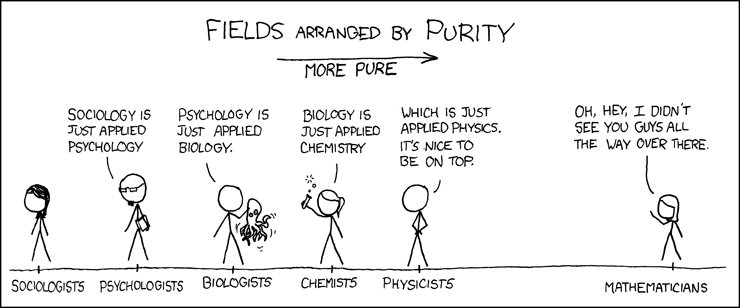
Image courtesy of XKCD.com (to read it is to love it)

Helping students discover fundamental concepts in math is a wonderful experience for all involved, yet as Lockhart himself admits, this can take a long time. Sometimes I cannot wait, I have things I want the student to use the math and the understanding can come afterwards. You see for me, math is both a beautiful thing but also a tool to be used. One can use an Arduino to create amazing things without understanding all of the design, science, and math behind it (in fact that was a part of its design), one can participate in the building of an FRC robot while learning along the way (it was similarly designed this way).

In the same way, the Pythagorean theorem can be tremendously valuable long before its understanding of how or why. While some would rail against this use before understanding, I find that it encourages motivation, play, and also progress. Often Math/Science teachers tell me that they never have the time to get to programming math because they are so busy trying to have them understand it before they can apply it. In my mind you will never get there in the unfortunately short amount of time we have students each day/year.

In my opinion, to try and teach understanding before application will often time go over student's heads and not stick in their minds in the long term. I would love to see what classrooms could accomplish if they were to start using math right away to build, create, derive, etc. Understanding would come but it would come from the student's aha moments and play. 

A car mechanic learns by playing and experimentation because often the manuals and experience fail to explain a problem, but a mechanic who has no basic understanding of the car, is just tinkering in their garage and is likely to break something. More so in the medical field where it would be grossly unethical to operate without understanding. On the job training is in my opinion the best there is but it is worthless if there is no foundation of skills.

Project based learning requires that we dive in and learn as we go but we must also have a skill set to build upon. At the beginning of the year, I am limited by what projects I can do with students because of their limited math, technology, and critical thinking skills. But as these grow throughout the year, I find them more and more able to do and create. By throwing them into the deep end and saying figure this out, they gain a mastery more quickly than a stepwise process would.

The pure math/applied math debate rages on even within the upper echelons of the math community as does the one over the superiority of theoretical and experimental science. What has been proven time and time again is that some gravitate towards a side but the community is stronger because of both. I can't imagine a class where my students constructed everything from first principles and derived and discovered all math/physics as that would seem to me to be too slow a pace and not my style of learning. Yet, a year spent only applying equations mindlessly would similarly leave the students at a disadvantage.

I don't struggle with the balance, I seek quality. As Allison mentioned in her post, I get frustrated by those who rabble rouse and say that teachers are doing it all wrong but don't provide any steps to improve. If your class is so amazing then share in detail. Don't just post on your blog, "My students are engaged and discuss math like Euler and Gauss reincarnate." Post the lesson, the dialog, a video, something! I know we cannot replicate another's teaching exactly because that depends on the context, relationship, style, etc. But, at least give us something to work with and inspire instead of just tearing others down.

I agree more than anyone else, that things need to change for the better. What I am unwilling to do is cut down the efforts of hard working passionate people (like the Khan academy) because their work is in its infancy or is being misused. I am also similarly frustrated with those who call for reform but provide no resources or ideas. If a teacher is online and reading blogs, that is a good thing and they should come away equipped and supported not guilt ridden. If there is something that needs correcting or calling out, then by all means do it, but it should always be coupled with resources or ideas on how they can improve.

Finally, lets all remember what has been said about opinions. No matter who you are or how popular your  blog, always remember that there is more than one way to teach "right". If your background is in pure math, then teach that with passion and your students will love it; if it is in the application of it (e.g. engineering) then likewise do that. Students love passion and while we should seek balance, if you are bored or confused, your students will be likewise. But let's please stop name calling and using superlatives. If someone's math or teaching looks weird and different to yours, learn from them but stop saying it "isn't math" or that they are "destroying critical thinking" at least unless you are willing to provide evidence or support to other teachers to help them see your side.

Subscribe to BrokenAirplane and keep up with all of the latest education and technology resources!

Highly Qualified Teachers - Why We Struggle to Get and Keep Them

My wife found this on Facebook, I think it is worth your time:

Are you sick of highly paid teachers? Teachers' hefty salaries are driving up taxes, and they only work 9 or 10 months a year! It's time we put things in perspective and pay them for what they do -babysit!

We can get that for less than minimum wage. That's right. Let's give them $3.00 an hour and only the hours they worked; not any of that silly planning time, or any time they spend before or after school. That would be $19.50 a day (7:45 to 3:00 PM with 45 min. off for lunch and plan--that equals 6 1/2 hours).

Each parent should pay $19.50 a day for these teachers to baby-sit their children. Now how many students do they teach in a day...maybe 30? So that's $19.50 x 30 = $585.00 a day. However, remember they only work 180 days a year!!! I am not going to pay them for any vacations. LET'S SEE.... That's $585 X 180= $105,300 per year.


What about those special education teachers and the ones with Master's degrees? Well, we could pay them minimum wage ($7.75), and just to be fair, round it off to $8.00 an hour. That would be $8 X 6 1/2 hours X 30 children X 180 days = $280,800 per year. Wait a minute --there's something wrong here! There sure is! The average teacher's salary (nation wide) is $50,000. $50,000/180 days = $277.77/per day/30 students=$9.25/6.5 hours = $1.42 per hour per student--a very inexpensive baby-sitter and they even EDUCATE your kids!) WHAT A DEAL!!!!

After I stopped smiling, I gave pause to think of how much educators work and how disproportionately they are paid. For the level of education they are required to have, plus the planning, and the care (not babysitting) that they provide it is unnerving that my son's daycare provider makes more than I do.
The 19th - Early 20th century school teacher was single or the secondary earner and therefore was not considered to need much in salary. But the cost of living has dramatically shifted and the number of teachers who are the sole breadwinners has increased.
I am speaking from the perspective of a citizen of California but I have also taught in Colorado and have colleagues in Oregon who are experiencing a similar situation. There is a huge budget crisis both at the federal and state level and everyone who is employed should certainly be grateful, but if we look at others who serve in government they are making twice or more what teachers are making so the pain is disproportionate.


I should also mention that this is not a pro/anti union situation. Unions have done wonderful things in the past but they need to evolve as do all organizations or risk irrelevancy. Many good teachers have been let go in order to keep more expensive tenured ones. A person should continue to do a job as long as they are good at it. Yes, I know the definition of what a good teacher is right now frankly sucks, but as it has been said, you know it when you see it.
Another concern is that our student population is exploding and as more and more teachers are needed, the cost of raising their pay by even a few dollar is going to add millions to the state budget. More schools and teachers are needed all of the time because in the past students were only required to go to a few years of school, then it became mandatory for high school, and now college is all but required. Will graduate schools be next to face overcrowding?
Yet, at the same time, everyone is demanding higher quality teachers. Can we have it both ways? Faced with hundreds of thousands of dollars in student loans, will a well trained physics major go work for a corporation starting at $75,000+ or work for a school district making half of that? Many of us consider teaching to be a higher calling that we would do no matter the pay, but how many millions of other potentially great teachers are not in the classroom? Not out of greed, but with student loans, home prices, and perhaps quality of life being a factor it is easy to see why we might have difficulty filling the teaching jobs with the best suited for the job.

Here are a few of my thoughts:
  • Tenure is wrong for education. There should be a reasonable process for letting go of teachers who are doing a disservice to their students.
  • Now that I have ignited the firestorm, let me also say that there should be a well thought out common sense criteria for evaluating teachers. This cannot simply be student test scores for reasons that have filled many books. It should also be peer evaluation, student evaluation, portfolio of work, considering the possibility of political or personal bias, etc.
  • Teacher pay cannot sustainably remain a function of time and how many credit hours one has. Teachers do not necessarily get better with time or additional education (although many do). We should not be measuring the inputs but the outputs.
  • Many teachers are struggling to do well because of a lack of sharing. For some reason, many teachers feel reticent and guarded about what they are doing in their classrooms. As a result, new teachers are having to reinvent the wheel in terms of curriculum. Quality lessons, activities, projects, ideas should be shared out amongst colleagues but also on a global scale. 
    • I see no reason why we cannot pool our resources and have a voting/ranking system to identify which ones are the best. I have litterally terabytes of stuff that I have created or received from colleagues over a wide variety of subjects. 
    • If someone is interested in helping me develop a system where we can just mass upload and crowdsource this, so educators can vote for their favorites, let me know!
  • The responsibility of education should not simply be the burden of citizens but of corporations which have a vested interest in a quality workforce. There is an uneven benefit between shareholders and the public when a school helps a student become successful. While some companies are taking an interest in education, many reap the benefits without returning anything to support the source from which they came. 
    • Imagine what would happen if companies gave a portion of their profits to help improve the quality of education. While the knee-jerk reaction is to shun anything that seems like a tax on business, this is no different than R&D and investing in human resources. The difference is that this requires a vision that reaches far beyond quarterly profits. Yet the most profitable companies know that you must invest in the long term otherwise there will not be a long term. Targeted funding for proven methods would greatly improve the quality of education in our society which has been proven to contribute to overall quality of life.
    • But then again, the problems of education aren't tied to how much funding we have or don't have. If they were, we would have fixed them long ago.
If you are in a position to do something, then do it. I always tell my students, we have to take advantage of our freedom to choose before we lose it. We are quickly losing our ability to choose what our next steps are going to be, very soon it will be chosen for us, and not one of us will like it.

Subscribe to BrokenAirplane for the latest in Education Technology resources and news.

Stop Multitasking, Tips to Take Back Your Life

For as long as I can remember, I have felt a push to become better and better at multitasking. Between work, home, family, life we are taught that it is possible to have it all and do it well. I truly believed that I was capable and actually quite good at multitasking, but as I spend more time in reflection and meditation, I can tell that it is taking a toll on my body.

The fast paced life is a result of the life that we live, we were told that computers and technology would cut our 40 hour work week in half, but quite the opposite has occurred. We are more busy than ever, and while we are connected around the world, we certainly are more distracted.

I have noticed that I find myself more anxious and less willing to sit and enjoy myself doing nothing or simply being. Email, Facebook, Twitter, and other projects provide instant gratification that are not bad in and of themselves but create an addictive quality that can creep into other parts of your life.

New research has shown that multitasking is doing multiple things poorly. We have a hard time writing, reading, or simply working on a task for a long period of time because we are trained to switch between tasks frequently. This means that we skim articles and lose our focus while writing. The result is lower quality and less creativity as we try to get multiple tasks done in the same time it took us to do one.

These tools were not meant to become our masters and these things can be incredibly useful if used correctly and with proper boundaries. I have some suggestions from what has helped my life, these can be implemented immediately and I would encourage you to not delay.
  • Turn off notifications of new emails, tweets, messages, etc on your phone. There is a Pavlovian response that we can't help but look at our phone when we hear the ring or buzz.
  • When working on a task requiring your fullest attention and focus, remove all distractions (e.g. Internet, computer, phone, lock the door if necessary) so you can devote your fullest attention to what is necessary.
  • Set boundaries for yourself so your work life and home/social life do not become one. There is so much to do, believe me I know that, but you will lose vital time with your family/friends and valuable time for yourself if you do not stop taking work home with you. I enjoy my work very much, which makes it all the more tempting to work on it at home but if you don't draw the line somewhere, then when will you?
  • Put a limit on the number of tasks or projects you take on. Determine what you can comfortably do and stick with that. There will always be more to do, so you need to take control of your workflow.
  • Examine your life. Are there more efficient ways of doing your work? If you are an educator, are you assigning busy work that your students hate to do and you end up spending hours grading? I read an article about an efficiency expert who saved an office hours of wasted time because the printer was placed down the hall instead of near the desks. A little change can make a big difference.
Leo Babauta maintains the ZenHabits blog. His habits and insights are invaluable and he has recently condensed and solidified these ideas in his new book Focus. There is a free version, but the premium version gives you a lot more resources and benefits that may justify the cost for you.

We run the risk of becoming so connected and engulfed in our hairballs that we could lose our individuality. Each of you has so much to contribute as a person and should enjoy life and not simply live it. Those of you who say this is impossible because of your current situation must realize that you are not in control of what happens to you, but you are fully in control of how you react to it.

A deep breath  can do wonders and I encourage you to take a moment and step away from it all. Even a hectic life can maintain peace, but it requires focus. When you realize what is most important you will be able to find balance and peace. It will result in a happier, more creative you.

25 Tips for Teachers Both New and Experienced

I was asked at the beginning of the year to come up with my recommendations for new teachers. However, I think that this list is also useful as a reminder. If you do not work with tools, projects, or write comments to your students, feel free to substitute whatever applies to your classroom (materials, assignments, grades) as the principle is the same.


  1. Do not feel pressured to come up with the biggest and best projects. More does not always mean more learning and in my experience it can often mean less (or at least it is spread more thinly). You might think that your budget is huge but if you are not careful, you will find yourself halfway through the year without any money left.
    • You have two directions you can take a project:
      1. A big project that involves everyone - This can be cost effective (sometimes) but can also be a nightmare keeping everyone busy. There are ways to plan a project so everyone has something to do. However, it is most likely going to result in not every student learning the same thing.
      2. A bunch of smaller projects that groups or individuals are responsible for. - This could ensures that every student will learn what you are expecting but can cost a lot ($5/student is still about $250 for the project)
    • In my opinion the best projects find the balance between these two poles.
  2. Never create a project/assignment that isn't strong in content. You do not want to be halfway into a project and realize that you spent most of that time without much learning. 
    • The students and my favorite projects have been those which required the content to complete the project as opposed to simply a short design phase in the beginning and much of the time spent building or making.
  3. Purchase quality tools so you do not have to repurchase, then label and be diligent about checking them in and out. Especially around exhibition times, If you are bombarded with requests from students or other teachers to borrow your materials, it is always ok to say no or come back later when you can properly check out equipment.
  4. Feel free to ask for donations for materials, expertise, etc. Your parents and community will amaze you with what they can provide. However, if you are going to do it often or for a large amount make sure you consult your director/principal.
  5. I really appreciate these workbenches and how they help organize tools and materials in class. They can be made for any size and even be configured as shelfs. They are cheap and quick to build. Link to more technology I recommend to make life easier in the classroom.
  6. Sign up to undergo a project tuning (resource website) either officially or with another colleague. Even just casual conversations with others will generate new ideas and refine your project into something amazing. Do not believe that asking for help or feedback is a sign of weakness. We don't want our students to feel that way and neither should we.
  7. Create a system for clean up and spend the last 5-10 minutes of every class doing so. I have a rotating schedule of tasks with a student supervisor that works really well (link)
  8. Plan your entire year out. While that sound daunting, with exhibitions and projects, you do not want to run out of time. I would take the year schedule and make at least a block schedule of what concepts you would want to work with the students on and then you can fill it in more later. You will be grateful later for any planning you do in advance.
  9. Never assume that to do a project, you must "dumb down" or do not teach for depth of understanding. Always make sure your students understand what they are working on.
  10. It is ok to give homework, lecture, and test. We seek to be innovative but that does not mean that anything is forbidden when it is the best way of sharing/practicing/assessing skills and knowledge. Reflect upon how you were taught and how you can refine and improve that. 
  11. Ask for help from anyone and everyone, you will always find someone who will support you. It may feel like you are alone as you get swamped and busy but I can not say enough about how much you will grow to treasure and value your colleagues. Take a walk around the campus, walk into another teacher's classroom and be refreshed and inspired! If you do not feel like you are able to connect with your colleagues at school, connect with inspiring and sharing educators on Edutopia, Twitter, and other blogs. The Internet means no one is ever alone.
  12.  Work closely with your team teacher and members of your department. If you are able to create a cross curricular connection then all the better. The humanities and sciences have been separated in the classroom for far too long.
  13. If you have the chance to connect with students through a club, advisory, or otherwise; take advantage of it in every way possible. You have no idea how powerful an impact you can make on a student's life just by being interested.
  14. Start your final comments/grades early! The longer you put it off the less of a quality job you will do. I find that if you start early enough, divide the work by the number of days it is much easier. I would rather do a half-hour a day than 6 hours straight.
  15. Challenge your stronger students and support those who need it. The best way to do this is to keep an open dialog between you and your students to get their input as to what they need.
  16. Keep a class website and update it regularly so your Director/Principal and Parents can be well informed and support you.
  17. Imagine your students going to a well respected University. What do you want them to know? What would you like their Professors to say about your them? I love to go into Universities and see what great things they are doing, then I bring it back to my students so they can get a head start.
  18. Consider starting an after school program. You will not regret it.
  19. The Internet will fail, the computers might take a while to start up, and the printer/copier will jam/run out of paper/have a long line so always plan for that. With the copier/printer I always try and print everything out the day before so I am not stuck in the line 20 minutes before class.
  20. Take care of yourself. It is very easy to get overwhelmed and burned out so plan to take a break or a night off as often as you need to.
  21. Always keep a notepad or something where you can write down project ideas because they will come to you on a trip, at the museum, with friends, and at 2 AM.
  22. Phil's Law of Planning: However long you think a project will take, multiply that by 2 and then add a week. The only way to minimize this effect is with careful structured planning. Make clear your expectations to the students and give them clear steps on how they can achieve them.
  23. Have specific and high standards for their work. If they do not meet these standards, do not give up and move on, give them time to reflect and refine until they are proud of it.
  24. Allow yourself to fail. It is OK if your first project (or 20th) does not go well or is a total disaster. Reflect, refine, and move on.
  25. Most importantly, take time to get to know your students well. Teaching can either be a joy or miserable it is all in your daily perspective. I encourage you to enjoy every minute of it and remember what is most important.

If you have an additional tip that I didn't get to, would like clarification on one of them, or a resource mentioned, leave a comment, tweet, email, or Facebook and if you found it useful, share it on Digg, FB, or give it to a colleague who needs it.

SOS - Save Our Schools With After School Programs Part 3

Let me ask you to put aside any of your concerns with starting a program for a minute and ask you a couple of questions.

1) Are you really passionate about something like art, engineering, theatre, math, a foreign language, programming, etc?
2) Can you devote a couple of hours a week after school?
3) Do you believe that every student has potential to do great things?

If you answered yes to all of these, then I would encourage you to start an after school program! Your kids need you!

You might have doubts (I know I did):
  • I am not good enough to run a _______ team or group: 
    • You will never be able to keep up with your students desire to learn, all you can do is keep the energy high and support them. I had found this to be true no matter how learned you are, students just have too much imagination and energy.
    • The MorTorq robotics team was started by a woman who had no engineering skills but was excited and passionate about working with students.
    • This is how the Virtual World emerged in my robotics team. I found this software called Blender that while I knew nothing about, I gave it it to a couple of students who I thought might be interested. A couple of weeks later they had created a video game that the whole school wanted to play. There skills continued to grow until they were making huge virtual worlds and that is how the science festival came about.
  • There isn't enough money:
    • There are so many organizations and companies who want to give money to innovative and effective programs like yours. Do a Google search on "education grants" or grants for ______ and you will see that the list is huge. Additionally your community will love to support you whether it be a company seeking to create future employees or the pizza place down the street that will let you do a fundraiser, the money is there.
    • If you are lucky, you might have someone in your district who rights grants as part of their duties. Were it not for our own Lisa Davis helping us raise funds and support us, it would be impossible to do all that our team does.
So hopefully, you have the courage to start a team, so what do you need to do?

1) Find initial funding: If you are creating a robotics team you are looking at a few hundred dollars, if it is a painting club then it might be significantly less. I would check with your school, district, parents, and community. You never know who you will find that would be willing to help so be sure to ask anyone you can.
  • A note: many after school programs have disappeared because they relied to heavily on one source of funding. You should always seek to be self sufficient through donations and saving. This ensures that your program will always be around and not dependent upon other people's decisions.
2) Find support: After school programs can take a toll on your time. No matter how committed you are, it is important that you continue to be able to spend time with family, friends, and your primary teaching duties. While you might think that your program will only take a little time, ask any robotics teacher or Patrick Yurick of the Graphic Novel Project and they will tell you that once your program takes off it can take up as little or as much of your time as you will let it.
  • Ask fellow teachers or parents, you will be surprised at how many community members would love to help out. I have seen artists, engineers, college students, politicians, writers, even a Disney Imagineer and LAPD Bomb Squad member come to our rescue. Plus the students love to see outside people with real world expertise come and advise them.
3) Find a project: You may think that passion is enough to fuel a group of students but I can tell you it is otherwise. In my opinion, the sole determinant of the success of an after school program is having something to work toward.
  • For my robotics team it is the competitions, for the Graphic Novel Project it is publishing two Graphic Novels a year, for a theatre program it is the productions, for a Japanese club it might be a field trip downtown to order lunch or to the cultural center. Whatever it is, I would encourage you to find something and have it ready to announce to the students on the first day as this will help fuel the program.
4) Let the students be the fuel for the fire: If your goal is to get students excited about a field, discipline, idea then once you have given them the tools let them run with it. They will come in with new ways of doing things and innovate right before your eyes. 
  • When a few of my students 2 years ago made a video game in Blender, it took them 6 months. They then showed a couple of my Freshmen how to do it, and one of them ended up recreating the game in a couple of hours. Now the bar was raised and there was a huge new influx of energy into learning and creating.
  • However, I do caution you against letting them have complete control over the class. I have seen this happen and it either devolved into just hanging out or the project dragged on (deadlines, deadlines, deadlines). 
  • Have fun but keep it professional otherwise people might bring in their friends that just want to hang out as opposed to wanting to help the project. I have been firm about asking people to leave the program in order to protect it from those who just want a place to mess around.
5) Market yourself: Neglect this point at your own peril. I am grateful once again for Eileen Kahn teaching me the importance of marketing. This is not just for fundraising, you may be in a situation where your program is taking up resources (students, room space, materials, funding, etc) from others and if you do not constantly extol the importance of your program then people will not know that it is necessary to keep around.
  • Some ways of easily marketing yourself are youtube videos, a website, yearbook photos, Facebook/Myspace, appearances before the city council/school board, appearances at school events, newspaper blurbs, referring to it in your classroom, posters, etc.
  • I cannot stress enough the importance of doing this. You may never know when it will be important to have the community on your side.

Finally, a message to the community:

Please, please, please seek out a way you can help out in your schools. Whether an after school program or otherwise you will make an impact that will extend beyond what you can imagine. If you are able to donate money, or have an expert in a certain field, can provide space, or materials, you will make a powerful change in student's lives. 

After school is the most powerful use of your resources. With little or no overhead, your donation goes directly toward the passion of a student that they may not even know they had. The ripple effect into the community will be incredible and I thank you for your time and involvement in one of the most important things you can do.

SOS - Save Our Schools With After School Programs Part 2

So after being a casualty of the California budget crisis I found myself at a new school. I knew that I had to start a Robotics team, but I was a bit concerned whether or not I had the time, the abilities to manage a team, or if there would be enough student interest.

As if a sign from the gods that this endeavor was blessed, I was approached by Ray Trinidad (more on this remarkable man in a bit) who had heard of my interest in starting a team. He said that the students had created a petition to start a team from over 20 kids and he wanted to hear more about robotics!

Well, now that the student interest was taken care of, Ray and I spoke for a while about the incredible things I had seen robotics do for students, especially when it seems like the odds are stacked against them. Ray has worked with all types of students for years, so it was an easy sale. Whether working as a leader of schools or partnering with "at-risk" students in Los Angeles Unified School District, Ray has been a champion for after school programs and helping students to find meaningful and safe places to work, play, and be happy.

Yet, it seemed that there might be some bumps in the road. The California budget had still not resolved itself and our district had frozen any new ventures such as this one. So what does Ray do? He whips out his personal credit card and purchases the materials we need! By mid-January of 2009 our team was ready to go. We decided to go with the VEX Robotics platform because of its cost but also because it is extremely preparatory for Engineering careers.

Students poured into this program and began building and learning. As far as my time concerns, after the students learned the basics from me, they went home and learned more and soon only needed me to help them troubleshoot or refine. However, there was another time constraint. Since our team registered so late, there was only one more competition for the year and it was in one month!

I told the students don't worry just do your best. We are rookies and everyone will support us no matter how we do. My team consisted of a lot of students from my class who had been enticed by my numerous geeky references to it. Let me give you a quick rundown of a couple of these students so you can follow their journey. I will only use their initials as to keep their identities private.

V. - A gifted student who was often bored in class because of the lack of anyone's ability to challenge him enough. He became my lead programmer (he became many other things as well).
Am. - Highly motivated and talented student who was unsure of what career she would pursue. Her attention to detail and leadership qualities landed her the Robotics President position.
An. - Very talented artist, while quiet and withdrawn from class. Her desire to "not be beaten by the boys" and video game talents made her an easy choice for the robot driver.

There are plenty more students that I could lavish praises on but I will hold off for time's sake.

Back to March 2009, we went to our first competition, excited and ready to go. From Eileen's MorTorq robotics team, we had learned that marketing yourself as a team is just as important as playing the game. My students had prepared and coached each other to speak to the judges and other teams about their school and their journey.

Meanwhile, the driver of our robot, lived up to her pledge not to be beaten as "The Bear Claw" as it was named quickly climbed up the rankings. Everyone was blown away by the newest team especially the first place team who asked us to be in an alliance with them!

In the end, we received a Judges award for being so eloquent in talking about our team and we won the entire competition! Our minds we reeling as we were now qualified for World Championship.

To summarize our last couple of years, we went to World Championship that year, as well as this year. We were also selected to go the the USA Science and Engineering festival this October for our virtual world. How does a robotics team go on to create a virtual world? You will need to check out the final post in this series to find out how to make after school programs truly effective and life changing.