
Showing posts with label classroom. Show all posts

Have Paperless Reading Discussions via Google Talk So Everyone Has A Voice

Whenever my colleague and friend Patrick is excited about something he did in his classroom, I know to put everything down and prepare myself because it is going to open my eyes to a new way of thinking about what technology allows us to do. I'll let him tell you all about it.

Paperless Final Word Protocol
I (Patrick) wanted to share this amazing thing that occurred in my classroom this past Friday. I have been practicing paperless classroom techniques for the past two semesters with resounding success. I started a graffiti project with a couple of my classes because, I think teaching underground art practices is amazing and I have tons of fun learning graffiti techniques with my class. I also love to teach the laws that are in effect just around the word graffiti. (California is spending somewhere in the millions each year to fight graffiti whee in european countries graffiti is as common as lets say breathing.)

Anyway, I love talking about subjects that are not black and white, where perspectives on situations are vast and controversial. About five minutes before class I found an Article I wanted to share with my students that was put out by the Los Angeles Times that give a radically different perspective on graffiti. It discusses its role as a new favored art form in the Fine Arts world and how that is enraging the people of LA who are busy fighting to keep their streets clean.

As soon as I read the article, which was around the time the students were entering the classroom, I knew that I wanted to do a final word protocol around the article. I printed a copy of the article and I held it in my hands. I started thinking about how I wanted to do it. I was about to jump out of my seat and run to the copier to make 26 copies of the article but I just couldn’t do it.

The kids were doing their lively thing behind me while my mind searched for a way to do this thing paperlessly. Then an idea came to me. I stood up and walked to each student and gave them a number between 1 and 6. This number was to be their group formations. I told them to meet with their group members and pick one person to write down the names of all of the group members. I then had them immediately go to their computers.

I sent a mass email to the entire class with this message:
1. Everyone silently read this article (10 minutes)
2. Pick 1-2 sentences that stick out to you
3. The person who collected your names is now referred to within your group as the “facilitator
4. The facilitator is going to start a group chat (Gmail Chat Video)
  • Invite all members of your group to the chat
  • Invite MisterY (me) to the chat group
5. At this time you should only have two windows open on your desktop:
  • The article
  • The group chat
6. Facilitator will pick the order of students who are going to share, including the facilitator
7. The first person simple copies and pastes the first quote that they liked into the group chat
8. Everyone in the group now responds to how they interpret the quote, except the person who originally posted the quote
9. After everyone has shared the person who originally shared can now respond with any additional thoughts, changed thinking, and/or responses to what everyone has said
10. Move on to the next person, repeat until everyone has shared at least one quote. If you have time move on to a second round of quotes.

Check out what happened next


Afterwards the moderators shared out to the class what their groups had discussed. Keep in mind, that there is no sound because the room is completely quiet. The only talking that occurred was through the chat.

Suggestions for instructors trying to repeat this process:
  • Preview the article and give a little blurb about why you are sharing it.
  • Go over the directions out loud with the class.
  • Get up and walk around as the protocol starts and as it transitions into the sharing phase just to make sure the students only have the group chat and the article open, the other things they have access to are really distracting. You may have noticed in the video that there was a lag in some of the conversations because they were distracted.
  • Be okay if you haven’t read everything the students wrote - that what you have chat transcripts for. If you have not enabled chat. Go to Gmail Settings (upper right corner), Chat tab, "Save Chat History". This a good idea if you are having conversations with students and parents anyway. 

Have fun and be part of the conversations!

See, what did I (Phil) tell you? Patrick's classroom is not only paperless and fun, but most of it can be used directly in your classroom tomorrow. Be sure to send some love Patrick's way so we can encourage him to post more often!

Subscribe to BrokenAirplane and keep up with all of the latest education and technology resources!

Habits of the Heart and Mind and Why They Matter

Culture is an important part of education. If you say that your school does not have a culture, then you should look carefully at how people act when they are at your school. How do students and teachers interact? Do you notice a difference in how people act towards each other when you go from one school to another. You do have a culture, but is it the culture that you want?

I have mentioned before some simple things you can do to enhance the culture in your classroom. Yet all of these ideas flow from our school culture which we take very seriously.

Where does our culture come from? How was it formed? When our school was developed, there was a discussion about what was important for us to see in each other, in our students, and in our interactions. We were inspired by the Habits of Mind from Debbie Meier's Coalition of Essential Schools and how they were able to work with students in creating a positive and supportive place for them.

At our school the Habits of the Heart and Mind are:
Refinement
Evidence
Mindfulness
Perspective
Perseverance
Cooperation
Compassion

or as one of our teachers puts it REMPPCC (pronounced REM P squared C squared)

These are what we ask everyone at our school to seek to cultivate within themselves and reach their full potential as a student but also as a human being.

Refinement - If it is worth doing, it is worth doing well (and over again if necessary). This is so contrary to a system that has so much information to cover and so little time to do it. Yet, the benefits of not accepting anything less than Beautiful Work makes all the difference.
Evidence - Can I back up what I am saying? Can I prove that I am learning and apply it?
Mindfulness - It is impossible to harm or do wrong when one is mindful. To be thinking about ones actions and the consequences or results of those actions is invaluable. Our society needs mindful leaders and citizens.
Perspective - Going beyond one's self and seeing a conflict, problem, or issue from multiple points of view. It is easier to compromise and reach agreement when we understand where others are coming from.
Perseverance - Randy Pausch in his last lecture said , "Brick walls are there for a reason. The brick walls are not there to keep us out. The brick walls are there to show how badly we want something." The best stuff is worth working hard for.
Cooperation - Best exemplified in Dr. Woodie Flowers' Gracious Professionalism Ethos. We can work together for mutual benefit even in that which we are competing.
Compassion - To share in one's struggles and help them out can be the most rewarding thing one ever does. If you have the ability to help, then please do so.


Each school or organization may need to come up with additional or other ones, these are not set in stone but they give all of us a framework for discussions about what kind of person we hope to be and help others become when they enter our school. Perhaps at your next professional development or staff meeting, you could consider discussing what is core to your culture or what you would like to be, and then see how you can weave that into everything you do in a meaningful authentic way.

Middle and High School Culture - Simple Things You Can Do to Enhance It

These are some of the things I do daily/weekly/yearly to help foster a positive classroom culture.

Greeting Circle: I have my colleague Patrick to thank for this but on the first day of the week, we sit in a circle and we take turns answering a question about themselves. Some great examples of this are, "what super power do you wish you had?", "what word do you wish could be deleted from the English Language," or "if you were given one million dollars but had to give it away what would you do," (more great circle starters can be found in books like The Book of Questions).
In order to be effective (not take up a whole class period) you want to phrase the questions so they can be answered quickly in a sentence or less. There are also 5 rules of greeting circle that keep it respectful and sacred:
      1. No talking when others are talking.
      2. Do not comment on what others have said (even laughing is considered commenting)
      3. Share seriously so others feel comfortable sharing seriously.
      4. Use your Jamba Juice voice. I managed a Jamba Juice at one time and part of the training was helping new team members be loud enough to be heard by anyone.
      5. You may pass once but we will come back to you.
             Some weeks the conversation is silly and lighthearted, some weeks it is somber and deeply reflective. But it is always powerful and a good use of time. The first couple of times it may take a little longer but if you are hard and fast on the rules it should take no more than 10 minutes.

Chair Ceremony: I have a very nice chair that the school purchased for me but just does not work for my back. The students were always asking if they could use it so I devised a little ceremony on Fridays that incorporated this as well as contributing to our culture. The first week I announce that someone in this class has really helped make this class a better place for people, then I will say a couple of examples. That student then receives the chair to sit in for the entire week. The next week that student will perform the same ceremony and pass it on to a new student. A couple of key points are:

  • This is for culture not necessarily academics so it is not about best test score etc.
  • If you don't want to give up your chair feel free to use something else that is awesome.
  • After the official chair ceremony, I ask the students to honor others who have contributed to the class/school culture and made their week better. Often I have to pause for a minute while they reflect. I ask them to keep the ceremony sacred and not simply give shout-outs to their friends and they must say something more specific than "he is nice".
  • This ceremony takes about 10 minutes tops once a week, but with News and media bombarding us with all the negative things in our world, I think it is worth it to highlight the good that people are doing.
Content Conversations or Geek Time: Geek has typically been applied to technology fanatics but it is actually a more general term applying to anyone who is exceptionally good or interested in a certain topic. So there are Football Geeks, Spanish Literature Geeks, Computer Geeks, and the list goes on forever. If you just became aware by reading that last sentence that you are a geek, welcome to an awesome club. 

You are most likely paid to teach a particular curriculum and adhere to very specific standards. Once in a while (I will leave the frequency to you), I encourage you to geek out with your students. The science/math curriculum in particular takes a few years to update itself with all of the new advances and so you might love Black Holes, Quantum Mechanics, or a new technology but there is no established time to talk about it in your class. Whether it come up from a conversation, an article that you ask them to read, a YouTube video, please take the time to have a conversation about it. 

Students will feed off of your interest and energy and they might discover an interesting topic that they never knew about. You will form powerful connections with your students. I understand that if you did this too often you would fall behind or gain a potentially negative reputation so you need to be mindful about how you do it but please do it.

Note: If you don't have anything you can geek out about. I encourage you to immediately go to your bookstore/library and find something of interest (just wander around). BBC has incredibly interesting documentaries you can look at. Check out your local paper for groups or meetup.com to connect with others. No one should just go through life without something they are passionate about, and your students want to see you passionate about something.

Puzzles: I love puzzles and I have one up weekly in order to challenge my students. You can have one that is academically challenging as well but I also try to have puzzles that can be figured out and understood by anyone so the class culture is enhanced. This helps students see that math, science, literature is as fun as you consider it to be. You can find a tremendous number of puzzles online (I would suggest you slightly change the wording or your students will find them too), there is also great show on NPR if you get it called A Way With Words which provides a weekly puzzle as well.

Clean Up Procedure: Whether or not you work with power tools like my math/physics students, classrooms can get pretty messy. I discuss the Broken Window Theory with my students to stress how important it is to their learning that we keep our room clean. We spend the last 10 minutes of every class cleaning up my room. If you do not work with tools or computers you could shorten that a bit I suppose but it really makes a difference for students to come into a clean put together classroom. 

My jobs include computers, floor, desks, lab equipment, calculators, notebooks, etc with a description of each. There is also a supervisor who ensures that others do their jobs. The supervisor checks that each job is done and when they believe they are all done, they come to me and tell me that it is done. I excuse the other students and the supervisor will stay and clean up anything that isn't finished. This plus the rotation of the jobs each week ensures that the students do their jobs well and that my room is put back together. The supervisor allows this all to happen without me needing to be involved, which provides me an opportunity to prepare my classroom for the next group of students.

Saying Hello: Seems obvious but you would be amazed at how your relationship with your students will change if you hold the door open for them and greet them each morning by name.

One-on-One Conversations: Student are human beings, they are not just a GPA and every time they do not turn in an assignment or come late, there is a reason. Even if you think the reason is silly, they do not. Rather than acting in a vacuum and creating frustration with your students, seek them out and have a discussion. Some thoughts to consider:
  • Don't make it about a specific assignment, make it about the person. Instead of saying, "Why didn't you turn in your  homework," perhaps you can ask them how they are feeling, are they really busy, how is the family, etc. A student who was typically doing well in my class, stopped turning in work. I asked him how things are and he told me a lot about how things are frustrating at home. Our students are human beings just like you with stress, concerns, hopes, and dreams.
  • Try and have a conversation with all of your students at some point. All students regardless of their grade or status deserve to be heard and supported. Conversations should initially be a few minutes long so you can have more depth than one word answers.
Class Discussions: I try at least once a semester to have a class discussion about my class and school in general. You can do it sooner if you need to as Anne blogged about here. It can be as meaningful as you are willing to be open to. The conversation should focus on getting their collective opinions and thoughts on how a test went, a policy is working, a news story that impacts them, etc. They are already talking about it outside your class, the question is do you want to be a part of that conversation?

Habits of the Heart and Mind:
At our school our culture stems from our adoption of the Habits originally created at Central Park East Secondary Schools (CPESS) in Harlem by Debbie Meier and her faculty. The Habits are Refinement, Evidence, Mindfulness, Perspective, Perseverance, Cooperation, and Compassion. I will do another post about these in the future.

Isn't this obvious/Why do we need to do this?
You are right, many of these things are what you would do anyway with other people and perhaps you already do it in your classroom. However, many classrooms focus so much on the content and the impending standardized tests that they believe there is no time to acknowledge your student's personhood. I can tell you that your students will be happier and more able to do a great job if they know that you care and you will be able to better serve them if you are aware of what is going on in their lives.

If you have any additional suggestions for what works well in your classroom, please leave a comment!

Collaborative Learning Strategies in the Digital Age

Every teacher at some point will arrange the classroom into groups either for a specific project, ease of walking around, or perhaps because they believe they will help each other. A few days later many of these classrooms will revert to a more individualized seating chart. Why? It could be noise of students talking to each other, copying each other's work, or not getting any work done at all.

There has never been a better time for you to move their desks back together. You might need to make a couple more adjustments to your classroom though to make it truly effective.

Let's state the obvious, students want to sit next to each other. Stated even more generally, humans are social creatures. We as educators love to meet in the lounge or department meetings and catch up and talk even if it isn't always about education. I believe that if the students already have motivation and energy to do something we should not fight it but harness it.

When students are sitting next to each other they are going to talk, the question is what will they talk about? Well if your assignment is compelling and worthy of their time then they will talk about that. Maybe not the entire time but we ask our students to work for 8-10 hours straight. This flies in the face of all wisdom about productivity. Those of us who are great at getting things done know that it can't be all work and no play.

You might say, well some topics are boring and simply must be learned and there is no way to make it otherwise. I say you are not being creative enough. Can the topic be placed into a social context like a game or involve peer review? Yesterday my students played the game battleship on graph paper to review/learn coordinate graphing, and I heard so many of the coveted "Ohhh now I get it" and there wasn't a student not playing/learning (and no I do not teach a magical class of students who love any and all things math).

So if you have a compelling assignment and are willing to accept that they will not be 100% efficient (no one truly is), then lets consider the benefits of putting them in a collaborative setup:

Peer Feedback and Instruction: If you have instituted a culture of collaboration and team success, then your students will look at each others work and give them ideas on how to refine their work. Most useful is when they start to help each other to understand their work. Students can speak to each other and explain things much more efficiently and effectively than those outside their circle can. If you constantly are encouraging your students to help each other to understand (and not cheat them by giving them the answer) then you will quite simply be blown away by how much students will want to help each other.

This also allows you to help more people because when you have explained something to someone else, you can ask them to help the other person with the same question. Every educator knows that teaching a concept to someone else helps them understand the concept even more. Give that gift to your students as well. As they struggle to coherently explain it to someone else they create deeper understanding. I tell both students that if either of them still have questions they can come back and ask me. You will find overtime that even those who are not typically well versed in math will eventually come around and become better at asking for help and giving help at what they do understand.

Initially students can be reticent to ask or give help to each other. This is due to years of training the students to be solely reliant upon the teacher. When I have given instructions to the students, placed them on my website for later reference, and/or placed them on the whiteboard. I ask the students for 2-3 questions as a class(and then wait until they ask them, sometimes they need some time to think about it). Then we begin group work.

When the students want to ask me questions, I will redirect them to students. "Have you asked everyone around you?" If they answer yes, then I have 3 or 4 students to work with, otherwise I move onto another student and only answer the questions that the students can't answer. This can be painful for students and teachers to do initially but it pays off greatly and will allow you to spend more time with struggling students or with those who need an additional challenge.

Social Innovation: When you are in the presence of thoughtful colleagues great ideas emerge. When students are working on projects or assignments and are in a creative mindset, it is an exciting environment to be in. This culture that is so willing to explore and try new things can take your curriculum to new heights. This is especially useful when my students are programming in Python. Some great side collaboration projects in the class and outside have emerged out of this.

21st Century Skills: Report after report from business leaders says that the two skills they wish their incoming employees had were the ability to think creatively (outside-the-box) and collaborate well with others. Collaboration  is also listed as one of the 7 survival skills in Tony Wagner's The Global Achievement Gap.  Please do not deny your students the opportunity to grow in this critical area. Using effective social skills to communicate ideas and learn is just as important if not more than any one thing you will teach them.

Digital Natives: A term coined by Marc Prensky, it describes those who have grown up in a world with YouTube, Google, Smartphones, and everything else that provides instant information. Just as teachers in the past needed to adapt their teaching style to incorporate other innovations (e.g. television, radio, chalkboards, books) we would do well to observe their natural learning state and utilize the power inherent in it.

Students from this generation and those of us who have migrated to this type of thinking, use the vast information of the Internet to learn skills and understand. What brought about "Web 2.0" was the increase in video content but also the ability to share information with others. Where the Internet used to be a digital repository, it has now become a living breathing community, truly a World Wide Web.

My students are often sharing ideas on others blogs and finding people from all over the world to collaborate with. Through free communication tools, they have found experts willing to work with them and bounce ideas back and forth. This was simply not a feasible option for them a few years ago. Bring in an author, expert, community member through video conference for free and see how it will change all that you do. Make sure that you have coaching sessions about how to professionally meet and speak with others as this tends to be a skill that students need improvement.

If you can find and encourage opportunities for your students to use this to learn traditional content (e.g. Personal Learning Networks - PLNs, Instructables, YouTube Tutorials, Khan Academy) your students might be more willing to "buy-in".


My experimenting with Social Learning began a couple of years ago when I asked students to work together on an SAT Math study packet. After they finished, I asked them to honestly share. Their responses included that they felt like they had understood it better than when they had heard it in a lecture (and their scores reflected this), they also admitted that the chances of them "cheating" and simply getting the answer was likely.

When we discussed this, I explained to them that the goal of these group activities is not simply to get the "A" but to learn and understand. I remind them that while they might have good short term results, "no one cheats their way through medical school". A statement that may not be true, but it drives home the point that at some point they will be asked to demonstrate their knowledge on their own and it is in their best interests to not take the shortcut.

I am not saying that students should only learn via the Internet or games, these are just some ideas for encouraging social exchange of information, and yes I do assess individually via tests, so while individual learning is the goal, you will find that the learning occurs will just as much and creates an environment electric with discovery and ideas.

If you need further convincing of how powerfully this can transform your classroom, I suggest you watch this TED Talk. Sugata Mitra is showing the world the power of each of your students. Below that is the Dean of Pixar Univerity (yes that Pixar) about the need for students and adults to collaborate.


Project Based Learning Best Practices Part 2

With projects as with almost anything, if you plan effectively, you are more likely to find success with your project. However, project planning is not just about the product, the process and assessment require just as much thought as what you are going to make/do.

Organizing a Project:
When I start a project, as I said in project based learning part 1, I will use forward design. So once I have decided upon the concept I would like the students to know and apply, I write that down in a Google Doc. It is important that you use some cloud based service or if you are going low tech, a piece of paper that you carry everywhere. The reason being, once your mind starts thinking about this, you will have flashes of inspiration at the most random of times.

I will spend a week or so simply adding the document until I reach a critical mass of thoughts about the project. Then I go through and organize it by topic (assessment, resources for materials, ideas for products, etc). You will find that the project practically orders itself. If you do not have much experience with projects to fall back on, it is most helpful to go talk to another teacher or colleague about it. You will find that your ideas will double and many of your concerns will be answered when seen from a new perspective.

Make sure you create a calendar of some sort where you have expectations of what will be done each day. Create extremely clear instructions to avoid confusion. If you have not yet made a model or example of the product, do so. If you have an exhibition in mind, consider how it will be displayed and where. My second year of teaching project based learning, I decided we would make life size boats out of PVC to study buoyancy and volume. We were about half way done building these amazing boats when it dawned on me, I had no idea where we are going to test them!

How Long Should a Project Last:
There is no strict rule that projects should be a week or a month, it depends on the project. However, if you have created a detailed calendar you should be able to estimate. I say estimate because unforeseen factors too numerous to mention will emerge and slow down or speed up your pace. To compensate for this I always build in at least two "fudge" days, to allow for mistakes or obstacles. I do not tell the students this as this might encourage them to slow down, but it is important to have them as you will find that students + projects = scheduling uncertainty.

Make sure you align your calendar with your school and local calendar. It would be a shame to have an exhibition due on the same day as a religious holiday or have your project broken up over winter break.

To summarize, careful planning will help you determine a pretty good estimate of the time needed.

Assessment:
This could be a post all by itself. If you are trying to achieve learning through projects, then a performance based assessment would seem to fit best. If you choose to use a paper based assessment to ensure understanding, make sure you align it to the project. Just because a student spent time applying the concept of slope, does not mean that they understand every aspect of it but if you are aware of that you can properly assess what they know.

While this isn't a one size fits all approach, my experience has determined that there are 4 main areas of a project through which one can assess.

  1. Self Assessment - Reflection on what went well and did not go as well.
  2. Group Assessment - How well did this person work with others, did they do their share of the work?
  3. Audience Assessment - Does your exhibition achieve the goal which it was intended to (teach 2nd graders a science lesson, put on a Shakespearean play, increase community awareness about global climate change, etc)?
  4. Teacher Assessment - Is the project of high quality, does it meet the expectations and parameters of the project?
As for grading, this is a choice to be made by the educator/school/district. Depending on the assignment, these areas are weighed differently. 

Rubrics are useful for determining to what degree a student has completed a task or shared the work. However, rubrics can skew the data heavily if students do not properly fill them out or are being nice to their friends. It is for that reason that I require that a response on a rubric be accompanied by anecdotal  evidence about why they assigned that grade (example: give an example of when the student helped out the group). Rubrics can be administered very effectively through Google Forms. It will collect and sort all of the data for you which saves a ton of headache at the end of a project. 

If you can plan your assessment into your project you will save a ton of heartache and stress. What this means is for the student to complete the project they need to understand the content. In all of my math projects, the student cannot proceed or complete the project until a previous step is calculated. Similarly if you structure your project to require feedback, the students can help each other to learn and improve the project.

Teacher Refinement:
If you are not refining your own work, then you should not ask the students to do it. Even the best planned out projects can still become better. I highly encourage you to keep a document where you can quickly jot down ideas on how to refine for next time. I call mine "Math/Physics for next year" and I am eternally grateful for that document because there is no way I would ever remember all of the feedback I gave myself throughout the year.

I wish you all the best as you seek to use an exciting and enjoyable way to work with students towards understanding. If you have any comments, questions, or suggestions, don't hesitate to leave a comment.

How To Save Paper in Your Classroom or Workplace

Over 550 years ago the Gutenberg printing press made information available to the masses. Books dropped significantly in price and the time to get information out to others did as well. This led to newspapers and other print media. Eventually technology improved to the point where anyone could print from home, it became so cheap and easy that we began to print everything.

The idea of using paper in schools is a recent one. The cost of copiers and paper has come down significantly but there is so much volume that it ends up being a significant expense. Most teachers have a horror story about the day that the copier broke and this speaks to our dependence on delivering content through worksheets and paper. This comes at significant cost to our environment (bleached white paper is a toxic and harmful process to water sources) and to our schools.

While changing this mentality could take some time I would like to share some resources and tips that might help you next time you think about hitting that print button.

1) Printer Settings: This is the easiest one as it is already built into your computer. Each time you click print a window opens up called the Printer Dialog Box.

  • In Windows you should see a drop down button under Pages per Sheet. 
  • On a Mac/Apple you must first select Layout and then you will see the Pages per Sheet option.

Depending on the orientation and size of the font you can usually fit 2 pages without a major problem. I have seen teachers create "mini quizzes" and then print out 2-4 per page which saves significant paper. Keep in mind that some of your students may be farsighted or simply prefer the larger font or space so I always have a couple printed normal size for them.

2) Printliminator (Print+Eliminator): While ads help pay for content and website logos and designs are pretty, they are deadly to a printer budget. Too often they are pictures in color and just simply eat up toner and space on your page. The Printliminator is a "bookmarklet" which means you create a bookmark in any browser you are in (best to have it on your main browser bar so it is quick and easy to access). Then when you are at the website you want to print, you click the Printliminator Bookmarklet.

Rather than take you to a new site, a new little window will popup with some options:


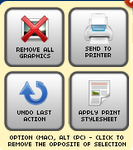
  • The primary way the Prinliminator works is you move your mouse over the area you would like to delete and when it turns red, you click and it will disapear. This isn't permanent so if you refresh the page or press UNDO on the Printliminator it will come back. 
  • Remove All Graphics - Keep in mind, this will do the job but also remove any graphics you need to print. It should only be used if it is just the text you want.
  • Undo Last Action - Simply takes you back to the original website one click at a time.
  • Send to the Printer - Brings up the Print Dialog box mentioned above so you could still print multiple pages per sheet.
  • Apply Print Stylesheet - Printliminator will try and do the hard work for you. Keep in mind like Removing All Graphics it may take out more than you want so be mindful of how often you use it.
3) Sheet Protectors: Sometimes the low tech solutions are the best. If you have a handout for a game/activity/lab that you would like your students to be able to write on but then be able to erase and use again then you will want to use this. Sheet protectors are those plastic envelopes that you can slide an 8.5"x11" piece of paper into. You can find them at office supply, department stores, and on Amazon.

Simply place the paper inside the sheet protector, use fine tip dry erase markers and you will be able to use the paper over and over again. I would suppose you could do this with laminating the paper as well, but the sheet protectors are more versatile.

May we all be more mindful of the paper we use and what we use it for. Until next time...

25 Tips for Teachers Both New and Experienced

I was asked at the beginning of the year to come up with my recommendations for new teachers. However, I think that this list is also useful as a reminder. If you do not work with tools, projects, or write comments to your students, feel free to substitute whatever applies to your classroom (materials, assignments, grades) as the principle is the same.


  1. Do not feel pressured to come up with the biggest and best projects. More does not always mean more learning and in my experience it can often mean less (or at least it is spread more thinly). You might think that your budget is huge but if you are not careful, you will find yourself halfway through the year without any money left.
    • You have two directions you can take a project:
      1. A big project that involves everyone - This can be cost effective (sometimes) but can also be a nightmare keeping everyone busy. There are ways to plan a project so everyone has something to do. However, it is most likely going to result in not every student learning the same thing.
      2. A bunch of smaller projects that groups or individuals are responsible for. - This could ensures that every student will learn what you are expecting but can cost a lot ($5/student is still about $250 for the project)
    • In my opinion the best projects find the balance between these two poles.
  2. Never create a project/assignment that isn't strong in content. You do not want to be halfway into a project and realize that you spent most of that time without much learning. 
    • The students and my favorite projects have been those which required the content to complete the project as opposed to simply a short design phase in the beginning and much of the time spent building or making.
  3. Purchase quality tools so you do not have to repurchase, then label and be diligent about checking them in and out. Especially around exhibition times, If you are bombarded with requests from students or other teachers to borrow your materials, it is always ok to say no or come back later when you can properly check out equipment.
  4. Feel free to ask for donations for materials, expertise, etc. Your parents and community will amaze you with what they can provide. However, if you are going to do it often or for a large amount make sure you consult your director/principal.
  5. I really appreciate these workbenches and how they help organize tools and materials in class. They can be made for any size and even be configured as shelfs. They are cheap and quick to build. Link to more technology I recommend to make life easier in the classroom.
  6. Sign up to undergo a project tuning (resource website) either officially or with another colleague. Even just casual conversations with others will generate new ideas and refine your project into something amazing. Do not believe that asking for help or feedback is a sign of weakness. We don't want our students to feel that way and neither should we.
  7. Create a system for clean up and spend the last 5-10 minutes of every class doing so. I have a rotating schedule of tasks with a student supervisor that works really well (link)
  8. Plan your entire year out. While that sound daunting, with exhibitions and projects, you do not want to run out of time. I would take the year schedule and make at least a block schedule of what concepts you would want to work with the students on and then you can fill it in more later. You will be grateful later for any planning you do in advance.
  9. Never assume that to do a project, you must "dumb down" or do not teach for depth of understanding. Always make sure your students understand what they are working on.
  10. It is ok to give homework, lecture, and test. We seek to be innovative but that does not mean that anything is forbidden when it is the best way of sharing/practicing/assessing skills and knowledge. Reflect upon how you were taught and how you can refine and improve that. 
  11. Ask for help from anyone and everyone, you will always find someone who will support you. It may feel like you are alone as you get swamped and busy but I can not say enough about how much you will grow to treasure and value your colleagues. Take a walk around the campus, walk into another teacher's classroom and be refreshed and inspired! If you do not feel like you are able to connect with your colleagues at school, connect with inspiring and sharing educators on Edutopia, Twitter, and other blogs. The Internet means no one is ever alone.
  12.  Work closely with your team teacher and members of your department. If you are able to create a cross curricular connection then all the better. The humanities and sciences have been separated in the classroom for far too long.
  13. If you have the chance to connect with students through a club, advisory, or otherwise; take advantage of it in every way possible. You have no idea how powerful an impact you can make on a student's life just by being interested.
  14. Start your final comments/grades early! The longer you put it off the less of a quality job you will do. I find that if you start early enough, divide the work by the number of days it is much easier. I would rather do a half-hour a day than 6 hours straight.
  15. Challenge your stronger students and support those who need it. The best way to do this is to keep an open dialog between you and your students to get their input as to what they need.
  16. Keep a class website and update it regularly so your Director/Principal and Parents can be well informed and support you.
  17. Imagine your students going to a well respected University. What do you want them to know? What would you like their Professors to say about your them? I love to go into Universities and see what great things they are doing, then I bring it back to my students so they can get a head start.
  18. Consider starting an after school program. You will not regret it.
  19. The Internet will fail, the computers might take a while to start up, and the printer/copier will jam/run out of paper/have a long line so always plan for that. With the copier/printer I always try and print everything out the day before so I am not stuck in the line 20 minutes before class.
  20. Take care of yourself. It is very easy to get overwhelmed and burned out so plan to take a break or a night off as often as you need to.
  21. Always keep a notepad or something where you can write down project ideas because they will come to you on a trip, at the museum, with friends, and at 2 AM.
  22. Phil's Law of Planning: However long you think a project will take, multiply that by 2 and then add a week. The only way to minimize this effect is with careful structured planning. Make clear your expectations to the students and give them clear steps on how they can achieve them.
  23. Have specific and high standards for their work. If they do not meet these standards, do not give up and move on, give them time to reflect and refine until they are proud of it.
  24. Allow yourself to fail. It is OK if your first project (or 20th) does not go well or is a total disaster. Reflect, refine, and move on.
  25. Most importantly, take time to get to know your students well. Teaching can either be a joy or miserable it is all in your daily perspective. I encourage you to enjoy every minute of it and remember what is most important.

If you have an additional tip that I didn't get to, would like clarification on one of them, or a resource mentioned, leave a comment, tweet, email, or Facebook and if you found it useful, share it on Digg, FB, or give it to a colleague who needs it.

Pandora Provides Free Streaming Music for Your Classroom

If there is one thing that your students love, it is music. It has become such a pervasive part of our society. The technology is wonderful but it has the effect of shutting out the world. This, I believe is why so many schools have made the decision to ban MP3 players from school as they prevent teacher/student and student/student interaction.

I love music and have eclectic tastes. It is rare that I do not enjoy others music .I like to play music in the classroom when students are working. It provides a calming effect during math and helps foster interaction between students. The problem is that so many songs have inappropriate words which prevents me from using other student's playlists. To use my player would require sorting through my own music which would take a bunch of time. Plus, any list of songs gets tiring if you hear it enough.

This is where streaming music comes in. Sites like Pandora provide free music that learns from your tastes. For example say you like Pearl Jam, it will use an algorithm (geek fact: it is based on the Distance Formula) to suggest other bands/songs you might like. Based upon your rating of those songs it will begin to learn your tastes. This is a great service that I highly encourage you to take part in.

So every year at the beginning, I provide a Google Form asking for their favorite song/band to relax to and favorite to get energized to. Then I input those choices into Pandora and voila I have two class playlists. All I ask from the students is that they be polite when a song they do not like comes on because it is a song that someone else likes. 

There are other streaming services but I like how Pandora has a wide variety of songs, the ability to filter out inappropriate language, and provides hours of free music.

I hope you and your students benefit from the psychological benefits as well as the increased feeling of community.

Snopes for Critical Thinking

How many times have you received an email that was alerting you that Coca Cola will pay you $25 to send this link to all of your friends or that Texas is going to secede from the US.? These are called chain mails and they are a powerful way of spreading myths, legends, and memes.

People of all ages are swept up in these which fuels them all the more to send them to their friends. They range from the interesting to the defamatory. More and more, students need to be aware of how to critically think in this day and age. Media is so powerful a presence in our lives with advertisements and opinions being sent to us in a constant stream, without the ability to distinguish between truth and fabrication we hand control to a very small group of people which can be dangerous to any society.

Snopes is the brainchild of Barbara and David Mikkelson who do an incredible job of researching and extrapolating truth from fiction. Whenever I hear about one of these urban legends I always ask, "Have you checked Snopes?" Almost every time, there is a post with research and links describing whether or not the point in question is correct or a fabrication.

When I use this in the classroom, I provide a few stories that I think might be useful. Some of them are not true, and some are true but equally absurd. Then I ask the students to underline which parts of the article provide evidence to the claims of the author, then write an analysis of whether this article resonates with their understanding of the world and common sense. Finally, we reveal the false articles and discuss what were the common parts that could be red flags that they were not true (e.g. sensationalism, fallacies, exaggerated numbers).

I could see humanities teachers being able to spend even more time analyzing and researching the media advertisements and Op-Ed articles. With elections always around the corner and so much mudslinging happening there is never a shortage of information to look through. It can be a lifelong lesson and skill to be able to research and ascertain what is truth and what is not.

The site is fun to browse through and see what legends are disproved. You will be surprised to find out that you have believed something for years which was simply a very powerful urban myth. I am grateful for the work done at Snopes to help the world fight ignorance, please share this resource with as many people and students as you can. 

Technology that Makes Teachers Happy

Educators are asked to stand up, sit down, talk at length, everyday and I wouldn't trade it for the world. That being said, anything that can be done to make our jobs easier is much appreciated.

Here are my technology suggestions. I know I already have a list of software but technology is not just about computer software. These are items that have made my day more manageable and because I live off a teacher's salary, they are affordable to all.

If I suggest a particular product that is only based on my experience but please select the product that best suits your needs and share in the comments what you chose.

E-reader: The revolution has begun, not since Gutenberg's printing press have we seen a dramatic change in how people read but with the recent developments in technology, e-readers have the potential to be an important part of your life. I have read on everything since it was possible to hold a computer in your hand (Calculator, Newton, Personal Assistant, etc). Reading is my favorite thing to do in the world but I would always read on an e-Reader because I needed to or was bored, not because I wanted to. The screen was too small or it would hurt your eyes and hands. Later in the military I suffered a dramatic back injury that made holding a physical book painful no matter what position I tried. 

The Kindle is made reading enjoyable for me again. It is so light but well made. The Ergonomics are     incredibly well thought out, the battery lasts forever, and I was able to surf the Internet and download books even while I was on vacation in a very rural area with the Whispernet Network.  You can upload PDFs, Audiobooks, and even have it read to you if you wish. There is even an application for your iPhone, Android Phone, or computer so you can read anywhere.

While the technology is incredible, the only drawback I have found is that the books are not dramatically cheaper. Additionally, while the iPad has the ability to read eBooks, there is a glare that you would not have with the other e-readers like the Kindle.


Wireless Keyboard: If you ever come to my classroom (and you are always welcome), I am rarely seated. Whether at the white board or working with students, I often need the ability to replay a video, pull up a document, send a student an email, click through a presentation, and the list continues. With a wireless keyboard you plug the USB dongle into your computer and then you are free to take the keyboard/mouse with you wherever you go. The one I use is a few years old and not sold anymore but you can find them for about $30. I would encourage you to go in the store or online and search for one that meets your needs. Here  are links to the top three. Logitech, HP, Microsoft

USB Flash Drive: You might think, this not worth mentioning. USB Flash Drives are so common and relatively inexpensive that almost anyone can get one. Plus with Google Docs and free Online storage sites like adrive Dropbox, and Mozy who needs to carry files with them anymore? But there are so many things you can do with a Flash Drive like run your own browser complete with bookmarks, and many other programs from any computer (PortableApps), plus you never know when the Internet will be out. Being able to pass a few of these around to get your files to the students can be a lifesaver when Murphy's Law goes into effect. The cost of these starts at $5 and goes up from there. The only reason I point out the SanDisk Flash Drives is to call attention to their practical design. Many of these drives come with a cap which you will lose within a week. The SanDisk Flash drives retract.

Multi-Tool: This is one of those items that I simply "don't leave home without it". There just never seems to be scissors or a screwdriver when you need it. I have had my Leatherman Squirt E4 for years now and every day I am using it. It currently sells for about $20. The Squirt P4 model has pliers instead of the Wire Strippers.


Ergonomic Laptop Support: Laptops are great, don't get me wrong. But they are miserable for your back and neck. If you are relatively young and free from pain you  might think this is unnecessary for you to concern yourself with now, but many older teachers I know suffer from some kind of occupational hazard from all of the varied roles we serve. I love the Swedish and their practical and frugal designs. IKEA sells a wonderful Laptop rest called the Brada for a measly $3! It sits on your desk or lap and is light enough for carrying from room to room but wide enough for a laptop and perhaps a phone or PDA. I have also heard wonderful things about the Dave from IKEA on Cool Tools which sells for under $20. If you do not have an IKEA near you (I am truly sorry) then order it online as the shipping is reasonable.
Workbench: Educators work in such varied settings. There is never enough storage or workspace and no one size fits all. I am grateful to my colleagues Ted and Jon for pointing these Simpson Strong Tie Workbench Kits out to me. The kit is about $50 and then you purchase about $30 of lumber. The best part about this kit over other prebuilt kits is the ability to customize the height, number of shelves, and more. You are limited only by your imagination.


Science Specific Recommendations:


Stopwatches: It seems whenever I need stopwatches for a lab, the batteries are all dead. Most stopwatches neglect to put a on/off button on them (battery maker conspiracy)! These made by Ward Scientific do have the power button and are a pretty good deal. Myself and other teachers swear by them.

I'll add to this page as more great products emerge. However, I am committed to only sharing those products that I myself have used, can afford, and love. 

Do you know a must have technology that will enrich all of our lives? Please leave it in the comments or send me an email at phil at brokenairplane.com.

SOS - Save Our Schools With After School Programs Part 3

Let me ask you to put aside any of your concerns with starting a program for a minute and ask you a couple of questions.

1) Are you really passionate about something like art, engineering, theatre, math, a foreign language, programming, etc?
2) Can you devote a couple of hours a week after school?
3) Do you believe that every student has potential to do great things?

If you answered yes to all of these, then I would encourage you to start an after school program! Your kids need you!

You might have doubts (I know I did):
  • I am not good enough to run a _______ team or group: 
    • You will never be able to keep up with your students desire to learn, all you can do is keep the energy high and support them. I had found this to be true no matter how learned you are, students just have too much imagination and energy.
    • The MorTorq robotics team was started by a woman who had no engineering skills but was excited and passionate about working with students.
    • This is how the Virtual World emerged in my robotics team. I found this software called Blender that while I knew nothing about, I gave it it to a couple of students who I thought might be interested. A couple of weeks later they had created a video game that the whole school wanted to play. There skills continued to grow until they were making huge virtual worlds and that is how the science festival came about.
  • There isn't enough money:
    • There are so many organizations and companies who want to give money to innovative and effective programs like yours. Do a Google search on "education grants" or grants for ______ and you will see that the list is huge. Additionally your community will love to support you whether it be a company seeking to create future employees or the pizza place down the street that will let you do a fundraiser, the money is there.
    • If you are lucky, you might have someone in your district who rights grants as part of their duties. Were it not for our own Lisa Davis helping us raise funds and support us, it would be impossible to do all that our team does.
So hopefully, you have the courage to start a team, so what do you need to do?

1) Find initial funding: If you are creating a robotics team you are looking at a few hundred dollars, if it is a painting club then it might be significantly less. I would check with your school, district, parents, and community. You never know who you will find that would be willing to help so be sure to ask anyone you can.
  • A note: many after school programs have disappeared because they relied to heavily on one source of funding. You should always seek to be self sufficient through donations and saving. This ensures that your program will always be around and not dependent upon other people's decisions.
2) Find support: After school programs can take a toll on your time. No matter how committed you are, it is important that you continue to be able to spend time with family, friends, and your primary teaching duties. While you might think that your program will only take a little time, ask any robotics teacher or Patrick Yurick of the Graphic Novel Project and they will tell you that once your program takes off it can take up as little or as much of your time as you will let it.
  • Ask fellow teachers or parents, you will be surprised at how many community members would love to help out. I have seen artists, engineers, college students, politicians, writers, even a Disney Imagineer and LAPD Bomb Squad member come to our rescue. Plus the students love to see outside people with real world expertise come and advise them.
3) Find a project: You may think that passion is enough to fuel a group of students but I can tell you it is otherwise. In my opinion, the sole determinant of the success of an after school program is having something to work toward.
  • For my robotics team it is the competitions, for the Graphic Novel Project it is publishing two Graphic Novels a year, for a theatre program it is the productions, for a Japanese club it might be a field trip downtown to order lunch or to the cultural center. Whatever it is, I would encourage you to find something and have it ready to announce to the students on the first day as this will help fuel the program.
4) Let the students be the fuel for the fire: If your goal is to get students excited about a field, discipline, idea then once you have given them the tools let them run with it. They will come in with new ways of doing things and innovate right before your eyes. 
  • When a few of my students 2 years ago made a video game in Blender, it took them 6 months. They then showed a couple of my Freshmen how to do it, and one of them ended up recreating the game in a couple of hours. Now the bar was raised and there was a huge new influx of energy into learning and creating.
  • However, I do caution you against letting them have complete control over the class. I have seen this happen and it either devolved into just hanging out or the project dragged on (deadlines, deadlines, deadlines). 
  • Have fun but keep it professional otherwise people might bring in their friends that just want to hang out as opposed to wanting to help the project. I have been firm about asking people to leave the program in order to protect it from those who just want a place to mess around.
5) Market yourself: Neglect this point at your own peril. I am grateful once again for Eileen Kahn teaching me the importance of marketing. This is not just for fundraising, you may be in a situation where your program is taking up resources (students, room space, materials, funding, etc) from others and if you do not constantly extol the importance of your program then people will not know that it is necessary to keep around.
  • Some ways of easily marketing yourself are youtube videos, a website, yearbook photos, Facebook/Myspace, appearances before the city council/school board, appearances at school events, newspaper blurbs, referring to it in your classroom, posters, etc.
  • I cannot stress enough the importance of doing this. You may never know when it will be important to have the community on your side.

Finally, a message to the community:

Please, please, please seek out a way you can help out in your schools. Whether an after school program or otherwise you will make an impact that will extend beyond what you can imagine. If you are able to donate money, or have an expert in a certain field, can provide space, or materials, you will make a powerful change in student's lives. 

After school is the most powerful use of your resources. With little or no overhead, your donation goes directly toward the passion of a student that they may not even know they had. The ripple effect into the community will be incredible and I thank you for your time and involvement in one of the most important things you can do.