Showing posts with label patrick yurick. Show all posts

Suited for the Thirsty

The following is a guest post from +Patrick Yurick


Myles Horton & Paulo Freire at the Highlander School

“The people wanted and needed to read and to write, precisely in order to have more of a possibility to be themselves... Because of that, you could start without too much preoccupation concerning methods and techniques and materials because you had the principle ingredient, which was the desire of the people...”

Paulo Freire - 1990


I remember reading that book during my first education course at Plymouth State University seven years ago as I started my path towards becoming an educator. I was completely enamored with the tone of revolutionary thinking involved in educating people who desperately needed education. I did not fully understand the irony, at the time, of studying countercultural education during a government mandated credentialing program.

It was soon after Freire's words, and my subsequent blog writings and experimentation with emerging communications technology, that I found myself working at one of the most revolutionary educational environments in the world, High Tech High Chula Vista. I spent five years at HTHCV developing collaborative projects and assessments with over 750 students. The campus brought me in as a college graduate and raised me to be an educator.

Still, Freire’s words above kept ringing in the back of my head. Why weren’t my students universally happy? Why did they care about grades when I was giving them literacy?
Every semester I saw dozens of students who were being pressured to attend school by their parents and society consistently “check out” of their educational experience. Subsequently, I saw them performing miserably in my class setting. No matter what I did as an educator, I could not reach every student.


“...the oppressed, who have adapted to the structure of domination in which they are immersed, and have become resigned to it are inhibited from waging the struggle for freedom so long as they feel incapable of running the risks it requires.”
Paulo Friere - 1968
Pedagogy of the Oppressed


There was an environment where I witnessed the active fostering of desire derived: an after-school program called the “High Tech High Graphic Novel Project”. Populated with students from all grade levels at HTHCV, with a desire for comic/art education, and selected based on choice, I began to see the educational environment Friere spoke of. We would stay for all-nighters, weekend classes, and go to conventions. Parents were involved and would regularly attend sessions to help. Outsiders wanted “in” as well and the students saw a slew of professionals come to donate time just because they had heard about what we were doing.


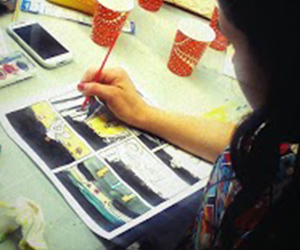
Victor Flores, now a Freshman at Cogswell University, 
brush inking a page of comic book artwork.

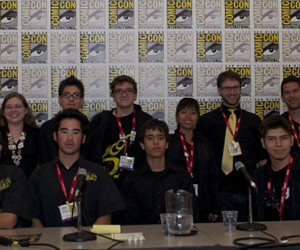
The 2011 Graphic Novel Project team presenting, as experts, 
on a panel at San Diego Comic Con International 2011.


Since the formation of HTH GNP, my principal’s mid-year evaluation would always have this part included: “What you are doing with Graphic Novel Project is amazing. How do we bring it into your classroom?” How could we bring mixed age-level classes into the classroom? How could we create an educational environment based on choice, passion, and commitment? I would always tell my director that unless we can restructure everything that school thinks it is about -- we can’t. At some point, people started going to school because it was expected of them as opposed to wanting education.

Learning and education became a hopeful byproduct of schooling as opposed to the point. School is about so much more than just education. Cultural requirements like proms, rites of passage, teams, theater, community are not bad! In fact, they seem to be vital to the human experience. It was when school stopped being about a pointed educational environment for the student that it lost its ability to be effective at education as an endeavor. School became about too many things, resulting in the gradual diminishment of all the things it was attempting to serve.
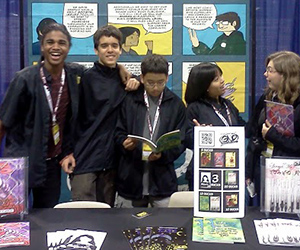


Students selling their comics at 
Wondercon Anaheim 2012


Students working on a collaborative comic during a 24 hour work session, during school vacation time

Student creating STEM comic books at the USA Science & Engineering Festival in Washington DC


A little over a year ago, the core students in GNP happened to be in the same graduating class and subsequently were all leaving the school at the same time. I had two options: 1) I could continue the Graphic Novel Project and recruit a new roster of workers or 2) I could do something else. I chose something else. Even though I was given incredible freedom to experiment as an educator, I felt that the constraints of working within a system with large numbers of students, grade levels, and bell schedules still constricted the likelihood of a pointed educational environment. I chose something else because creating a new, pointed educational environment was the only option I had if I was going to test my theories about the reasons why GNP was so successful.

I wanted making comics and teaching to passionate learners to become my full-time job and that meant leaving the standardized education system in all of its forms (including beloved charter schools). In the next incarnation of my educational journey, I had to abandon that idea of school.

I have seen the power of calling yourself an artist. People react differently to artists. They equally criticize and revere them, and I believe that is because they cannot seem to define them. Where do artists work? In “art studios.” What were we going to concentrate on? Comic books. Thus we knew “Comic Book Studio” was going to be in our name. The last piece of what we were was defining what we were about. When we read the Leo Leonni book Swimmy we knew our name: Little Fish Comic Book Studio.


                                                         Little Fish Comic Book Studio launch party Friday August 31 2012


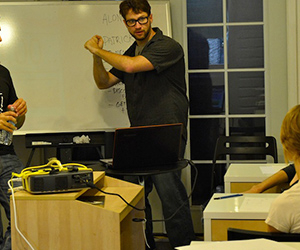
Teaching comic book theory at 
Little Fish Comic Book Studio


An all ages created comic book mural led by Little Fish for San Diego’s Figment 2013


Little Fish members/students range from 
11-40. Each come in with a comic project 
they dream of finishing.

I am sitting in my comic book studio a year later looking over at the members who are attending Little Fish. I am tempted to call them students, but they are more than that - they are creators. A 30-year-old who joined to work on his 150-page autobiography, two 14-year-olds who are launching weekly webcomics, an 11-year-old who loves manga but is just starting out, and an early 20-something who has been publishing but is looking to push his work to the next level. They are all making jokes about comics and movies that are coming out soon. You can hear the scratching of pens on paper as they are looking down at the concept art that they are designing for their individual projects.

They are here because they want to make comic books. They want to learn and they passionately have stories to tell. Each conversation is outlined with this implied expectation that they each share: “We are all brilliant. We all need each other in this moment to continue our journey.”

In the short seven years since I have read the line: “The people wanted and needed to read and to write, precisely in order to have more of a possibility to be themselves” and I am seeing it before my eyes. When I first read it, I was inspired, but also thought that if Friere tried to teach my students it probably wouldn't occur now because the system will not allow it.


MYLES: ...you can lead a horse to water but you can't make him drink.
PAULO: Yes.
MYLES: This is a problem they deal with in academia by hitting the horse over the head and beating on him till they force his nose in the tub, and just to keep the blows from continuing, he'll try to drink.     My system is to make him thirsty, so he'll volunteer to drink.
Myles Horton & Paulo Friere - 1990


As I sit in my studio and work with the people who have come to be a part of it, I can’t help but think of the interaction between Horton & Freire above. The creation of Little Fish may have been a fool’s gesture, but I think it was a necessary one. What if educational environments were pointedly suited for the thirsty? What would a place look like if the common denominator between all people was just how much they wanted to be taught? Who would show up? I’d like to think that I would.


Patrick hosts monthly comic book & education related hangouts, free classes, resources, and more at Little Fish Comic Book Studio Website: www.lilfish.us

To see more of the kinds of work Patrick has done as an educator check his portfolio/website: theheadcomic.com

Patrick’s webcomic “American BOOOM!” at American.BOOOM.us which uses a superhero story to talk about the ongoing narrative of the US/Mexican Border.

Creating Video Tutorials for Your Classroom Version 2.0

Subscribe to BrokenAirplane!

Video tutorials are a tool with the power to do a lot of good for learning. I have believed this for quite sometime in fact it was one of the first posts on BrokenAirplane. There are three main obstacles to overcome in this area and they are: Access to technology and videos, pedagogy and usage of video tutorials in your classroom, and high quality creation of video tutorials.

The first one is quickly diminishing as smartphones become more and more ubiquitous, many more students around the world have a phone rather than a computer. The issue of pedagogy is arising as an issue as some schools are adopting video tutorials or technology based lessons as a replacement for the teacher. Others feel that the video tutorial is not effective at delivering content.

I believe that video tutorials have a time and a place. In Patrick and my experience, they are most effective when they are used for a specific skill or concept as opposed to curriculum. This keeps the video focused and allows students to focus on a concept. When it is something "fuzzy" like Inertia or Gravity (as proven by the Veritasium videos/research) it is difficult to convey it through a video, there are better ways of ensuring that these concepts are understood and that they stick. Video tutorials best work in situations where it is a new skill and has multiple steps.

It is my belief that we are stronger when we work together as a global community of learners and educators. Each of us must have at least one amazing thing that is worth sharing with the world and video tutorials allow us to share all of those wonderful talents with each other and our students. So Patrick and I have worked much this year to refine our instructions on how to make video tutorials. In that time we have discovered some really cool things both technologically and pedagogically and we wanted to share them with you. I hope you will share this around your school, share with us what you are doing with the technology, and provide any feedback to ensure that this is helpful to as many people as possible.

Here is a link to the original PDF for the Video Tutorials.

Subscribe to BrokenAirplane for all of the relevant technology and education news/information. 

Have Paperless Reading Discussions via Google Talk So Everyone Has A Voice

Whenever my colleague and friend Patrick is excited about something he did in his classroom, I know to put everything down and prepare myself because it is going to open my eyes to a new way of thinking about what technology allows us to do. I'll let him tell you all about it.

Paperless Final Word Protocol
I (Patrick) wanted to share this amazing thing that occurred in my classroom this past Friday. I have been practicing paperless classroom techniques for the past two semesters with resounding success. I started a graffiti project with a couple of my classes because, I think teaching underground art practices is amazing and I have tons of fun learning graffiti techniques with my class. I also love to teach the laws that are in effect just around the word graffiti. (California is spending somewhere in the millions each year to fight graffiti whee in european countries graffiti is as common as lets say breathing.)

Anyway, I love talking about subjects that are not black and white, where perspectives on situations are vast and controversial. About five minutes before class I found an Article I wanted to share with my students that was put out by the Los Angeles Times that give a radically different perspective on graffiti. It discusses its role as a new favored art form in the Fine Arts world and how that is enraging the people of LA who are busy fighting to keep their streets clean.

As soon as I read the article, which was around the time the students were entering the classroom, I knew that I wanted to do a final word protocol around the article. I printed a copy of the article and I held it in my hands. I started thinking about how I wanted to do it. I was about to jump out of my seat and run to the copier to make 26 copies of the article but I just couldn’t do it.

The kids were doing their lively thing behind me while my mind searched for a way to do this thing paperlessly. Then an idea came to me. I stood up and walked to each student and gave them a number between 1 and 6. This number was to be their group formations. I told them to meet with their group members and pick one person to write down the names of all of the group members. I then had them immediately go to their computers.

I sent a mass email to the entire class with this message:
1. Everyone silently read this article (10 minutes)
2. Pick 1-2 sentences that stick out to you
3. The person who collected your names is now referred to within your group as the “facilitator
4. The facilitator is going to start a group chat (Gmail Chat Video)
  • Invite all members of your group to the chat
  • Invite MisterY (me) to the chat group
5. At this time you should only have two windows open on your desktop:
  • The article
  • The group chat
6. Facilitator will pick the order of students who are going to share, including the facilitator
7. The first person simple copies and pastes the first quote that they liked into the group chat
8. Everyone in the group now responds to how they interpret the quote, except the person who originally posted the quote
9. After everyone has shared the person who originally shared can now respond with any additional thoughts, changed thinking, and/or responses to what everyone has said
10. Move on to the next person, repeat until everyone has shared at least one quote. If you have time move on to a second round of quotes.

Check out what happened next


Afterwards the moderators shared out to the class what their groups had discussed. Keep in mind, that there is no sound because the room is completely quiet. The only talking that occurred was through the chat.

Suggestions for instructors trying to repeat this process:
  • Preview the article and give a little blurb about why you are sharing it.
  • Go over the directions out loud with the class.
  • Get up and walk around as the protocol starts and as it transitions into the sharing phase just to make sure the students only have the group chat and the article open, the other things they have access to are really distracting. You may have noticed in the video that there was a lag in some of the conversations because they were distracted.
  • Be okay if you haven’t read everything the students wrote - that what you have chat transcripts for. If you have not enabled chat. Go to Gmail Settings (upper right corner), Chat tab, "Save Chat History". This a good idea if you are having conversations with students and parents anyway. 

Have fun and be part of the conversations!

See, what did I (Phil) tell you? Patrick's classroom is not only paperless and fun, but most of it can be used directly in your classroom tomorrow. Be sure to send some love Patrick's way so we can encourage him to post more often!

Subscribe to BrokenAirplane and keep up with all of the latest education and technology resources!

Setting Up Students for Success

Note: After much encouraging, I have finally convinced my colleague and friend Patrick Yurick to post on BrokenAirplane. It is my hope that he will post often and that you will be able to benefit as I do from his creativity, innovations, and humor. Patrick is the founder of the Graphic Novel Project, creator of Hipster Picnic, and Co-Author of the Hub Proposal.

Setting Up Students for Success
Classroom Rules for Technology Usage with Mister Y
by Patrick Yurick

Within my classroom are rules unlike any other American public high school classroom I have ever been in. Because of these rules I have seen my students move dramatically away from being fearful and anxious about learning computers to courageous learners and practitioners of technology. I believe that while there are many other resources and advantages within my classroom, these rules lay the very pivotal groundwork that goes into creating the successful environment I instruct within.

There are aspects that make my class look different than that of a traditional ed classroom. I do have a 1 to 1 computer ratio. My students are allowed to use GChat during worktime. (Sometimes they are even forced to communicate that way) They are allowed to get up and walk around the room, as they do not have assigned seats. They receive almost all of their assignments via their email, as opposed to me writing it on my white board. No paper is printed for my class unless it is to be drawn on and all of their work is completed on their blogs

If you read closely in the evaluations the students wrote, you will find several that say,

“Mister Yurick could be more helpful cause he won’t really help us during work time,”

They are correct. I will not help them and sometimes I do leave them alone. There are very good reasons for this.

The Reason:
It is year one of my teaching career. All of the sudden I am thrust into a position that was all about me teaching something that didn’t give me peace, computers, while being asked to blend it with something that did give me peace, art. My frustration was not caused by the computers as I am fairly adept in their use. The problem came from trying to teach principles of marketing and graphic design.

That first semester was a gift in that it was a complete education for me on a lot of “what not to do” when teaching. I went against everything that I believed to be amazing about art and tried consistently to create a graphic design course. Having never taught computers before, I made some very silly mistakes. At first, I tried to teach the course like an art class.


In a traditional art class, you have the instructor gather the students around when you are ready to give them the instructions they need for their project. When they are all around you, you start by showing them the finished product and then you proceed to making the product yourself in front of them. You break down the steps of the project in simple terms for the students to remember, then you disperse the students and send them on their way. As they attempt (with their inexperienced hands) to replicate the thing that you (the expert) just did, you walk around the class and give simple, encouraging words and corrections to those who need it.

This method of instruction does not work for computers. Trust me, I have tried.

“Mister Yurick! Mister Yurick!” My name is being yelled from different corners of my classroom. Several hands are up in the air waving impatiently at me, pleading for my help. A student has been waiting for me patiently for 20 minutes. I start listening to her. My name gets screamed. My head turns. Eager to solve the crisis, I walk away from the young girl. She immediately starts sobbing.

Working with computers is not like working with a paint brush. When working with art there is less between you and your intended action. There is you, your hand, and the canvas. When working computers it is something different. Your hand has been replaced with a foreign object. It only understands commands. All of a sudden producing art is like taking your brush and hand away and replacing it with a blind man who can do any number of a million things, but needs the correct marching orders.

I found it easy to understand why teachers are reticent to adopt technology into their classrooms.

Then I started looking to other classrooms that I was a part of. I was desperate for answers on how to teach to a completely tech based classroom. For my mental sanity and need for physical challenge, I had started practicing the martial art of Aikido.

Aikido is so heavily ritualistic (bowing in, member rankings, multi-level help, and the structure of politeness) that it lends itself easily to an instructor, or sensei, who has the ability to observe his students without being constantly torn in a billion directions when the many students need him. Like a highly differentiated classroom, there are anywhere between between 10 and 30 students, of all belt/ability levels, attending class on any given evening; yet it is always peaceful in the dojo. Because Aikido is fundamentally prefaced on the practice of peace and nonviolent resistence there seems to be a greater emphasis on acceptance of practitioners of all ability levels.

I wanted my classroom to be like an Aikido dojo! It was from that sentiment that I started experimenting with my own kinds of rituals for my classroom.

The Classroom Rules When Learning Technology:
DON'T HOVER: Mister Yurick is trying to help everyone, but can only help one student at a time.  Wait your turn.
DON'T YELL ACROSS THE ROOM: This is considered rude and disruptive behavior.
DON'T RAISE YOUR HAND: Because of the high volume of requests for help within the course it is imperative that you utilize different methods of problem solving other than the teacher to get help.
WHEN YOU GET STUCK:
  • ASK A NEIGHBOR FOR HELP: A lot of the time your neighbor has the same answer as the instructor if you are lost. Get the courage to socialize. Ask.*Quite a bit of the time students will not use their very intelligent classmates as resources because students do not take the time to see what is happening in places in the class other than from where they are sitting. Get up. Walk around.
  • USE THE GENIE: Some years ago a magical genie was given to the world of computer users that answers any question you may have.

As stated before these rules are not the only thing in place within my class to help with student success. It is these rules though that set the initial groundwork for my students to interact with the computers.

I am a teacher of ninth grade multimedia. I was placed in the position because it seemed logical in the design of my role within our school that every student receive technology training early on in their project based learning career. This is so that they may use the computers within the school for future projects. As outlined above, I was daunted with this task. Through the implementation of these rules I have seen students start to think critically on how to solve problems that they encounter. I have seen students, on a much larger basis, become avid users of different technological tools much due to the problem solving nature the students have to go through in order to master and complete their tasks.

As a side note: The crying girl mentioned above and I had a talk today. She is my student once again this year as a high school junior in my 11th grade section. She told me that she is excited to be in my class now, three years later, and even cited these rules and the clear expectations they outline as reasons for her looking forward to the class on a weekly basis.

Subscribe to BrokenAirplane!

Great new Math Blog: Infinigons.com and the 2010 BrokenAirplane Edublog Nominations

It is time for the 2010 Edublog Awards Nominations:

It has been a great experience for me to blog. I really appreciate the many unique opportunities I have enjoyed and people I have met through doing it. In my opinion it is really important to get many voices in the conversation about education. To get various perspectives and new ideas.

Over the last couple of years, I have had the privilege of working with Allison. She is a hard working and committed to giving her students the most interesting math experience they can have. Her and I have also worked to create curriculum that integrates computer science and math through the Python Programming Language. She has begun a math blog www.infinigons.com (Infinity + Polygons) which I hope you will check out.

www.infinigons.com

Here are my EduBlog award nominations:

  • Lifetime Achievement: Karl Fisch The Fischbowl - I was introduced to this blog over 3 years ago while I was working with the University of Utah on creating their Epigenetics Curriculum. Since then I have followed him on Twitter and his Math focused blog Transparent Algebra. Innovative and thoughtful posts.
  • Best Educational Wiki: Patrick Yurick 9th Grade Multimedia Wiki - It has been my pleasure to work and consider myself friends with him. A deeply thoughtful teacher, his ideas and pedagogy has influenced every educator at our school. The founder of the very popular and groundbreaking Graphic Novel Project and co-creator of the Interdisciplinary Spanish/Multimedia Talk Town Project. Start a conversation with this guy, you will not regret it.
  • Most Influential Blog Post: Anne Smith Alfie Kohn - I Need You. When the blog world saw how open she was about sharing her concerns and open to asking for help, it could not help but offer suggestions and support. Even Alfie Kohn found time to respond.
  • Best Group Blog: Graphic Novel Project. This group of students works extremely hard to produce professional quality comic books about compelling and important topics like Immigration and School Dropout. The work that they do will have far reaching effects as their influence in the community grows.