Showing posts with label project based learning. Show all posts

Suited for the Thirsty

The following is a guest post from +Patrick Yurick


Myles Horton & Paulo Freire at the Highlander School

“The people wanted and needed to read and to write, precisely in order to have more of a possibility to be themselves... Because of that, you could start without too much preoccupation concerning methods and techniques and materials because you had the principle ingredient, which was the desire of the people...”

Paulo Freire - 1990


I remember reading that book during my first education course at Plymouth State University seven years ago as I started my path towards becoming an educator. I was completely enamored with the tone of revolutionary thinking involved in educating people who desperately needed education. I did not fully understand the irony, at the time, of studying countercultural education during a government mandated credentialing program.

It was soon after Freire's words, and my subsequent blog writings and experimentation with emerging communications technology, that I found myself working at one of the most revolutionary educational environments in the world, High Tech High Chula Vista. I spent five years at HTHCV developing collaborative projects and assessments with over 750 students. The campus brought me in as a college graduate and raised me to be an educator.

Still, Freire’s words above kept ringing in the back of my head. Why weren’t my students universally happy? Why did they care about grades when I was giving them literacy?
Every semester I saw dozens of students who were being pressured to attend school by their parents and society consistently “check out” of their educational experience. Subsequently, I saw them performing miserably in my class setting. No matter what I did as an educator, I could not reach every student.


“...the oppressed, who have adapted to the structure of domination in which they are immersed, and have become resigned to it are inhibited from waging the struggle for freedom so long as they feel incapable of running the risks it requires.”
Paulo Friere - 1968
Pedagogy of the Oppressed


There was an environment where I witnessed the active fostering of desire derived: an after-school program called the “High Tech High Graphic Novel Project”. Populated with students from all grade levels at HTHCV, with a desire for comic/art education, and selected based on choice, I began to see the educational environment Friere spoke of. We would stay for all-nighters, weekend classes, and go to conventions. Parents were involved and would regularly attend sessions to help. Outsiders wanted “in” as well and the students saw a slew of professionals come to donate time just because they had heard about what we were doing.


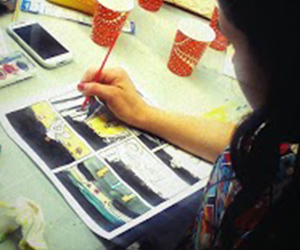
Victor Flores, now a Freshman at Cogswell University, 
brush inking a page of comic book artwork.

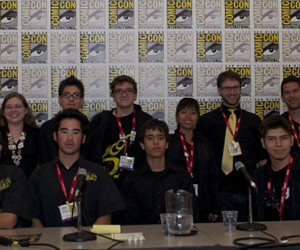
The 2011 Graphic Novel Project team presenting, as experts, 
on a panel at San Diego Comic Con International 2011.


Since the formation of HTH GNP, my principal’s mid-year evaluation would always have this part included: “What you are doing with Graphic Novel Project is amazing. How do we bring it into your classroom?” How could we bring mixed age-level classes into the classroom? How could we create an educational environment based on choice, passion, and commitment? I would always tell my director that unless we can restructure everything that school thinks it is about -- we can’t. At some point, people started going to school because it was expected of them as opposed to wanting education.

Learning and education became a hopeful byproduct of schooling as opposed to the point. School is about so much more than just education. Cultural requirements like proms, rites of passage, teams, theater, community are not bad! In fact, they seem to be vital to the human experience. It was when school stopped being about a pointed educational environment for the student that it lost its ability to be effective at education as an endeavor. School became about too many things, resulting in the gradual diminishment of all the things it was attempting to serve.
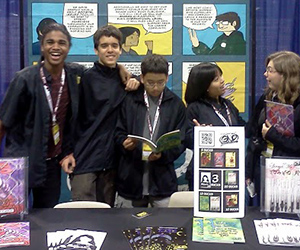


Students selling their comics at 
Wondercon Anaheim 2012


Students working on a collaborative comic during a 24 hour work session, during school vacation time

Student creating STEM comic books at the USA Science & Engineering Festival in Washington DC


A little over a year ago, the core students in GNP happened to be in the same graduating class and subsequently were all leaving the school at the same time. I had two options: 1) I could continue the Graphic Novel Project and recruit a new roster of workers or 2) I could do something else. I chose something else. Even though I was given incredible freedom to experiment as an educator, I felt that the constraints of working within a system with large numbers of students, grade levels, and bell schedules still constricted the likelihood of a pointed educational environment. I chose something else because creating a new, pointed educational environment was the only option I had if I was going to test my theories about the reasons why GNP was so successful.

I wanted making comics and teaching to passionate learners to become my full-time job and that meant leaving the standardized education system in all of its forms (including beloved charter schools). In the next incarnation of my educational journey, I had to abandon that idea of school.

I have seen the power of calling yourself an artist. People react differently to artists. They equally criticize and revere them, and I believe that is because they cannot seem to define them. Where do artists work? In “art studios.” What were we going to concentrate on? Comic books. Thus we knew “Comic Book Studio” was going to be in our name. The last piece of what we were was defining what we were about. When we read the Leo Leonni book Swimmy we knew our name: Little Fish Comic Book Studio.


                                                         Little Fish Comic Book Studio launch party Friday August 31 2012


Teaching comic book theory at 
Little Fish Comic Book Studio


An all ages created comic book mural led by Little Fish for San Diego’s Figment 2013


Little Fish members/students range from 
11-40. Each come in with a comic project 
they dream of finishing.

I am sitting in my comic book studio a year later looking over at the members who are attending Little Fish. I am tempted to call them students, but they are more than that - they are creators. A 30-year-old who joined to work on his 150-page autobiography, two 14-year-olds who are launching weekly webcomics, an 11-year-old who loves manga but is just starting out, and an early 20-something who has been publishing but is looking to push his work to the next level. They are all making jokes about comics and movies that are coming out soon. You can hear the scratching of pens on paper as they are looking down at the concept art that they are designing for their individual projects.

They are here because they want to make comic books. They want to learn and they passionately have stories to tell. Each conversation is outlined with this implied expectation that they each share: “We are all brilliant. We all need each other in this moment to continue our journey.”

In the short seven years since I have read the line: “The people wanted and needed to read and to write, precisely in order to have more of a possibility to be themselves” and I am seeing it before my eyes. When I first read it, I was inspired, but also thought that if Friere tried to teach my students it probably wouldn't occur now because the system will not allow it.


MYLES: ...you can lead a horse to water but you can't make him drink.
PAULO: Yes.
MYLES: This is a problem they deal with in academia by hitting the horse over the head and beating on him till they force his nose in the tub, and just to keep the blows from continuing, he'll try to drink.     My system is to make him thirsty, so he'll volunteer to drink.
Myles Horton & Paulo Friere - 1990


As I sit in my studio and work with the people who have come to be a part of it, I can’t help but think of the interaction between Horton & Freire above. The creation of Little Fish may have been a fool’s gesture, but I think it was a necessary one. What if educational environments were pointedly suited for the thirsty? What would a place look like if the common denominator between all people was just how much they wanted to be taught? Who would show up? I’d like to think that I would.


Patrick hosts monthly comic book & education related hangouts, free classes, resources, and more at Little Fish Comic Book Studio Website: www.lilfish.us

To see more of the kinds of work Patrick has done as an educator check his portfolio/website: theheadcomic.com

Patrick’s webcomic “American BOOOM!” at American.BOOOM.us which uses a superhero story to talk about the ongoing narrative of the US/Mexican Border.

How to Plan Projects that Make Jaws Drop

Subscribe to BrokenAirplane!

It is no accident that this post is on July 4th, America's celebration of Independence. It is even more appropriate having just returned from Philadelphia, PA from the 2011 ISTE conference. Lisa Davis, and I were presenting our students' Virtual Bike Tour and the other incredible projects accomplished through the HP EduInnovator Grant.

What I saw and heard, was the same thing that happened at the National Science Fair and almost everywhere I talk or show my student's work. Double takes, jaw drop, questions as to which college my students go to (they are Freshmen in HS), and more or less disbelief that students are capable of doing these things. Unfortunately for me, the audience always seems to think it is something special that I do, or that I have specially gifted students (neither are true, nor are they absolutely false). I'll tell you my secret so you can go and replicate it with your students:

1) I always look at what the "real world" or colleges are doing and steal it for my classroom. If there is a professional software, I'll find a way to get it for them. Is ground breaking research occurring at Engineering universities, I'll take my students to go talk to them. I vehemently oppose a belief that students have a limit to what they can accomplish at any age. Countless professors, parents, executives, and project managers have come to me and said something like, "I never learned that until my Junior year of College," and yet here are these students doing graduate level research, creating software and designing interactive circuits.


2) The second thing to create amazing opportunities for learning (often referred to as projects) is to keep plates spinning. This is similar to a project manager in the corporate world, but sadly we don't do enough of this in High School. Shawn (of Think Thank Thunk) talks about this in his Education without Coercion Ted Talk.

When I hear that a student is interested in something, I will passionately (some would say obsessively) learn how I can help them to become better at it. If a student wants to learn 3D games, I'll learn Blender with them. If they have always wanted to learn to make Android apps, lets make one for our robotics team! He loves to play guitar, why not make our own. All of my favorite and best projects have come from students inspiring me to keep learning along with them.

Basically it comes down to three steps to creating a great project, do you believe in the students, can you listen to them, and are you willing to learn along with them or at least support them in doing so? If so then you and your students will have an amazing adventure. Along the way you will find many roadblocks to creating these amazing opportunities. Some will say that all students need to learn the exact same thing and we need to find a way to motivate them to be on board, others will say that students are not capable/ready/mature enough to handle a complex or professional project.

In the meantime you know that you have truly unlocked a student's passion and ability. You have forever changed their lives and empowered them to create. That is the purpose of education, don't let anything stop you from doing so because it is the best part of being an educator. The amount of freedom and empowerment your students feel they have, will determine how much they learn and do with what you are teaching.

Subscribe to BrokenAirplane for all of the latest in Education News and Resources.

ISTE 2011 HP EduInnovation

Subscribe to BrokenAirplane!

A couple of years ago, we received a grant from HP. In that time we have used the grant to make a magazine about the Otay Valley Regional Park, a virtual bike ride through the park, and a lot of collaboration across Elementary/Middle/High School Students. HP is looking for votes on what you think was the best use of their grant to see who they would fund again. Check out our video below and then follow the instructions to vote for us or anyone else. There's only one week left and it would ensure we are able to continue to provide amazing opportunities for the students.


Find out more about the contest here. 

To vote go to the EduInnovation channel on YouTube. Search "mind collisions" in the space on the right like you see in the picture on the right.


Then click on the thumbs up sign to vote. 


Thanks for helping! This grant made a lot of really cool learning happen and students had some wonderful experiences. We will be presenting the Virtual Bike Ride at ISTE 2011 and we would love to see you there!

Subscribe to BrokenAirplane for all of the relevant technology and education news/information. 

Senior Project: Runaway Alarm Clock

Subscribe to BrokenAirplane!

I never experienced Senior Projects in my high school (my wife did) but I wish I had. The opportunity to  receive professional feedback and receive credit for work you have always wanted to do is something I had to wait a long time to do. For a semester, I worked with 2 of my graduating robotics students as their mentor and although I am biased I think their projects are incredibly cool.

In this post, I share Amanda's Run Away Alarm Clock. When I sat through her presentation of her work, it was incredible to see how much she has grown since I met her as a Sophomore. She served as our robotics president for two years and our team will never be the same without her. With this project she took on electronics and programming, two aspects of engineering she had not focused on before.

She was creating no simple project, but what I love most about Amanda is how she has an endless supply of energy and will persevere through all obstacles. Randy Pausch's quote that, "brick walls are there to show us how much we want something," is personified in her. Her math teacher and she both agreed that she is much more capable at courageously approaching any problem she encounters and she continues to be interested in both Business and Engineering. I am so grateful to have women role models like Limor Fried to share with Amanda to inspire her. This project was made possible with Arduino, AdaFruit Industries, SparkFun, and the Arduino Cookbook for parts, resources, and inspiration. So without further ado, here is her project.

Run Away Clock
By Amanda Snyder
Can the new and improved Clocky help students wake up on time for school?
Given the number of students not coming to school on time, students clearly need a more effective way of waking up on time.  The purpose of this project is to improve the already existing Clocky to help students not only wake up on time, but to come to school awake and prepared.  The Run Away Clock will be able to tell time, run away from the user when an alarm goes off, and flash lights as it runs away from the user.  I created a program to implement all these features using an Arduino Uno and an accelerometer.  The accelerometer will cause The Run Away Clock to hit an object and, using a sensor, back up from the object it hits and start running away again.  After completing the clock, I gave three students The Run Away Clock and had them complete a feedback form so I could refine the product.  I have also created a pamphlet for students interested in creating their own Run Away Clock.   


Subscribe to BrokenAirplane for all of the relevant technology and education news/information.

Festival del Sol: Students Exhibit Their Learning and Growth

Every year, our school has a school wide exhibition of learning called Festival del Sol (The Sun Festival). It is incredible because the creative potential of what students are capable of really shines through (pun intended). I think the teachers are always really exhausted because this is the time where we see the most growth in our students and it takes a lot of energy to help them through that. Watching them learn time management (some more than others) and work through conflicts and obstacles with their students is gratifying to see.

On your right, you'll see one a really cool example of project based learning. At this exhibition, people entered a seemingly normal restaurant and watch films about the dangers of intoxication and gambling only to be whispered the secret password "Gatsby sent me" and sent through a secret door behind a bookshelf. On the other side, you enter a speakeasy/casino where students teach probability by demonstrating how easy it is for the casino house to win overall. Meanwhile all of the students wear badges saying "ask me about the 1920s" and speak to you about the roaring 20s and what life is like during Gatsby's time. There is no question when you have left that students have learned.

How do students get to that level of creativity and capability? We do not get some special "gifted" student, we have the same student as any one else but we spend years unlocking their potential and creativity. Growth as a person is our highest metric of success and as we walk the halls from 9th to 12th grade, it is incredible to see that progression.

In the 10th grade you will see the student begin to step forward as a confident person, one interested in making decisions and creating. Changing the world is a common theme at this age, and it was evident tonight in the stories about Africa, and protesting the Vietnam War, sweatshops and so on. I love these playable miniature golf courses that filled up our entire auditorium and you could ask the students about the angles they designed in Geometry to determine the least possible amount of shots it would take to sink it in the cup.

I am totally biased about the 9th grade as that is what I teach but there is so much that happens this year. Imagine you are a student who enters our school, hearing the teachers talk about the Habits of the Heart and Mind and how we will are going to learn from these crazy projects. There is the added stress of finding one's identity and where that fits into their peer groups and how they can best fit into a culture. Festival del Sol is the moment where we see our 9th graders really transform and see what they can do.

The way I plan projects is I always see what college students are doing and think, "How can I have my freshman math and physics students do that?" For this year's big project I asked them to learn to program Arduino Microcontrollers. These are amazing devices that have so much open ended potential and they can be purchased for the same price as a dinner for a family of 4. I let the students search and come up with ideas and they did not disappoint. I kept hearing adults and students talk in the halls about this bear that could wave hi (see right).

The group of the left created a laser activated shooting gallery where LEDs lit up when the sensor was activated. There was a great electromagnet controlled catapult where the girl said she got to spend a whole day learning with her dad how to build in his shop; and another group who became experts at soldering but also learned what happens when you put your IC chips in backwards (it's not good). The learning goes way deeper than what can be measured by the standardized tests and it is truly a beautiful thing.

I have a great passion for women in STEM, in fact I actively pursue them to join Robotics and get into programming and the like. Women have a different way of looking at the world and to see their creativity and passion unlocked is wonderful. This project was a way for me to help students who would never think they could do what the robotics team does see their potential. There was an all girl group that took on a very ambitious project, worked hard at it and it did not work. Did that stop them? No way, they found a new project and worked at it with equal passion and created this incredible LED Dice.


Another all female group was intrigued by my statement when we started this project that one could make a video game with the Arduino. With no experience at all, they dove into the process of connecting an accelerometer to an animated monkey. I couldn't contain my delight when they told me of all of the young children and adults who got such a kick out of putting on the "Banana Hat" and making the monkey on the screen jump with it.

Another project played an 8-bit programmed version of Lady Gaga, another group made an electronic MIDI drum kit. Wall-E even made an appearance!

Even though these exhibitions take so much out of all of us, it is hard to imagine not having them. A science fair, a play, using the learning to benefit the community, the possibilities are endless and the payoff is huge. Check out BrokenAirplane's project resources for more ideas.

Thank goodness, the day after is clean up and then we take our Spring Break. We are exhausted and will use the time to recharge and spend some time with family and friends. I leave you with Marisol (one of our delightful and energetic Spanish teachers) wearing the Banana Hat and playing the Monkey Video Game.


Subscribe to BrokenAirplane and keep up with all of the latest education and technology resources!

Water Rockets - Fun Physics Project

Almost every year that I have taught Physics, I have used the Water Rocket activity. They are relatively cheap and easy to build and launch and it never fails to inspire awe. Here are the instructions I created from experience and various sources (link).

I have used various water rocket launchers and they each have their drawbacks. This time, I bought the launcher from this site. It worked perfectly and never had an issue in hundreds of launches.

There are multiple options, you can either buy the launcher, buy a kit at a discounted price, or build it yourself for free. His customer service was awesome and to be willing to give the plans away for free is much appreciated to teachers not afraid to DIY.

As long as the students play by the safety rules, they are free to be as creative as they like. It is a great introduction or review for trigonometric functions and solving linear equations. Also students loved seeing a little cloud being formed by the pressure release after launching. Lots of great questions asked before, during, and after launch. Just a fun project all around.


Subscribe to BrokenAirplane!

Virtual Bike at the National Mall in Washington DC

After almost a year of preparation 4 of my students are bringing our virtual bike tour of the Otay Valley Regional Park to the first ever USA Science and Engineering Festival in Washington DC. How did this happen? Let me back up and tell you the story.

The incredible Lisa Davis approached me about participating in the HP Grant our school was receiving to encourage the implementation of technology in the classroom. Through this grant we received laptops and scientific sensors.

One of the organizations we were were connected to work with was Wildcoast and the Otay Valley Regional Park. Through our discussions, we learned that the largest obstacle the park was dealing with was obscurity. There are miles of beautiful trails and natural resources that much of the San Diego community is not aware of. So we decided our project would be to help make the community more aware of this park while encouraging the use of technology.

After some brainstorming and prototyping, the students developed a basic 15 second movie of what was possible. The video was created using Blender a free and open source 3D Rendering Software. I have embedded below the prototype video (which the students despise because they have learned and improved their skills so much since then). 


Wildcoast and HP were extremely happy with our idea and so we received the green light and funding to move forward. After months of work and learning along the way, the students refined their work significantly. The user sees the virtual park through Virtual Reality Googles we received through a sponsorship with Vuzix. With the built in accelerometer, it is possible to look around 360 degrees within the virtual park.

The bike was donated by REI, and while were unable to bring it with us for logistical reasons, it is quite an exciting experience to ride. Using force sensors from Sparkfun Electronics and the Arduino Microprocessor, the game is able to detect when the rider pushes on the pedals and moves them forward in around the park.

The final video file is huge and I am unable to show you a video inside the final version of the park, but here are screenshots, pictures of the students working, and pictures of people enjoying it at the USA Science and Engineering Festival.


I hope you will be able to stop by and say hi, this is a result of a lot of student (and teacher) effort and we are honored to be a part of such an exciting event. We will be located in National Mall 3 on 4th Street. Next week I will post pictures and a report about the other events and exhibits at the festival.


Subscribe to BrokenAirplane and keep up with all of the latest education and technology resources!


Project Foundry Empowers Students and Supports Teachers in Project Based Learning

It is really difficult once you have seen Project Based Learning in action to want to experience education in any other way. Students really enjoy hands-on-learning and the lessons last a lifetime. With that being said, Project Based Learning is exhausting. Students are working hard researching, creating, and learning by doing. Teachers are managing multiple groups and projects at once all the while planning the next one.

Project Foundry is the best solution I have seen for creating and managing projects. Praised by some of the best PBL schools in America, its open ended and easy to use interface makes it possible for students and educators to effectively communicate and collaborate on projects. A lot of educational management software is created by companies for whom their edtech is an oft neglected side product that provides a steady revenue. 

This is not the case with Project Foundry. From conversations I have had with Shane Krukowski, the Managing Director of Project Foundry, it is clear that this is more than a business. He and his colleagues are passionate about education reform and helping education to transform into what research and experience show to be authentic and meaningful learning experiences for all.

One fear when implementing a new technology is that it would diminish or degrade the student and teacher relationship. With Project Foundry, the goal is actually to encourage and increase effective communication and feedback between the two and it does it quite well.

There are two main roles in the software interface, the Student and the Mentor:

Students are considered the main driving forces at Project Foundry. It makes sense that if a student learns in their own way and in what they are passionate about, then they will be more motivated to learn and remember. Students learning process begins with a project proposal. The questions asked to help develop a project proposal are not only thorough but thought provoking,. I have seen students use this to create very well thought out projects because of the structure of the project proposal. 

The student also aligns their project to core content standards or any standards your school uses to determine proficiency. In order to receive a High School diploma, they will need to earn enough credits to graduate. Rather than a teacher attempting to create one project/assignment that fits everyone, each student (or group) can decide for themselves the best way to learn the concept and demonstrate their evidence of learning.

Once a project is created and approved by a mentor, the student journals/logs about their daily progress and builds a portfolio of evidence that they are completing the project. This culminates in a presentation or exhibition of their work and if it meets the agreed upon standard for completion, the student receives credit towards their diploma. Below is an example of the main student screen where they can track their progress in various projects simultaneously.


Mentors is the term which Project Foundry applies to educators because their role is to provide assist the student in completing their project. With so much information already on the Internet and in books, the idea that teachers must deliver content for students to learn it is outdated. Students are fully capable of learning from their surroundings as we all do naturally from the time we are born. The important thing is that the research and motivation comes from the student. When educators are mentors they are able to spend their time helping the student develop their own skills and habits as opposed to solely concerning themselves with the degree to which content is learned.

Mentors use Project Foundry to manage the projects their students are working on. Mentors review proposals, time logs, journals, evidence, to provide feedback, resources, and wisdom/guidance on the students path of discovery. All of the information is stored and managed in an easy to view way so to provide efficient and effective feedback to a large group of students. Below is a view of what a Mentor's portal would look like. 


There is also an Admin role which allows for even more customization to suit the needs of the learning environment. As Students complete projects and earn credits for their work, Project Foundry keeps track of it and automatically creates portfolios of learning and an official transcript.

Implementing Project Foundry:
There is no one right way to learn or educate and Project Foundry respects this principle by providing numerous ways to use it in your classroom/school to suit everyone's needs and goals. Some possible implementations are: 
  • Independent Projects - The Student fully creates the project and all aspects of the process and assessment. The Mentor provides feedback and support throughout this process.
  • Seminars - Teacher creates and guides the project. Project Foundry is used to disseminate information and assign roles within the project. Students use Project Foundry to log their time and work completed.
  • Thematic Common Projects - The Teacher creates a project template based around a theme or unit and students create their own project proposals. 
    • Our Physics department has used this in the past where students create their own videos on Forces, Newton's Laws, etc.
  • Capstone Project - Whether it be the end of a large unit or the final project of a student's high school career, Project Foundry provides the structure to support a long term project that demonstrates the students ability to apply their knowledge.
Project Foundry is a service to educators and students that has the power to free you from the copious amounts of data tracking and planning that is necessary with Project Based Learning. With that taken care of, you and your students are able to spend more time working together and learning. I encourage you to check out the benefits of Project Foundry and then try it out for yourself.

My school is broadening its use of Project Foundry over the next few months and I will update you on all of the exciting accomplishments. I am committed to the mission of the BrokenAirplane Blog, to promote technology and services that make it possible to for students to learn more effectively. Project Foundry does an incredible job of helping educators work with large numbers of students and projects and I would highly recommend you look at how your school would benefit from using it.

Math Project - Slope Art

I wanted to share out this project that I have done for 2 years now with great success. For me a project should ideally be: cheap enough that it can be done in any school, effective at teaching content, and encourages learning through the project itself.


The Slope Art project (examples above) meets all three requirements and provides an opportunity for students to learn some programming. Students have a lot of creativity in the designs and the project provides feedback to the student so they can learn and correct their work. The project is called the Slope Art project but it also teaches/reinforces Cartesian graphing, domain and range, slope intercept equation, manipulating variables, etc.

I have used the project in different ways with my 9th graders. Last year I gave them the template and had them write all the code for each line, the second year I had them develop the functions which makes the code a little cleaner but may take a little more time to understand.

This project could also be scaled down and created using string and nails in wood. You just wouldn't get the self-correcting feedback that you do from the Python.

I dedicate this project to Ms. Dairiki who first had me create a hyperbola with straight lines.

Slope Art 1.0 (with each line individually)
Slope Art 2.0 (with functions)

Some resources that helped inspire this:
https://scratch.mit.edu/projects/89023/
http://www.stringartfun.com/
http://www.mathcats.com/crafts/stringart.html

If you have any questions about the resources, the instructions, or the Python code let me know. I hope your students learn as much as mine do through this project. Enjoy!

Update: VPython (required for the Slope Art Project) now works with Python 3.0 so unless you have reasons to do so, I would highly recommend using Python 3.0.

Project Based Learning Best Practices Part 2

With projects as with almost anything, if you plan effectively, you are more likely to find success with your project. However, project planning is not just about the product, the process and assessment require just as much thought as what you are going to make/do.

Organizing a Project:
When I start a project, as I said in project based learning part 1, I will use forward design. So once I have decided upon the concept I would like the students to know and apply, I write that down in a Google Doc. It is important that you use some cloud based service or if you are going low tech, a piece of paper that you carry everywhere. The reason being, once your mind starts thinking about this, you will have flashes of inspiration at the most random of times.

I will spend a week or so simply adding the document until I reach a critical mass of thoughts about the project. Then I go through and organize it by topic (assessment, resources for materials, ideas for products, etc). You will find that the project practically orders itself. If you do not have much experience with projects to fall back on, it is most helpful to go talk to another teacher or colleague about it. You will find that your ideas will double and many of your concerns will be answered when seen from a new perspective.

Make sure you create a calendar of some sort where you have expectations of what will be done each day. Create extremely clear instructions to avoid confusion. If you have not yet made a model or example of the product, do so. If you have an exhibition in mind, consider how it will be displayed and where. My second year of teaching project based learning, I decided we would make life size boats out of PVC to study buoyancy and volume. We were about half way done building these amazing boats when it dawned on me, I had no idea where we are going to test them!

How Long Should a Project Last:
There is no strict rule that projects should be a week or a month, it depends on the project. However, if you have created a detailed calendar you should be able to estimate. I say estimate because unforeseen factors too numerous to mention will emerge and slow down or speed up your pace. To compensate for this I always build in at least two "fudge" days, to allow for mistakes or obstacles. I do not tell the students this as this might encourage them to slow down, but it is important to have them as you will find that students + projects = scheduling uncertainty.

Make sure you align your calendar with your school and local calendar. It would be a shame to have an exhibition due on the same day as a religious holiday or have your project broken up over winter break.

To summarize, careful planning will help you determine a pretty good estimate of the time needed.

Assessment:
This could be a post all by itself. If you are trying to achieve learning through projects, then a performance based assessment would seem to fit best. If you choose to use a paper based assessment to ensure understanding, make sure you align it to the project. Just because a student spent time applying the concept of slope, does not mean that they understand every aspect of it but if you are aware of that you can properly assess what they know.

While this isn't a one size fits all approach, my experience has determined that there are 4 main areas of a project through which one can assess.

  1. Self Assessment - Reflection on what went well and did not go as well.
  2. Group Assessment - How well did this person work with others, did they do their share of the work?
  3. Audience Assessment - Does your exhibition achieve the goal which it was intended to (teach 2nd graders a science lesson, put on a Shakespearean play, increase community awareness about global climate change, etc)?
  4. Teacher Assessment - Is the project of high quality, does it meet the expectations and parameters of the project?
As for grading, this is a choice to be made by the educator/school/district. Depending on the assignment, these areas are weighed differently. 

Rubrics are useful for determining to what degree a student has completed a task or shared the work. However, rubrics can skew the data heavily if students do not properly fill them out or are being nice to their friends. It is for that reason that I require that a response on a rubric be accompanied by anecdotal  evidence about why they assigned that grade (example: give an example of when the student helped out the group). Rubrics can be administered very effectively through Google Forms. It will collect and sort all of the data for you which saves a ton of headache at the end of a project. 

If you can plan your assessment into your project you will save a ton of heartache and stress. What this means is for the student to complete the project they need to understand the content. In all of my math projects, the student cannot proceed or complete the project until a previous step is calculated. Similarly if you structure your project to require feedback, the students can help each other to learn and improve the project.

Teacher Refinement:
If you are not refining your own work, then you should not ask the students to do it. Even the best planned out projects can still become better. I highly encourage you to keep a document where you can quickly jot down ideas on how to refine for next time. I call mine "Math/Physics for next year" and I am eternally grateful for that document because there is no way I would ever remember all of the feedback I gave myself throughout the year.

I wish you all the best as you seek to use an exciting and enjoyable way to work with students towards understanding. If you have any comments, questions, or suggestions, don't hesitate to leave a comment.

Project Based Learning Best Practices Part 1

Project Based Learning can be a wonderful experience for you and your students. However, there are some things to consider to avoid frustration and to accomplish that what you are hoping to achieve.

Before we get started, know that my Colleague John has created some great food for thought at his Blog, I encourage you to check out and reflect upon his thoughts.

Forward Design vs. Backwards Design:
Forward Design is where you start with the learning objective and move towards the product and process. Backward Design involves envisioning the product first and then deriving the learning objective  afterwards. I tend to lean more towards Forward Design only because when I have tried to do backwards design, the learning seems less deep and contrived. I am not saying it cannot be done, but it takes a lot more work to do it well and the focus tends to be more on the product than on the learning.

When creating a project though, you will find that it is not a linear process at all, the product will emerge and refine over time; as will the learning objectives and the process. I would just encourage you to start with what you want them to learn as this will help you have a strong anchor point throughout the process.

Audience:
Just as important as the learning objective is the audience as it drives the project and determines the process. Typically, the audience is only the Teacher and I would avoid that being your only audience. It sets up an adversarial situation where students will only come to you asking whether or not a product is worthy of an 'A'. If you are not the sole audience, you can be the master helping them to refine and achieve their goal without as much focus on the grade.

Knowing explicitly who your audience will determine the how as in how much, how many, how deep, etc. It might not be wise to rely upon an algebraic equation for  your students to teach 5th graders the meaning of slope. If you have already determined your audience, it is a great idea for your students to meet them or get their input before starting the project. This puts a real face to their work and motivates them all the more.

Audience members are anyone who is going to see and interact with the project. If you do not have one for your project, look in your district for Elementary/Middle Schools. The teachers there are always very welcoming. You might have community resources like a Earth Day Fair, City Council meetings, History Museums, Zoos, Businesses. I have seen all of these and more be very effective audiences. You have nothing to lose by asking, and the opportunity this will provide your students to have a
 real world location to demonstrate their learning is priceless.

Class, Group, or Individual Project:
There is no one solution, it depends completely on what you are trying to accomplish.

Class Project: This setup is very useful if you are trying to create a large product as you can break it down into departments (e.g. writing, filming, building, painting, etc) or components (top,middle,bottom). Also, since you are building just one or a couple of the product it will cut down costs dramatically or allow you to make something of higher quality.
  • What you will need to be particularly mindful of is the learning. With such a large project broken down into pieces, will each student learn the same thing with the same depth? While some say that giving a traditional assessment or giving a lecture (front-loading) is a way to avoid this, I prefer to have all of the learning and assessment take place within the project itself otherwise it diminishes the reason for doing the project in the first place. 
  • It is also possible that students will have days where they simply do not work, this is easy to happen as you are so busy orchestrating. Two possible solutions to this are to assign class leaders to take care of the administration and completion of the project so you can focus on classroom management and refinement, or to have students update a daily log through a Google Form, Twitter, Blog, etc.
  • When my teaching partner and I considered making Electric Guitars we had to decide whether or not to make 30 or 3. Something would have to be sacrificed as the saying goes, "Fast, Cheap, and Quality, you can only have two.

Group Project: Students are more likely to learn the same as their peers or at least not have the learning divided up as much. The costs are certainly more than a class project but less than an individual project. Also, there is a greater chance for each group member's ideas to be heard as opposed to a class where they might have less of a say in how it turns out.
  • Be mindful of the fact that when students are in closer interaction with each other, there is a higher risk for conflict. It would be a good idea to talk to students about conflict resolution and understanding what their triggers are. I have seen groups where a "ringmaster" was assigned. Not a leader in the traditional boss of the group sense, but in the mindset of a circus where the ringmaster does not lead but manages. The ringmaster's role is to keep the project moving and make sure it all comes together without coercion or unnecessary stress on the group.
  • Additionally, I would suggest implementing Google Docs to collaborate and share files and information. It is devastating to a group to find out that one or more of their group members is absent (and they always seem to be the ones with all of the work).
Indivdual Project:  There is a 1:1 ratio of product to student and therefore it is easiest to design an assessment that measures work and learning that has occurred. The student is able to fully express their creativity and completion is completely on them.
  • The biggest factor in this type of organization is cost. Even a project that only costs $5 per student is going to cost hundreds to complete. I try and alleviate this by choosing individual projects that use household items or are paper based.


Note: There is no one type of project that works for every scenario. Evaluate what your most important goals are so you can choose that which works best. It is possible to minimize the shortcomings of each of these with in depth planning.

Inspiration and Motivation: I have written previously about resources you can use for designing projects, but where do the ideas come from in the first place? The answer is everywhere. They will just pop out of nowhere, when you are driving home, taking a walk, reading a magazine, etc. Have a way of writing these ideas down (I send a message to my email) then keep a document of all of your previous ideas, even those you did not end up using as they will be used someday.

In part 2, we will examine other important aspects of planning and implementing a project like assessment and exhibition.

25 Tips for Teachers Both New and Experienced

I was asked at the beginning of the year to come up with my recommendations for new teachers. However, I think that this list is also useful as a reminder. If you do not work with tools, projects, or write comments to your students, feel free to substitute whatever applies to your classroom (materials, assignments, grades) as the principle is the same.


  1. Do not feel pressured to come up with the biggest and best projects. More does not always mean more learning and in my experience it can often mean less (or at least it is spread more thinly). You might think that your budget is huge but if you are not careful, you will find yourself halfway through the year without any money left.
    • You have two directions you can take a project:
      1. A big project that involves everyone - This can be cost effective (sometimes) but can also be a nightmare keeping everyone busy. There are ways to plan a project so everyone has something to do. However, it is most likely going to result in not every student learning the same thing.
      2. A bunch of smaller projects that groups or individuals are responsible for. - This could ensures that every student will learn what you are expecting but can cost a lot ($5/student is still about $250 for the project)
    • In my opinion the best projects find the balance between these two poles.
  2. Never create a project/assignment that isn't strong in content. You do not want to be halfway into a project and realize that you spent most of that time without much learning. 
    • The students and my favorite projects have been those which required the content to complete the project as opposed to simply a short design phase in the beginning and much of the time spent building or making.
  3. Purchase quality tools so you do not have to repurchase, then label and be diligent about checking them in and out. Especially around exhibition times, If you are bombarded with requests from students or other teachers to borrow your materials, it is always ok to say no or come back later when you can properly check out equipment.
  4. Feel free to ask for donations for materials, expertise, etc. Your parents and community will amaze you with what they can provide. However, if you are going to do it often or for a large amount make sure you consult your director/principal.
  5. I really appreciate these workbenches and how they help organize tools and materials in class. They can be made for any size and even be configured as shelfs. They are cheap and quick to build. Link to more technology I recommend to make life easier in the classroom.
  6. Sign up to undergo a project tuning (resource website) either officially or with another colleague. Even just casual conversations with others will generate new ideas and refine your project into something amazing. Do not believe that asking for help or feedback is a sign of weakness. We don't want our students to feel that way and neither should we.
  7. Create a system for clean up and spend the last 5-10 minutes of every class doing so. I have a rotating schedule of tasks with a student supervisor that works really well (link)
  8. Plan your entire year out. While that sound daunting, with exhibitions and projects, you do not want to run out of time. I would take the year schedule and make at least a block schedule of what concepts you would want to work with the students on and then you can fill it in more later. You will be grateful later for any planning you do in advance.
  9. Never assume that to do a project, you must "dumb down" or do not teach for depth of understanding. Always make sure your students understand what they are working on.
  10. It is ok to give homework, lecture, and test. We seek to be innovative but that does not mean that anything is forbidden when it is the best way of sharing/practicing/assessing skills and knowledge. Reflect upon how you were taught and how you can refine and improve that. 
  11. Ask for help from anyone and everyone, you will always find someone who will support you. It may feel like you are alone as you get swamped and busy but I can not say enough about how much you will grow to treasure and value your colleagues. Take a walk around the campus, walk into another teacher's classroom and be refreshed and inspired! If you do not feel like you are able to connect with your colleagues at school, connect with inspiring and sharing educators on Edutopia, Twitter, and other blogs. The Internet means no one is ever alone.
  12.  Work closely with your team teacher and members of your department. If you are able to create a cross curricular connection then all the better. The humanities and sciences have been separated in the classroom for far too long.
  13. If you have the chance to connect with students through a club, advisory, or otherwise; take advantage of it in every way possible. You have no idea how powerful an impact you can make on a student's life just by being interested.
  14. Start your final comments/grades early! The longer you put it off the less of a quality job you will do. I find that if you start early enough, divide the work by the number of days it is much easier. I would rather do a half-hour a day than 6 hours straight.
  15. Challenge your stronger students and support those who need it. The best way to do this is to keep an open dialog between you and your students to get their input as to what they need.
  16. Keep a class website and update it regularly so your Director/Principal and Parents can be well informed and support you.
  17. Imagine your students going to a well respected University. What do you want them to know? What would you like their Professors to say about your them? I love to go into Universities and see what great things they are doing, then I bring it back to my students so they can get a head start.
  18. Consider starting an after school program. You will not regret it.
  19. The Internet will fail, the computers might take a while to start up, and the printer/copier will jam/run out of paper/have a long line so always plan for that. With the copier/printer I always try and print everything out the day before so I am not stuck in the line 20 minutes before class.
  20. Take care of yourself. It is very easy to get overwhelmed and burned out so plan to take a break or a night off as often as you need to.
  21. Always keep a notepad or something where you can write down project ideas because they will come to you on a trip, at the museum, with friends, and at 2 AM.
  22. Phil's Law of Planning: However long you think a project will take, multiply that by 2 and then add a week. The only way to minimize this effect is with careful structured planning. Make clear your expectations to the students and give them clear steps on how they can achieve them.
  23. Have specific and high standards for their work. If they do not meet these standards, do not give up and move on, give them time to reflect and refine until they are proud of it.
  24. Allow yourself to fail. It is OK if your first project (or 20th) does not go well or is a total disaster. Reflect, refine, and move on.
  25. Most importantly, take time to get to know your students well. Teaching can either be a joy or miserable it is all in your daily perspective. I encourage you to enjoy every minute of it and remember what is most important.

If you have an additional tip that I didn't get to, would like clarification on one of them, or a resource mentioned, leave a comment, tweet, email, or Facebook and if you found it useful, share it on Digg, FB, or give it to a colleague who needs it.