Showing posts with label book. Show all posts

Science vs The Bible: A Study in Conflation

Science and the Bible are at odds. Intelligence or faith, you have to choose. That's what we've been told. It's not true. Why am I posting this here on an education blog? I don't want anyone, student or educator, to feel like if they are studying or working in STEM, that they cannot also be a person of faith (and vice versa). Since many present this as a two sided issue, I wanted to share my perspective.

When I first became a Christian I found myself surrounded by people who, upon finding I was studying science, wanted to tell me how to harmonize the Bible with science. I spent the first few years of my faith, reading all of the apologetics and resources I could find in hopes of understanding how the Bible would be compatible with my knowledge of science and math.

Some of these resources were interesting and enlightening but many raised more questions and issues than they solved. Worse yet, many were attempting to discredit evolution and the like because of the perceived incompatibility with the Bible. It was very frustrating because I felt that the Christian community was forcing me to choose what I observed to be true about the universe and what I believed to be true about God.

Sadly, this black and white belief is also reflected by many prominent voices in the science community. Making claims like, "if evolution is true then there can be no God" is an untestable statement and is just as much a belief system as any religion.

The problem with this either/or debate is it leads to unnecessary confusion and frustration. Is the Bible made obsolete by modern theories and discoveries? Can one apply the same intelligence to their faith that they do to their work and other aspects of their lives? I believe it is possible and God's will that we be able to fully use our minds to learn more about the Universe while using that same mind to deepen our understanding and relationship with Him.


Science: An cumulative progression or a series of paradigm shifts?
Textbooks and many historical narratives send the message that science has been a cumulative effort where each previous theory and law builds on the previous. If you consider the stories of Copernicus, Galileo, Newton and Einstein as an example, each proposed a new theory that was not initially well received within scientific circles. Their detractors were opposed not always based on evidence, as some would have you believe, but because it conflicted with their worldview and paradigm.

These scientists, as well as Darwin, Crick, and many more in the scientific community continued to have skeptics and detractors long after the theory was confirmed by data and evidence. One day, I stumbled upon the word "conflation" which I found to be very useful in this situation. Conflation is where you take your personal beliefs (e.g. that the world is only a few thousand years old, or that there is no God) and combine them with the Bible or the theory of Evolution to make them say something they were not intended to say. In hermeneutics, the study of texts like the Bible, this is known as eisegesis and one must constantly be on guard against it. If one is to read a text, they must understand what assumptions and worldview they are bringing to it.

The problem is well meaning and passionate people on both sides of this supposed debate are trying to "save your mind and soul" when they don't realize, or refuse to acknowledge, that they have an "-ism" or a worldview as much as anyone else. You may think it was Galileo vs the church but it was much more about politics and cherished philosophies left over from Aristotle. It's been said that Christians have always opposed evolution and that scientists have always embraced it. Neither are true and it has led to misleading representation about what the theory of evolution actually is (as well as what a "theory" is for that matter).

If you were writing the book of Genesis for the Jews a couple thousand years ago, what do you think would be the most useful message to them? Remember they were just rescued from slavery in Egypt and are wandering in the wilderness. The writer of Genesis was inspired to write a message about God and creation that explained why God was different than the other gods they had seen in Egypt and would encounter from other nations. The story told in Genesis 1-3 (creation) and 5-9 (Noah and the flood) is not intended to be a literal account of the geological and biological events that took place in the early days of the Earth. A scientific explanation would not have had much value to the aforementioned Jews in their situation. Throughout these narratives and the Bible as a whole, God describes his love for us and why we need salvation. As Galileo, quoting Caesar Baronius, put it famously in his letter to the Grand Duchess of Tuscany, "The intention of the Holy Ghost is to teach us how one goes to heaven. not how heaven goes."

This post could be miles long, but I feel you will get more value if you check out some of these books:
  • The Structure of Scientific Revolutions - Thomas Kuhn: As mentioned above this is where the term "paradigm shift" is coined and it is an excellent tour through the history of science with examples of how evidence required a complete change in how we perceive the universe rather than an cumulative progression as textbooks would have us believe.
  • Personal Knowledge - Michael Polanyi: Everyone has a belief system and worldview and it is impossible for one to be 100% objective. Experiments are reproducible, their implications are open to interpretation.
  • Galileo Connection - Charles E. Hummel: If you have the understanding that the Bible is incompatible with science, then you may find this book useful. It clarifies the role of Scripture and nature in understanding God and the universe. It also provides an excellent perspective on the politics and disagreements that led to Gailieo being forced to recant his scientific findings.
  • The Blind Watchmaker - Richard Dawkins: This book, among others, helped me to better understand the topic of emergent complexity and how very simple rules can lead to diverse behavior. Dawkins is also an interesting read, as a self proclaimed "militant atheist" you will see an example of how a brilliant scientist can see the same data and evidence as others but interpret it differently based on one's own personal belief system.
  • Perspectives on an Evolving Creation - Keith B. Miller et al.: A series of articles from Christians who are also scientists on how the we have been misled to believe that one cannot be a scientist and a Christian.
  • Galileo's letter to the Grand Duchess Christina of Tuscany - Galileo was a devout and pious Christian which is why he was so confused and frustrated by those in the Church who opposed his discoveries on theological grounds. In this letter, he describes his faith and how that lives in harmony with his scientific pursuits, his belief that his accusers in the Church were misunderstanding the passages from the Bible and its role, and the role of the natural world in declaring the glory of God.


If you have a strong opinion on this topic, how much of it is based on evidence and how much based on your own personal belief system.? Regardless of your position on the issue, I have always found it helpful to hear other perspectives. I am glad that science is an endeavor I can continue to pursue while maintaining a faith in God. My hope is you will also find harmony on this topic and realize that a universe with evolution, a big bang, or whatever else we discover, are not barriers to understanding God's existence and love (Ps 19:1).

Stop Saying I Don't Know to Student's Questions

Make everything as simple as possible, but not simpler - Albert Einstein

The above quote is the challenge of every science teacher. My professor once told me that Einstein would walk up to people on the street to tell them about his theories and if he was unable to explain it to them or answer their questions sufficiently, then he felt he did not understand it well enough himself.

I am a big fan of the Mythbusters as well as books like There Are No Electrons which show us when our conceptual models are too limiting to our understanding. So when David Rudel, editor of the excellent ExploreLearning site (home of the awesome science Gizmos) asked me to review his book Science Myths Unmasked, I couldn't wait to check it out. I have to say I was not disappointed, in fact I would have written this review sooner but I was enjoying the book too much to stop.

Science Myths Unmasked takes the most common experiments and models that every middle and high school student encounters.  In Vol 1: Earth and Life Science, Rudel challenges some of the big questions that teachers encounter every day from students.

If you have ever had students question the genetics and evolution curriculum they are right to do so. Textbooks ask students to go from Mendel's pea pods and variation within the species to evolution into new species which leaves them wondering how Dominant and Recessive genes can accomplish this. With clarity and research to back it up, the book explains how evolution can occur as well as the modern viewpoints on the mechanism for evolution.

There are many other topics covered in the book like:
  • How do clouds form?
  • Why do my veins appear to be blue?
  • What is the "greenhouse effect"
These topics are those that keep coming up in classrooms and from our own children, unfortunately the canonical explanations are often half true or completely false (the blood in your veins is not blue). These books read like a mystery novel rather than a textbook and you will find it hard to put it down.

I especially enjoyed Vol 2: Physical Science, having spent time as a 8th grade physical science teacher. Students are wonderfully skeptical and with encouragement will have no problem speaking out about it. When something doesn't match their view of reality they must ask WHY?

Unfortunately, our textbooks in an attempt to make things simpler often omit or erroneously explain natural phenomena. I have reviewed most of the textbooks out there and there is always one or two places where I reread a paragraph over and over because it just doesn't seem right.

I must admit there were a couple of times in Rudel's book where I thought, "Oh that's why, that never made sense before!" I too have misconceptions that I have explained away and it has been a great week to reaffirm and test my own understanding of Physics.

Some of the explanations include:
  • Why does the water in an overturned jar rise when the candle inside burns out?
  • Does electricity only flow in a "closed circuit"?
  • What do we mean when we say a wave of light and why do we draw a sine wave to describe it?
The best part about these books is how accessible they are. They contain no additional math and the descriptions are clear enough to be read by anyone with an inquisitive mind. Rudel takes all of the questions teachers and textbooks sweep under the rug and finally bring them to light.

If you go to the book's website, you can download sample chapters. At the price these books are being offered, they make a great gift for the science teacher in your life.


Connect with BrokenAirplane on Google+, Twitter, and Facebook.

The Four Pillars of Math Education

I have had the pleasure of finding excellent books and articles this summer, it seems like change is in the air. If you want to know whether I am really enjoying reading something, look and see if I have a piece of paper out (or my phone), writing down all my thoughts. My wife tells me to read something to take my mind off things every once in a while, but if it isn't thought provoking then what's the point?

I believe I came across this article first in an EDU-SIG Python mailing but I cannot find the original post. This group participates in discussions regarding education and computing (specifically with the Python Programming Language). It is an excellent convergence of brilliant minds and I highly recommend it anyone with an interest in the subject.

The article is titled The Four Pillars Upon Which The Failure of Math Education Rests and in it Matt Brenner writes with the same passion and conviction as the writer of Lockhart's Lament (original article is a free PDF) so famously wrote. While there is no difference in the passion nor the topic of discussion, Four Pillars involves not didactic rhetoric but data and research. The article is longer, but it provides concrete steps math educators (and other content subjects as well) can take to make effective change in the classroom and is well worth the time.

If I may spoil the surprise a little bit to review the article, he shows an avalanche of data to support the claim that high stakes standardized testing based education (as it currently exists) is not working (no surprise to anyone reading this blog I'm sure). The claims of growth and success within districts or states are found to be the result of playing with the data or setting goals so low that it would be impossible not to meet them.

Additionally, we have feedback loops that makes it difficult to create reform. One example cited is the ever increasing size of the textbooks in order to be perceived as the best resource for schools. This results in a curriculum that becomes less and less based in understanding but in "skimming" information and "covering" facts. This arms race cannot cease as no textbook publisher seems interested in reducing the content to cover more in depth as it would potentially be perceived as less/lower quality.

In another cycle we must break out of, we are now in a society where the technology of our lives is far different than the ones our parents did. The ways and amount we can learn is staggering but we still teach and act as if the technological breakthroughs never happened. While we could continue to think that as long as we do it as well as our teachers did for us, things will carry on as they have. However, our society is different in many ways and calls for new learning in method and matter.

The article/book continues to point out the flaws in our educational system, but points more specifically to the flaws in math education. But far from a doom and gloom prophet, he provides excellent suggestions for what can be done tomorrow. Yes, while there are big picture issues to overcome there are still things we can do in our classrooms to break from the pedagogy of the past.

If Lockhart's Lament stirred you but left you wanting more, check out The Four Pillars.

The Watchman's Rattle: Thinking Our Way Out of Extinction

"You consider yourselves inventive don't you? Well, be inventive."

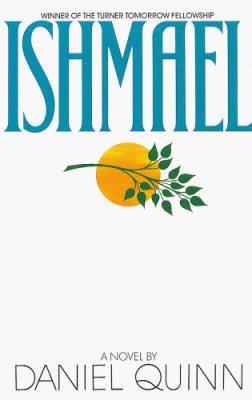
For those of you who don't recognize those words, they come from the Gorilla Ishmael from Daniel Quinn's book of the same name. Described as an "alien anthropologist" by some for his unique perspective, Quinn reveals through Ishmael to us the flaws in our thinking and why it is our story not our actions that are sending us towards inevitable collapse. Our cultural memes dictate everything we do, even the rebellious reforms we try to implement are still operating in opposition to the laws of nature.

Ishmael caused a critical shift in my thinking almost a decade ago and my highest recommendation to anyone would be to read it and share it with someone else. It is easy enough that it could be read by a 5th grader and with  less than 200 pages it could easily fit into your summer reading plans.

The quote at the beginning of this post is Ishmael's response to the main character's realization of our predicament. I won't spoil for you the paradigm shift that one gets as a result of reading Ishmael but it is important to realize that our society does not lead a sustainable existence. Not exactly news to anyone but what makes Ishmael truly valuable is the insight as to why we continue to do live an unsustainable existence.

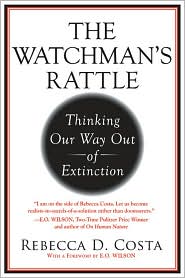
Many readers of Ishmael are left with the question, well what should we do now? In fact, an entire section of the website devoted to Ishmael revolves around that question (don't click expecting an easy answer). About 15 years later, research and insight allowed Rebecca Costa to provide her perspective in her book The Watchman's Rattle: Thinking Our Way Out of Extinction.

Although I read a lot of books, my favorites are those that inspire new ideas for me. As I was reading this on the way to the ISTE Conference in Philadelphia, I easily filled 2 pages worth of thoughts, ideas, innovations inspired by this book. If for no other reason, check this book out because it makes you think.

The author draws from her research the realization that one of the causes of societal collapse is when we hit our cognitive threshold. When a society's problems become so complex that they cannot be solved by left brain/right brain thinking then we inevitably will fall prey to some cause like the Romans and the Mayans before us and be unable to think our way out of it.

Evolution, is too slow to provide us the biological gains to solve these problems, but we already have a mechanism built in that could be the key to our survival. Through numerous examples and with the latest in neuroscientific discoveries, the case is laid out for "insight" as a way to solve complex problems. While insight has always been a spontaneous non-repeatable occurrence, it has led to dramatic scientific and societal paradigm shifts as a result. Now scientists are discovering the factors that increase the likelihood of insight which could be used as a basis for innovation out of our current situation and into one more sustainable.

As Ishmael lays out in his book, our culture is the primary cause of our problems and not some failing of human nature or lack of technological innovation. Rebecca Costa shares the five supermemes which prevent us from reaching our goals. Memes are a cultural idea that is transmitted from person to person and generation to generation. The supermemes are those which are everywhere and are most destructive.

The problem is, when you describe a supermeme to someone their response is, "well that's the only way it could be or has been". We encounter this quite often with education as those who would remember a time before our industrialized classroom emerged are no longer with us and so we believe this is always the way it has been.

According to Quinn and Costa, the only way to overcome these cultural memes that are detrimental to our society  is to ensure our beliefs are rooted in fact and logic as opposed to destructive memes. Once a critical mass of people understand why we are doing things the way we are, it is possible to abandon it and start again. This is demonstrated in science (documented by Thomas Kuhn) as well as in our history that a small growing group of people can cause a shift in our societal thinking.

So while I know what I need to do, it is also critical that more of you read these two books and become inspired yourself to, "Save the World" as Ishmael called it. I can think of no better time than now.

Ishmael by Daniel Quinn

The Watchman's Rattle by Rebecca Costa

Subscribe to BrokenAirplane!

The New Cool: Follow The Adventure and Excitement!

As we prepare for the FRC World Championship in St. Louis, Missouri; we can't help but reflect about the amazing experience we had at the San Diego Regional. Much of my team had only known about robotics through my experiences with my previous team MorTorq and the excellent PBS documentary Gearing Up. When we went to compete, there was an overwhelming aura of excitement and awe for the students. The teams they had heard and read about were finally here! Dean Kamen's vision that Engineers would be the role models and superstars was coming true for my students.

I have never come across someone who sees a robotics competition and walks away unexcited. When I tell people about my students, their first impression is to jeer at the "nerds" and I smile because they have no idea that the tables have turned. You see, sports and entertainment will always have a place in our society but there is a new source of excitement and inspiration and that is Robotics. Neal Bascomb in his book, The New Cool, gives those who are yet unaware a peek inside this world.

The book revolves around FRC Team 1717 the D'Penguineers. Led by their passionate mentor Amir Abo-Shaeer, the story follows the team through their 6 week build process for the FRC game Lunacy (see the game animation below)


The book gives an uncanny immersion into the world of FRC and allows you to feel every emotion that is experienced by the team. As Amir said at the San Diego regional, this book could have been written about any team because there is this common exhaustion and yet joy that comes from seeing students design, build, program, and compete with a robot from the ground up.

Just as modern marketers were wise to target the baby boomers and their kids with consumer ads, FIRST literally stands For Inspriation and Recognition of Science and Technology and the organization works toward that goal with a passion. This generation is empowered to create as no other generation has ever been with technology and resources being readily available and the results of what they build and learn is the coolest thing ever.

I was forever changed when I started working with Eileen and her amazing team 1515, what is astounding is that up until last year there were still some who did not know that the school had a robotics team. If you are a teacher, you have the best job of all as you can start a team where there was not one before. There are competitions of all kinds to fit all situations and if you need help post a comment and we will point you in the right direction.

If you are a student, hurry up and find/start a team. My team was founded by students and you might be the one that has the vision to get one going at your school. I promise you there are other students just like you who would love to be a part of this and you will learn, do, and connect in a way you never thought possible.

Adults who are outside of education, lend your talents and gifts to this generation. They need it now more than ever before. Whatever you are knowledgeable or passionate about, a robotics team can use you. Marketing, engineering, programming, team support, there is no one who is unable to help a team get started and flourish. If you have the means to financially support a team please find your local mentor and do so (and if you are in the Southern California area check out Chaos Vortex)!

As team 1717's mentor Amir has said, "this is what education should be," and he is absolutely right. Check out The New Cool because this is what everyone is talking about.

Subscribe to BrokenAirplane and keep up with all of the latest education and technology resources!

Winter Break Book Recommendations

Winter break is soon upon us (for some of you it might already be here). A chance to spend time with family and perhaps get a chance to learn something new. I don't know if I am the first person to say this but regarding professional development I always say, "It is a lot easier to work on a car not running." We all have a desire to grow and increase our ability to help our students but it is difficult in the midst of all of that happens in our daily lives as educators and as human beings.

I would like to recommend a few books that really got me thinking about education. I am only mentioning books that are truly the best of the best so as not to waste your time. These are excellent for generating conversations or challenging what or why we do things the way we do. I hope you enjoy them and leave a comment if you have read any or afterwards leave your thoughts.

Book Recommendations:
Disrupting Class: How Disruptive Innovation Will Change the Way the World Learns- Written by 3 incredible authors, one of whom will be speaking at the 2011 CUE Conference. This book outlines how education is undergoing a dramatic shift towards personalized differentiated learning. Outlining the different technologies and resources that are making this happen, this book is full of stories that will have you cheering for the student as they find success in ways they couldn't possibly before.

Drive: The Surprising Truth About What Motivates Us- By bestselling author Daniel Pink, this book has interesting and applicable research and information on every page about what keeps us going as human beings. By making a few simple changes you can dramatically increase you and your student's interest towards any activity or project.

The Homework Myth: Why Our Kids Get Too Much of a Bad Thing - Alfie Kohn makes a strong case for why we should consider how and why we give homework. He outlines all of the reasons that educators, administrators, parents, and lawmakers typically offer in support of it and provides data and research which refutes these claims. If you really want an eye opening book you can't go wrong with any of Alfie Kohn's articles or books.

Measuring Up: What Educational Testing Really Tells Us - We all want to see our students be successful and challenged. The question is how do we do that and afterwards check to see how we as educators and they as students are doing. Both private and public institutions are swamping our schools with tests and overwhelming us with data. The data is being misinterpreted and misused to portray a shortsighted and false image of how our schools are doing. This book, written by a Havard Professor of Statistics, makes the facts and data more understandable so we can properly communicate it to those who have a vested interest.


No More Secondhand Art: Awakening the Artist Within - Do not make the mistake in thinking this book is only for "art teachers". This educator explains why everything a student creates should be beautiful work and originality. Many parallels between his work and other subjects. Every time he mentioned the word art I thought of math. How often are we asking students to do the same thing as everyone else has for the last 100 years and then asking ourselves why they are not interested.

Tinkering toward Utopia: A Century of Public School Reform - Another great book by Tyack and Cuban who do a thorough and detailed job of showing us what education has looked like over the last hundred and fifty years or so. Every generation a politician will make an outcry for how schools are failing and need reform. This book shows how these same statements have been made repeatedly throughout history and why they failed. There is a more complete book review here. Just remember Roy Roger's poignant observation, "The schools ain't like they used to be, and they never was".

Do you have thoughts or suggestions for another great book to read? Leave a comment and share it with us!

Subscribe to BrokenAirplane!

Get Your Students Thirsty for Math

Many of you read the Is Calculating Math? post last week and are now considering what can you do to bring Math back into your classroom. There are so many resources out there to get students thinking mathematically. What does it mean to think Mathematically? Every student is different and we need to take that into account. Is our goal just to teach a canon of concepts or to inspire students to look at the world with the eyes of an artist? I think it is a little of both.

Howard Gardner's Theory of Multiple Intelligences refers to 9 various intelligences which describe a student's strengths and preferred method of learning. If we look at the logical-mathematical sphere of intelligence it refers to quote:

Less emphasis on traditional mathematical ability and more on reasoning capabilities, abstract patterns of recognition, scientific thinking and investigation, and the ability to perform complex calculations.

I believe all students are capable of enjoying these aspects of life and our universe and so in addition to the standard curriculum, wherever possible, I provide my students opportunities to explore.

One great resource that I have come across is James Tanton. His website provides a lot of great resources and ideas about math and how to make concepts more easily understood. Many teachers do not know the reasons behind why they do certain things in math and this can frustrate students when they want to understand. Mr. Tanton's resources and books are more conversational and geared towards students and teachers reading them for enjoyment and explanation. For example, here is a great free guide and resource about Quadratics.

I really enjoy using Math without Words and examples from Solve This. The post that inspired me to  check out these resources came from this Math Mama Writes blog post. In the post you can see some examples and see why my students and I were so excited about it. Every time I use one of these resources I seem to hook one more student into realizing that math is fun. The coveted, "Wow, this is really interesting" to the student who is working on a Kakuro puzzle you gave them after school for fun.

We can have the best teachers in the world, but if the students are not enjoying themselves then they will not be receptive to learning. In We Make The Road by Walking, Myles Horton is asked to comment on education as related to the quote, "you can lead a horse down to water, but you cannot make him drink." His response was:


This is a problem they deal with in academia by hitting the horse over the head and beating on him till they force his nose in the tub, and just to keep the blows from continuing, he'll try to drink. My system is to make him thirsty, so he'll volunteer to drink.


If you can get your students thirsty for math, they will be able to learn anything because they have motivation.


Updated: After writing this post, I received an email from BachelorsDegree.org with a link about 20 Incredible Math Ted Talks some of which I had seen before and some I had not but they are a really good list. It is important to keep learning all of the time so you can answer student's questions. Not just the ones about how to solve problems, but why and what makes math interesting.


Subscribe to BrokenAirplane!

Download and Search Books from Any Device through Google eBooks

The opportunities for learning have increased dramatically since the emergence of the Internet. The ability to share and  help one another find resources and learn new information has removed many barriers for students who want to learn and develop their knowledge and  skills.


Google is again pushing the envelope for what should be public and free. Now everyone with a computer and Internet access has the ability to have Email, Document Collaboration, Websites, Translation/Phone, and soon even an Operating System. Our society has often needed to adjust to these changes and while Google has faced legal battles from their attempts to free books from restrictions, the time has come for Google to roll out its solution to book availability.

Announcing Google eBooks
Google eBooks is going to become one of your favorite websites. Now, you have access to search and read millions of books for research and preview. Through an agreement between Libraries, Publishers, and Google, you can now search the text of books to find relevant information for what you need. While this was available in part before, it has been greatly expanded to coincide with their ability to ready eBooks in the cloud.
Textbooks, magazines, and many other resources are available for search, viewing, and purchase. Through a new agreement you can now purchase digital versions of your media and then view them on  your computer, eReader, and mobile device.

While the resources available are expansive, I am sure that even more will be available with time since Google has devoted a large amount of resources and time to this venture.

I am grateful to all who have worked hard to create exciting new ways and methods for learning. 


Benjamin Franklin has always been one of my heroes (which is why my son is named after him). One of the most laudable and long reaching gifts he gave to this country was the US library system. How many of our lives have been enriched by a library? Yet, in much of our country access to high quality resources proves difficult for many in low income or rural areas. Thankfully, there are programs that allow libraries to share but it is time consuming and expensive.

Then Tim Berners-Lee dramatically cut down the barriers to learning when he opened up the World Wide Web to us all. Now information from all over the world was accessible through personal computers and while this can still represent a stumbling block, community resources are available so that almost all people can use the Internet, just maybe not as often as others.

Now as more and more people shift away from the traditional work/learning space and find themselves using phones and small devices, Steve Jobs and Jeff Bezos made learning mobile with the Apple iPods/iPhones and Kindle respectively which made it possible to read large amounts of information on mobile devices (I should mention that I don't solely attribute this to Jobs and Bezos but their leadership certainly drove the innovation that led to the new technologies).

With each passing day, more and more people are able to learn the new and widely diverse skills that make our society so unique. I hope more people take Google's lead and provide their technologies for as little as possible to provide equitable opportunities for all to learn.

Google eBooks

Subscribe to BrokenAirplane!

Tinkering Towards Utopia is your History Textbook if you are interested in Education Reform,

The infamous quote by George Santayana that, "Those who cannot remember the past are doomed to repeat it,"points out one of our most difficult tasks as a society to overcome. Without tribal elders and with our society being so large, it is near impossible for wisdom to be passed through the ages. Generation to generation we tend to make the same mistakes over and over again. Yet each time we say that it will be different and is sure to work.

History provides us with a look into our past and education reform leaders and those concerned need a look into their past now more than ever. With the structure of education being carved about a century ago and remaining much the same since, we can look what was tried in the past to perhaps guide us and inform us of our next steps. As a nation we need to be more aware of how our system

Tinkering toward Utopia by David Tyack and Larry Cuban provides us with that detailed and unique look into our educational system's past. There are chapters explaining why our system changed dramatically over 100 years ago, where the practice of tracking began, Carnegie Units (the credits determining the worth of our classes), how technology was used in the classroom, and more.

I was captivated by every example and amazed at how similar the frustrations of the past mirror those of today. Any of the quotes taken from 25 years ago (A Nation at Risk), 50 years ago (Sputnik), 80-100 years ago (WWI-WWII) could just as easily been taken from last week's newspaper. Clearly we as a nation are making the same mistakes as our predecessors.

In my opinion, the primary issue stems from our desire to want students to fit into an Industrial Model. While on the surface most of us would disagree with this statement but, when we grade all students according to a rubric or standard with expectations that all will or should perform then we are quality assurance managers seeking a standard quality product. The assumption is that all students should be able to know everything (and the amount of information that constitutes "everything" has grown exponentially while the time in class has stayed stagnant).

The curriculum is standardized which prevents the student from showing their natural talents unless they align with those expected for all to learn and if you subscribe the Howard Gardner's Multiple Intelligences Theory many students are not reaching their full potential because they are not learning in a way conducive to them.

To hear me talk about this, it would sound like there is no hope and that our classrooms are cold uncaring assembly lines of learning. I know many of us seek to make the best of a situation, but perhaps if we are frustrated it may be the system and not our efforts that are at fault. We strive to determine the best practices for all but we know how different we each are. It is not easy to help all students individually reach their own potential but it would certainly be more enjoyable than trying to come up with ways to convince and motivate students to learn that which they feel is irrelevant to them.

I highly recommend this book to anyone who is interested in what we have tried in the past, why we did it, and even perhaps why it did or did not succeed.

Student Video Tutorials

If you are curious whether or not your students will be interested in your video tutorials or if they would want to make their own, check out Hayden Parker a 17 year old who does Chemistry Lessons in his back yard and puts the videos up on YouTube.

Make Magazine Original Link
Hayden Parker's Chemistry Videos

And if you are interested in your own great and fun chemistry experiments that you can do in your backyard, basement, kitchen, this is a well written book that will take you step by step through labs amounting to a semester or two of high school chemistry.